Sunday, March 30, 2008

Liberal Fascism - Getting to the Root of the Matter

The Roots of Liberal Fascism – the sickly off-shoots of healthy LiberalismI finally finished reading Liberal Fascism, and enjoyed it, with some caveats, but before getting into a useful review of it, I think I need to go back to the source of the ‘arguments’ against it, and the ideas which underlay them and modern leftism and its more extreme expression in Fascism.

Liberalism, in the Modern sense, the Enlightenment sense, is something new on the stage of governing – not so much in the form it takes, there is little truly new that Plato and Aristotle didn’t describe 2,500 years ago, but their mainsprings are different now with Liberalism – whether clean or corrupted - and all points in between, through it, both Liberty and Tyranny have taken on a new character and power.

Prior to Descartes, Hume, Rousseau and Kant, we of course had many variants of despotism –but we didn’t have that ingredient so necessary to the corruption of Liberalism and the growth of Progressivism & Fascism, until after Hume. Prior to modernity, the differing modes of government were essentially variations in the exercise of power – but Liberalism brought something new to government – that of power exercised not for powers sake alone, not even for maintaining order… or tradition, but for Good (even if it requires doing Evil).

How this pertains to Hume, is that because of his peculiar manner of making his observations, he observed what he did not see and succeeded in convincing others that his myopic perspective was in fact the whole vista of what was there to be seen. In his blindness was sown the seeds of not seeing what was clearly there to be seen with two good eyes - but necessarily missed with a single microscope. He not only convinced others that what he didn’t see, was there to be seen by all, but that in order to claim to see, you had to shut one eye and refuse to see the full picture. The philosophic equivalent of zooming in on a picture of Marilyn Monroe so that only the pixels are visible, and claiming that to be conclusive proof not only that she was not beautiful, but that beauty itself is an illusion. What he didn’t see, was Causality, which means nothing less than our connection to reality – no causation, no connection to reality, no principles, no Good, no Beauty, no Truth.

It’s a biggee to miss out on.

Hume’s errors, or rather the further errors which his errors ensured, made possible the rejection of Truths Self Evident, made pointless a pursuit of Happiness, and cast as baseless and imaginary, the Rights of citizens to their lives or their Property. The Sun which had risen with the Renaissance, broken through the gloomy sky of tyranny and ignorance in that period between Locke and the Founders Generation, was noticeably dimmed from his words and nearly blotted out by those who followed them up afterwards.

Normally I tend to give Hume and Descartes a pass on their errors, but recently rereading Hume reminded me that he is where we find the first tangible expression of the coming storms of intellectual destruction. Like Descartes, whose errors are most responsible for spawning the modern madness, I think Hume made his errors innocently, misdirected by erring perspective and flawed premises, but his errors, together with Descartes’, made the deliberate constructions of Rousseau and Kant possible – and torrential rivers of blood have flowed from those words, proving in fact that the pen is far mightier, and far more destructive, than any sword.

What is Causality and Where is it? The essence of Hume is to be found in his relatively short “An Enquiry Concerning Human Understanding”, the core of his essay, and source of his blinded vision, is his attack on the idea of our being able to grasp causality, and his use of Necessary and Contingent truths (its interesting to see how Kant later intensified and recast their usage) to help accomplish that.

Hume asked what IS Causality, and where is It? As with many things, asking a question in the wrong way, as Hume did, almost ensures an error filled response. Before getting into the Modernist view, let's take a look at what the older dead white guys said about it first.

Zeno (490 – 435 B.C.) was a master of asking questions inappropriately, causing your mind to seize up in exasperation. I’ve noted the ‘Achilles vs Tortoise’ paradox before, which says crossing the gap is impossible, because it always involves halving the distance, but halving the distance means never crossing the whole… but another of his paradox’s, related to that and causality, but via motion, is the Arrow Paradox, in it Zenoasks us to imagine an arrow in flight. He then asks us to divide up time into a series of indivisible nows or moments. At any given moment if we look at the arrow it has an exact location so it is not moving. Yet movement has to happen in the present; it can't be that there's no movement in the present yet movement in the past or future. So throughout all time, the arrow is at rest. Thus motion cannot happen.”

This is precisely the type of error Hume made, expecting more or different data than is appropriate for the nature of the subject. Now, a full explanation of the facts of the paradox, how to measure motion, required Calculus, which meant having to wait 2,000 years for Newton… but not being quite that patient, Aristotle answered it’s more fundamental philosophical flaw, and rejected its being worthy of any further attention – and he was correct in doing so. He focused on the obvious mis-applied question “for time is not composed of indivisible 'nows', no more than is any other magnitude.” Time is whole and complete, for our convenience, we mark off lengths of it into years, days, hours, etc, but Time isn’t made up of such assembled units, and trying to ask of it such criteria, loads the error in up front. Zeno assumes that position, movement and time are all actually divisible into physically compartmentalized points or ‘moments’, and that movement consists of pushing causality into the future. Also, it assumes what we now recognize to be incompatible variables, in position and movement, in the sense that an exact determination of either one of them leaves the other completely undetermined (“um… hello Heisenberg? Ancient Greece calling…”). It’s attempting an equivocation, mixing apples and oranges, just because they are round fruit, and then trying to apply citrus queries upon the apple, and apple criteria on the citrus, then blames you or the trees for the resulting error. Blech.

Aristotle approached the issue of causality with four perspectives: Material, Formal, Efficient and Final; and if you look closely at Aristotle’s, he isn’t so much looking for Causality, as if it were a thing to be found, but describing it as a process to be observed and identified. There is little similarity between the two approaches; the word he used doesn’t even mean quite what we do by causality, their meaning leaning more towards responsibility than cause. But there’s a larger reason why Aristotle doesn’t approach causality as we do, he wasn’t misled into justifying reality against error. He didn’t buy into the modernist schism between us and reality, he saw that IT is and he was able to know it. He didn’t chase an ever receding bread crumb trail of infinitesimal arbitrary “what if?’s” into infinity… he chose to stay with reality. There is a huge difference involved between these two premises, and it forms the root of what separated Classical Liberalism from modern Leftism.

Lets compare the two, here’s the bullet points of Aristotle’s classic example of Causality in describing the creation of a bronze statue:
The material cause: “that out of which”, e.g., the bronze of a statue.
The formal cause: “the form”, “the account of what-it-is-to-be”, e.g., the shape of a statue.
The efficient cause: “the primary source of the change or rest”, e.g., the artisan, the art of bronze-casting the statue, the man who gives advice, the father of the child.
The final cause: “the end, that for the sake of which a thing is done”, e.g., health is the end of walking, losing weight, purging, drugs, and surgical tools.

Aristotle is identifying four phases of the creation of the statue, to answer the why-question of causality. (True, Aristotle sometimes let that 4th cause run away with him, ‘a ball falls in order to find its natural place closer to the earth’, etc, but we need to realize that ol’ Ari’ didn’t have Newton, or even Galileo’s shoulders to stand upon… it is they who stand upon his… it can be read as an attempt to grasp at deeper identifications which his instrument-less, calculus-less world was not privy to.)

Hume takes a very different approach, and seeks after something essentially different than Aristotle did. Here’s Hume’s classic example of two billiard balls, where he attempts to describe the first impressions a person might have, who has never before seen two billiard balls collide – he takes out his magnifying glass and seeks after a knowledge-thing, whole and innate, to spring forth on its own into his eyes (for all his protestations against a priori knowledge, his every doubt seems to assume it) :
…so must we also esteem the supposed tie or connexion between
the cause and effect, which binds them together, and renders it impossible that
any other effect could result from the operation of that cause. When I see, for
instance, a Billiard-ball moving in a straight line towards another; even
suppose motion in the second ball should by accident be suggested to me, as the
result of their contact or impulse; may I not conceive, that a hundred different
events might as well follow from that cause? May not both these balls remain at
absolute rest? May not the first ball return in a straight line, or leap off
from the second in any line or direction? All these suppositions are consistent
and conceivable. Why then should we give the preference to one, which is no more
consistent or conceivable than the rest? All our reasonings a priori will never
be able to show us any foundation for this preference.

In a word, then, every effect is a distinct event from its cause. It could not, therefore, be discovered in the cause, and the first invention or conception of it, a priori, must be entirely arbitrary. And even after it is suggested, the conjunction of it with the cause must appear equally arbitrary; since there are always many other effects, which, to reason, must seem fully as consistent and natural. In vain, therefore, should we pretend to determine any single event, or infer any cause or effect, without the assistance of observation and experience.[emphasis mine]
Notice the supposition of a Human uncontaminated by knowledge, coming into contact with experience; whereas Aristotle approaches it from the viewpoint of a knowledgeable human seeking to have his knowledge being deepened.

For Hume, reality exists to us only on the level of appearances, and those exist as mosaics, not paintings, disconnected and unrelated except by arbitrary placement (now that’s telling). Where Aristotle seeks to identify and integrate, to conceptualize, Hume specifically seeks to find, disintegrate and perceptualize. An Aristotelian finds that causality becomes apparent, natural, sensible, as their understanding of the balls identities deepen (‘from the rigid nature of the billiard ball, force transmits through the one ball into the other, rather than being absorbed, as would a tomatoe’). But Hume doesn’t seek to understand the nature of the billiard balls, but only that their apparent, immediate, in the moment visible, behavior doesn’t convey it all at once which is taken to mean that we can’t ever access it, he seeks only to analyze… find… something as if he’s looking to peel back a layer of the random and chaotic occurrences of reality and find a hidden and duly labeled packet which if squeezed open, causality will pop out!

Skeptics similarly seek value and quality in this way, always as separate and isolated items, contingent, not necessary, NEVER as an integrated whole[This is extremely important when it comes to their conception of policy and rights]. Hume defines causality as that which causes the one ball to spin off; but then asks something like, where is it? Where is causality? I see one ball hit another, I see one spin off, I see velocity and action, but I don’t see causality, do you? No, it is a surmise, a fabrication of your own mind, an understandable conclusion for a person to make, but it is a description, an explanation of events after the fact, a story we tell ourselves to explain it, little different than that of the sun being a chariot Apollo pulls across the sky, and no more valid. Hume, failing to find causality, declares it invalid.

In Hume’s words, Quantities and Movement exist, but what he calls Qualities – characteristics, properties, identity - on the other hand, are an illusion and a fabrication. This is core and critical to all of the ideas and movements which have followed ever since. It is central to the rejection of, and attack upon principles, and the fracturing of Liberalism into Classical Liberalism and all of the flavors of leftism in progressivism, Marxism, fascism, etc.

How do you go about seeing what they don’t see?
From the opening of Aristotle’s Physics:

When the objects of an inquiry, in any department, have principles, conditions, or elements, it is through acquaintance with these that knowledge, that is to say scientific knowledge, is attained. For we do not think that we know a thing until we are acquainted with its primary conditions or first principles, and have carried our analysis as far as its simplest elements.
Plainly therefore in the science of Nature, as in other branches of study, our
first task will be to try to determine what relates to its principles.

Now what is to us plain and obvious at first is rather confused masses, the elements
and principles of which become known to us later by analysis. Thus we must
advance from generalities to particulars; for it is a whole that is best known
to sense-perception, and a generality is a kind of whole, comprehending many
things within it, like parts.

How alien an approach, in relation to modernity – Aristotle analyzes for the purposes of synthesizing, integrating, Hume analyzes for the purpose of further disintegration, behaving, like Zeno, as if his separated, analyzed slices actually exist as separated slices, and through the further interposition of Descartes, Hume and Kant, we’ve allowed ourselves to become intellectually unsighted.

Skeptics behave as if they are standing outside reality observing appearances only and then they, Hume, claims to see no causation, to see no mind. They gasp “Trickery! Deceit!”at how the thing perceived somehow gets into the mind of its own, and is lodged there separate, different and unrelated to that which is perceived.
But this universal and primary opinion of all men is soon destroyed by the slightest philosophy, which teaches us, that nothing can ever be present to the mind but an image or perception, and that the senses are only the inlets, through which these images are conveyed, without being able to produce any immediate intercourse between the mind and the object.
They see no connection between perception and the thing perceived. Well, HOW did that perception get into the mind(This is the door to Kant’s playground – don’t get left there unattended)? The answer of course, is that it gets there through the process of the senses sensing it, it, that thing which exists, and which we sense. The Senses are the conduit by which the mind perceives reality, and the act of perceiving it, is what you, your consciousness does. But Hume dismisses that notion.
“It is a question of fact, whether the perceptions of the senses be produced by external objects, resembling them: how shall this question be determined? By experience surely; as all other questions of a like nature. But here experience is, and must be entirely silent. The mind has never anything present to it but the perceptions, and cannot possibly reach any experience of their connexion with objects. The supposition of such a connexion is, therefore, without any foundation in reasoning.” [emphasis mine]
Note the bizarre idea that there is some sort of nefarious switcheroo taking place between the starting point of perception - out there… somewhere… disconnected from us, where a snapshot or facsimile of the object is taken, and while in the possession of the biological U.S. Mail of the senses, it is tampered with, altered – maybe even substituted with a completely different image, before finally reaching our home – its packaging banged and torn, where it is finally pushed through the mail slot and into your mind. Now that’s doubt.

Why would you think that? Is there some basis for it, or is it just an arbitrary fear and assertion? Is there some discrepancy you’ve noticed between reality and what you perceive to be reality? How? How did you notice it, unless by means of your senses? If so, we can correct for it, if not, then such concerns are arbitrary and deserve no further consideration whatsoever. You don’t argue with someone asserting that maybe gremlins on mars are responsible for making leftists believe these things – you just dismiss it out of hand.

Hume says clearly and explicitly, that we have no way, no way, of reliably forming principles and determining causality, physically or normatively (that’s morally for those of you in Rio Linda). Keep in mind, that Hume’s point isn’t ‘Be careful you don’t get misled by your assumptions, always check to see that experience bears them out’ – that is not his message, neither is it that scientists must be careful that their premises are based in fact.


By what argument can it be proved, that the perceptions of the mind must be caused by external objects, entirely different from them, though resembling them (if that be possible) and could not arise either from the energy of the mind itself, or from the suggestion of some invisible and unknown spirit, or from some other cause still more unknown to us? It is acknowledged, that, in fact, many of these perceptions arise not from anything external, as in dreams, madness, and other diseases.
And morally,

The sceptical objections to moral evidence, or to the reasonings concerning matter of fact, are either popular or philosophical. The popular objections are derived from the natural weakness of human understanding; …. The great subverter of Pyrrhonism [skepticism] or the excessive principles of scepticism is action, and employment, and the occupations of common life. These principles may flourish and triumph in the schools; where it is, indeed, difficult, if not impossible, to refute them. But as soon as they leave the shade, and by the presence of the real objects, which actuate our passions and sentiments, are put in opposition to the more powerful principles of our nature, they vanish like smoke, and leave the most determined sceptic in the same condition as other mortals.

The sceptic, therefor,… while he justly insists, that all our evidence for any matter of fact, which lies beyond the testimony of sense or memory, is derived entirely from the relation of cause and effect; that we have no other idea of this relation than that of two objects, which have been frequently conjoined together; that we have no argument to convince us, that objects, which have, in our experience, been frequently conjoined, will likewise, in other instances, be conjoined in the same manner; and that nothing leads us to this inference but custom or a certain instinct of our nature; which it is indeed difficult to resist, but which, like other instincts, may be fallacious and deceitful. While the sceptic insists upon these topics, he shows his force, or rather, indeed, his own and our weakness; and seems, for the time at least, to destroy all assurance and conviction. These arguments might be displayed at greater length, if any durable good or benefit to society could ever be expected to result from them.

For here is the chief and most confounding objection to excessive scepticism, that no durable good can ever result from it; while it remains in its full force and vigour. We need only ask such a sceptic, What his meaning is? And what he proposes by all these curious researches? He is immediately at a loss, and knows not what to answer.
In the end, Hume grasps that his ideas don’t deepen knowledge, but destroy it, though he doesn’t grasp his error. To his credit, he doesn’t attempt to fabricate cover for his errors (as did Kant), but says ‘there’s something wrong here, but I don’t see it, and so I’ll just go right on believing it’. The root of his error, is the very thing that he seeks after, or rather, the way in which he seeks after it. Is causality a process, or a thing? A predictable result based upon the Identity of the actors involved within a context, or is it something, a thing, which is to be sought and found, or rejected for not being found, or as Kant would later do, prop it up with a false front and label it “Found – but Off Limits – No visitors please”? His problem is similar to trying to find ‘Motion’, you don’t find it, but describe and track it – to seek an actual existent called motion will bar you from being able to describe it at all, like one of Zeno’s old paradoxes.

But not seeing their error, or rather than admit their motive error, the skeptics response is to kill the messenger by attacking the senses – we can only know a faked and deliberately misleading representation of reality:”You think your senses show you reality? Whose reality? A bee doesn’t see the same reality as you do!”

Which is true.

Is it possible that we don't receive All of the data? Well, of course, as infra-red and ultra-violet prove, but does that reduce the validity of what we do receive & perceive? Hell no. How did we come to learn about ultra-violet? Are we sometimes wrong? Of course. There is a fear of error, present in both the Humian and Cartesian branches of thought, that always results in denial of Free Will. A fear and desire to either deny the possibility of error, through determinism, or deny the possibility of being correct, with skepticism, either way it seeks to escape the responsibility inherent in Free Will for your judgment and actions.

How do we become aware of our being wrong, except through having the ability to be Right? To perceive the Truth of the matter? While a bee doesn’t see the same reality that I do, the bee will never realize that, whereas we, by seeing more of reality than mere appearances, by seeing the deeper integrated nature of reality via our conceptual minds, are able to determine that we do see things differently than the bee does, and even are able to determine to what degree we differ, and approximate the reality that the bee does see. That is only possible because we do perceive a reliable grasp of reality through our perceptions. We see things, within the range of our senses, as they in fact Are.

We are not blind because we can see, we are not conscious-less because we are conscious of what we perceive. Because we are able to see into and conceptually understand reality, not just the surface, we needn’t look for causes as if they were stains upon a blue dress, we see the causes in the identity of the things themselves, no less so with the structures of billiard balls, than in the character of presidents.

The more we learn about what we perceive, the more we understand about causality, the only way two billiard balls will behave as Hume supposes, striking and stopping, is if they are not billiard balls, or else have something unusual present in their context, such as one being glued to the table, and perhaps both fitted with powerful interior magnets. That doesn’t affect causality, only expectations and lack of understanding their identity, and the surrounding context. Our expectations are of the fact that they are billiard balls and so will behave As billiard balls, and if not, not; but that is our expectations of their being a certain identity – expectation, not causality. And errors and illusions, so far from disproving our senses, the fact that we can be wrong, proves our ability to be Right! It proves our ability to perceive reality, discover error, and correct our conceptions.

In short, from identity, we derive principle. For Hume, from the proximity of disparate events, they propose explanations – not from identity and principle, but supposeds and effects.

What was the Causality of that?
As Hume states, following in his own flavor from Descartes, if there is no quantity, and no number, there is nothing to discuss, quality being out. Well, sorry Hume, but it is by way of the Qualities which your mind most certainly grasped, by which you are able to understand and utter the words quantities and number - without Quality – conceptual abstractions, there can be no concept of ‘number’ at all, and no quantities to be numbered. The very word number is a Quality, Quantities is a quality, to lack the ability to unite Quantity with the Qualities of the thing being quantified, is to experience madness.

Hume likes to make bones about the fact that he doesn’t fall for Descartes Cogito… but he’s really only the flip side of the same counterfeit coin. Where Descartes says “I think therefore I am”, Hume says “I think, therefore I can’t know” – each view separates consciousness from reality, and ensures the instability of all conceptual structures built upon them. Following from Descartes, if the Mind comes first (or after, as with Hume), there is either no cause – or no way to perceive it, no preconditions for it, either way you are separated from IT, that dreaded Reality, and so from that perspective it is not unreasonable to assume that other things just happen, uncaused and causeless, objects and actions for our minds to perceive and endlessly why about it, and so on….

Hume says we never perceive causes, only events and sequences and only infer causes - no, the events and sequences are only descriptions of the causes in action - in the case of the colliding billiard balls, the interaction of the properties of matter and force. He should perhaps have read Zeno’s paradox’s more closely – they demonstrate clearly what world would result from such thoughts, track stars who can’t catch tortoises, arrows which shot from a bow and never move – these are perfect illustrations of skeptical thought – that the world doesn’t behave that way, should be something of a wake up call to Hume and modernity! Sadly, modernity only continues to slap the snooze button.


Adam, though his rational faculties be supposed, at the very first, entirely perfect, could not have inferred from the fluidity and transparency of water that it would suffocate him, or from the light and warmth of fire that it would consume him. No object ever discovers, by the qualities which appear to the senses, either the causes which produced it, or the effects which will arise from it; nor can our reason, unassisted by experience, ever draw any inference concerning real existence and matter of fact.
Hume’s problem here is that he takes this to mean that no past experience can be used to predict present or future experiences, because he see’s these all as being isolated events. In the skeptics world, experience doesn’t add to your knowledge store, because that’s conceptual, not real, just imagination, it doesn’t increase your understanding of an objects identity, experience only applies NOW, and the very word ‘Objects’ smacks of ‘Quality’ to them, it is abstracted, they see only this, and this… and this… never these.


It is universally allowed by modern enquirers, that all the sensible qualities of objects, such as hard, soft, hot, cold, white, black, &c. are merely secondary, and exist not in the objects themselves, but are perceptions of the mind, without any external archetype or model, which they represent. If this be allowed, with regard to secondary qualities, it must also follow, with regard to the supposed primary qualities of extension and solidity; nor can the latter be any more entitled to that denomination than the former. The idea of extension is entirely acquired from the senses of sight and feeling; and if all the qualities, perceived by the senses, be in the mind, not in the object, the same conclusion must reach the idea of extension, which is wholly dependent on the sensible ideas or the ideas of secondary qualities. Nothing can save us from this conclusion, but the asserting, that the ideas of those primary qualities are attained by Abstraction, an opinion, which, if we examine it accurately, we shall find to be unintelligible, and even absurd. An extension, that is neither tangible nor visible, cannot possibly be conceived: and a tangible or visible extension, which is neither hard nor soft, black nor white, is equally beyond the reach of human conception. Let any man try to conceive a triangle in general, which is neither Isosceles nor Scalenum, nor has any particular length or proportion of sides; and he will soon perceive the absurdity of all the scholastic notions with regard to abstraction and general ideas.[1]
Here, Hume comes perilously close to describing what in computer programming is called a Class “…An extension, that is neither tangible nor visible, cannot possibly be conceived…” somewhat difficult perhaps, but hardly impossible – you only need to imagine a definition of properties and methods(actions, abilities) without the presence of those characteristics – or as Ayn Rand presciently (without benefit of any computer knowledge) described a Concept (in part) as “A concept is a mental integration of two or more units possessing the same distinguishing characteristic(s), with their particular measurements omitted". A square has four sides, that is the concept, the class, what squares are made from, but which itself never becomes an object, you don’t actually have a square until you instantiate it with the measurements for the sides. And remember, we are abstracting from reality!

Perhaps he lacked a coalescing metaphor to give order to his thoughts, to illuminate them – think Newton’s apple plopping down upon his head. Hume might have benefited from computers. Or Mr. Hume might have benefited from the experience of having children, had he, he might have discovered that babies discover that things fall – by experience. Spoons, forks, plates, you can see the baby learning that not only this and this and this fall to the ground… but that things fall! Not just “repetitious occurrence, habit” but knowledge of the objects in question. Babies, unlike skeptics, have no problem abstracting from particulars to generalities. They also recognize when an identity isn’t what they expected it to be - while they are busy dropping their tableware, hand them a helium balloon and watch their amazement as it floats away!

Wow! That's different from the other things!

They – babies – we - learn from and through experience with reality, they correct their errors through continued experience with and in, reality. They don’t Not See That! They don’t throw out their new found fascination with causality, they incorporate and amend it from all things fall, to some things fall, based on the identity of the thing involved. And they relentlessly examine the characteristics of objects, bit by bit - no one is suddenly aware of water or anything else - but when the situation occurs of something new being introduced, notice the fascination with the new object that a baby, and even adults (perhaps even skeptics) demonstrate - everything must be examined, weighed, tasted, banged, dropped, tossed, rolled - this is the process of discovering as much about that objects characteristics - it's Qualities - its Identity, as is possible to discover. From these examinations of particular things, higher concepts are abstracted, principles are discovered about reality by abstracting from experiences. This being done, we can more and more reliably observe the identity of objects and infer principles for them, and infer causality from their interactions, in this case, that most things fall – depending on the nature of the thing in consideration, and they aren’t invalidated by the billiard balls being glued to the table.

What’s the problem? “I Think, therefore I…” What? Of What? About What? Welcome to the world
The problem is that the skeptics of mind or spirit, both see themselves as outside of the universe, outside of their selves, as observers or hitchhikers on reality and mind, eagerly examining the dashboard for some proof of consciousness and reality. What they don't get is that they are of reality too, and the very process of perceiving reality, that which they think they are observing and seeing the absence of consciousness, is in fact the very consciousness they are unconscious of! That action of observing, of perceiving, is in fact the consciousness that they are unconscious of!

Reality exists, it exists as something, and that which perceives it, is Consciousness. You don't, as a conscious creature, observe something happening by examining outside reports of actions, you are part of the process of perceiving - the arguments of skeptics are like a hose hunting for what brings the water to the nozzle, and not finding it, declaring it doesn't exist.

It is You! You damn bonehead, Hume! When you ask where is consciousness, you've just demonstrated that you've not only found it, but ARE it!

When you see two billiard balls collide and look for the causality of one of them spinning away, you've just seen it! True, from appearances alone, you don’t know much about it, but it’s a start - the properties and structure, the quality of the material items, their nature IS the causality you are seeking after! And our grasp of it is deepened by our minds ability to conceive what we perceive into conceptual structures – these structures do not separate us from reality, but connect us to it, and our conceptual understanding does not separate us from that which our senses perceive, but more deeply enhance the integration of our minds with reality. These are not separate and distinct objects and modules from the visual image of the billiard ball, and attempting to describe them in that way, is the folly of over analyzing an item to the point of forgetting that you are analyzing, artificially demarking portions of a whole for the purposes of examination, and then taking those artificially separated items as being actually separate from the whole. They aren't, it isn't and neither are we.

In Ayn Rand’s words:

Causality
The law of causality is the law of identity applied to action. All actions are caused by entities. The nature of an action is caused and determined by the nature of the entities that act; a thing cannot act in contradiction to its nature … The law of identity does not permit you to have your cake and eat it, too. The law of causality does not permit you to eat your cake before you have it.
So What?This is at root, the trouble with modernity. Descartes, innocently perhaps, began the separation of thought that has resulted in hundreds of millions of deaths. By reviving the Cogito, 'Cogito ergo sum', 'I think, therefore I am', he created an intellectual disposition that saw the world as being separate, and ancillary, to ourselves. Thought came first, doubt came prior to that, and the world only exists as we come to perceive it to exist and is only real and significant where we can’t doubt it. This is the result of, and results in, ultimately the disintegration of thought – its dis-integration - and its separation from reality.

But 'I think, therefore I am' or ‘I think, therefore I can’t know’ is not the way it works, and it is very easy not to grasp that, and very easy to miss the mischief it impregnates into your mind - the crack which results in the shattering of all that is known to you.

It is important perhaps to first see what both the Cogito, and the skeptic, does not say, what they refute. It does not say 'It is, and in grasping that, I am aware that I AM.'

Do you see the difference? It is such an important one.

To say 'I think, therefore I am' is to say that you, your awareness of yourself, the thoughts you have, the ideas which form them, the words you use - somehow those preceded and are more substantial than the world out there; that only that which is, to use their terms, necessarily True are valid, and what depends upon that outside reality, is merely contingently true. It is necessarily true that a triangle have three sides - you can't imagine it otherwise. It is only contingently true that ice floats, after all, you can easily imagine it sinking - right? This mis-perspective unavoidably places the whimsy of your imagination, as being over and above in importance, of that which actually IS Real! Hume substitutes expectations based upon appearances for Identity and causality.

You can not think, at least not is such an abstract manner, without words, and you cannot acquire words without experiencing reality, that which the words apply to. And unless you are the very first, you must receive your language from exterior reality, and through all of the process of experiencing reality which the infant transitions towards adulthood, you acquire the ability to grasp reality with your mind, and to think. Then, and only then, can you 'Think' and say "I AM", but only after having come into contact with reality, only after through a long process of abstracting from concretes into ever deepening hierarchical structures of thought, do you attain the conceptual wherewithal of abstract thought.

From appearances we extend our concepts higher and deeper, and better grasp identity. Our child with his objects first sees that this, and this and this, falls, and he rises up to Objects fall. Then the helium balloon alters it to some objects fall, but balloons don’t. Then if you give him a breath balloon as well as a helium balloon, he will see that there is something different about the one… let the ‘air’ out of both, and they both fall, blow them up with breath and they both fall. Fill one up with helium, and that one will rise, and he then sees that some things, if you put them into others, makes them rise. He might continue, breathe in the helium, and now his voice sounds like a chipmunk, and conclude that helium makes all things rise, even voices. Now that is a partial truth, the seed of errors, a separation from reality, but more identification, more understanding of helium and larnyx’s will correct him, and his grasp of reality will be strengthened.

The process of continually abstracting, ever higher, leads to the most awesome power - for good or ill - of philosophizing. Half truths lead to full errors, and if separated at a fundamental level, will ensure error upon error, a separation from reality, and as history has shown, it is not unlikely that untold death and destruction may follow.

And finally, regarding the idea that we could possibly conceive of abstractions without images in our minds, such as the class of definitions absent measurements as with that of thinking of triangles as being three sided figures without measured sides, Hume says:
[1] This argument is drawn from Dr. Berkeley; and indeed most of the writings of that very ingenious author form the best lessons of scepticism, which are to be found either among the ancient or modern philosophers, Bayle not excepted. He professes, however, in his title-page (and undoubtedly with great truth) to have composed his book against the sceptics as well as against the atheists and free-thinkers. But that all his arguments, though otherwise intended, are, in reality, merely sceptical, appears from this, that they admit of no answer and produce no conviction. Their only effect is to cause that momentary amazement and irresolution and confusion, which is the result of scepticism.
Hume is, in the final analysis, anti-conceptual, keeping in mind that the concept of concepts at that time, were grasped only dimly by the Idealists such as Berkeley and Descartes (Dr. Samuel Johnson gave such ideas as idealism (that nothing really exists but the Forms, Ideas, the impressions of which our consciousness mistakes for reality - really just the flipside of skepticism), their due regard by kicking a heavy stone and stating "I refute it thus!"). And while I’m certainly not endorsing the idealism of Berkeley, but just as Hume chastises him for being a cloaked skeptic, I say the same about the idealism of Kant. What Kant brought to the equation, was not merely saying that we don’t really know what we think we do, but that we cannot know reality itself, except through an intermediary realm created from the consciousness of the collective culture. It isn’t really real, unless most people see it too. ‘a million Frenchmen can’t be wrong’, ‘66% of Americans don’t believe Iraq is going well’. That, due to Kant, is not just taken as popular comments from random people, it is assumed by those with their heads buried in the clouds, to actually mean something, to affect reality! To which the proper response, is as Cheney made to Martha Raddatz, ‘So?’.


Martha Raddatz, chief White House correspondent for ABC News, sat down with Mr. Cheney in Oman, the subject turned to the deep unpopularity of the Iraq war:
Raddatz: Two-third of Americans say it’s not worth fighting.
Cheney: So?
Raddatz: So? You don’t care what the American people think?
Cheney: No. I think you cannot be blown off course by the fluctuations in the public opinion polls. There has, in fact, been fundamental change and transformation and improvement for the better. That’s a huge accomplishment.
The network has posted video of the exchange online
What she might have answered, what was behind her reaction and which I’m constantly poked with by modernist lefties is “but you are confusing the Necessary with Contingent, because people can’t imagine it otherwise, it must be so – facts to the contrary...." which is what she did say by saying “Don’t you care what the American people think?” Implying that because the people see it as being unavoidable, as being necessarily true, like a circle being round and not straight, then it MUST be true!

Now, you might think that a bit of a stretch, why is it important, and how does one possibly follow from the other? Well, take a look at her reaction, her shock isn’t just “Oh, that’s interesting, I thought so too, where do you think we are wrong?” Her shock comes from her being impressed over what large numbers of people believe and think to be true, in her mind that gives weight to the argument, to her way of thinking; those numbers are in and of themselves a compelling factor… which is a very Kantian notion – when in fact, politics aside, it is completely irrelevant to whether or not the war is worth fighting, or in other similar usages, whether or not global warming is caused by man made actions, the worthiness of Gov’t run healthcare, etc.

One of the results of buying into Necessary vs Contingent Truths, is the blurring between what is metaphysically given – ice is made up of water frozen below a particular temperature, and that freezing affects its molecular structure in such a way as to make it float atop unfrozen water - and that of happenstance and human choice, such as ice being a block of ice, or being carved into the figure of a woman; and using the malleability of the later to weaken our grasp of the immutability of the former. It is used, particularly by professors, and politicians, to confuse people into thinking that they have no way of knowing whether or not a billiard ball struck by the cue ball will zoom into the corner pocket, or roll back towards you, or whether or not gov’t interference in the economy will destroy the economy and deprive you of freedom and liberty – or produce utopia this time because we are nicer and better. That is the trajectory of the destruction of causality through the fraud of Necessary vs Contingent Truths.

From an old post of mine, but Would you trust a liar who told you he was going to lie to you? - pt 5:

One way Kant attempts to throw trees into your face, is with his extensive use of “necessary" and "contingent" statements or truths. The classic example of "2+2 equals Four is a necessary truth", and that there can not be round squares - because we cannot imagine (hear Descartes echoing through here?) it otherwise. Their purpose is to trick you into looking so closely at the particulars, that you miss the sleight of hand removal of the wider context within which they both reside - all issues of the molecular structure of water and your experiences of life here on earth, in reality, are removed from your consideration by the Kantian 3 card monty player who says "But Ice sinking in water, is merely a contingent truth, because we can easily imagine ice sinking to the bottom of a glass of water."[do you hear the echo of Hume there?], as he whisks reality, unseen and out of your attention, off of the table without your even relaizing it.

It is as if they are stymied by anything deeper than the perceptual level concept. Circles & Squares are too two dimensionally defined by their appearance for even them to deny. But anything whose conceptual depth is deeper than those 2 dimensions, and their conceptual grasp is strained, their mental gripping power too weak (Hume suffered from the same lack of conceptual gripping power 'Principle'? Too darn heavey) like an Ostrich, they seem to think “If I can’t see it’s properties, it must not be important”.

What that actually means, is that they've divorced their thoughts from having any connection to the real world. They've lost the understanding that reality IS. Things are. Squares are 4 sided objects where each side is of equal length - in that the length of the sides are all properties of a square, in the same way as the properties of Ice are just as integral to it. Just as they like to rip the meaning out of a word, while cherry picking it's desirable connotations to be used regardless of it's actual meaning - they do the same thing when having you imagine Ice as having the "look" of Ice, maybe being cold also, but then scrapping away all the other properties of ice such as being lighter than water. Ice is Ice - it is defined by all of its properties, you can’t separate its buoyancy from its temperature, its essential properties are reflective of what it IS, you cannot pick and choose them.

Whenever you hear them talking about whether something "could be true or false in some other universe", you should reject it outright as the worst of hypothetical garbage designed to divorce truth from that which makes it true, divorcing mind from body, thought from reality. Whenever you hear them start “Imagine a universe where…” they are not only going to play “lets pretend”, but then try to convince you that their conclusions formulated in their pretend world should take precedence over yours, and then even that their pretend world is more real than the real real one we live in. It is the source of all of their 'errors', and their disappointment in, and neurotic rejection of Life, and which can be seen in their art, literature and failed lives.

Just imagine the world of Zeno’s paradoxes, of runners unable to pass tortoises or even to ever cross the room, of arrows shot from bows that stand frozen motionless in mid air, that is the world that would result from the Cartesian, Humian, Rousseauian, Kantian way of thought and just as the world does not look that way, their thought cannot function in this world as they like to pretend it will – it can, will, and does, disintegrate the minds of those who hold it, and it does destroy the world. When you are presented with it, recognize it and dismiss it out of hand. Look deep into your mind, find that point in your philosophy where Hume and Kant snuck in their Necessary vs Contingent gimmicks, and rip them out wholesale. Find the portions of your thought, your ideals, which weave into it, remove them and repair the damage - do that, and you may begin to regain your depth perception - the blinded may yet learn to see.

Where to go from here
I’ll take a step back here, to gain some perspective on this, with a look at what Milton said in his Areopagitica, said:

For Books are not absolutely dead things, but doe contain a potencie of life in them to be as active as that soule was whose progeny they are; nay they do preserve as in a violl the purest efficacie and extraction of that living intellect that bred them. I know they are as lively, and as vigorously productive, as those fabulous Dragons teeth; and being sown up and down, may chance to spring up armed men. And yet on the other hand, unlesse warinesse be us'd, as good almost kill a Man as kill a good Book; who kills a Man kills a reasonable creature, Gods Image; but hee who destroyes a good Booke, kills reason it selfe, kills the Image of God, as it were in the eye. Many a man lives a burden to the Earth; but a good Booke is the pretious life-blood of a master spirit, imbalm'd and treasur'd up on purpose to a life beyond life. 'Tis true, no age can restore a life, whereof perhaps there is no great losse; and revolutions of ages do not oft recover the losse of a rejected truth, for the want of which whole Nations fare the worse.
There is perhaps more than a series of posts to be mined from just that portion of one of Milton’s paragraphs, but for our present purposes, let me limit carrying just these points forward:

Ideas present in books carry forward in the lives of those who grasp them
As with the teeth Cadmus flung behind him, the ideas you least understand, and allow to go unanswered, may sprout armies borne of your ignorance and dedicated to your destruction
Ages may pass in darkness for the loss of a Truth, whether forgotten, lost, or rejected, and entire nations, and in our time, the entire world, may suffer horribly from their lack
With the Cogito, “I think therefore I am” – Descartes presented raw supernaturalism recast in scientific terms, and its being absorbed into the popular philosophy spawned:

The noble savage – Rousseau’s ideas of social man, that free will is illusion, and of the necessity and ability of the state to mold society into utopia
There is no basis in reality for what we know – Hume and quantification and the illusion of Reason
We can not know reality as it is – Kant’s ‘contribution’ with which he brought about the destruction of the Enlightenment and trust in capital ‘R’ Reason, replacing it with little ‘r’ rationalistic reasoning
These ideas have removed from public awareness, the understanding – however peripherally grasped – that Reality IS our method of dealing with reality and eachother, and that reality IS knowable, and that knowledge of reality is our source of power and wealth, that

Man is ennobled by a civilization based upon Reason and the protection of Individual Rights
Virtues are the practice of Reason respecting Reality
We rely upon reality; derive our lives and understanding from it, and Truth and Beauty and Goodness flows from reasoned insight into it.
The rationalistic views of Descartes, the skeptical views of Hume were flipsides of the same coin of separating us from the world, Kant merely took the coin of their realm and melted and recast it into an idealistic nugget of pyrrhonist pyrite, the fools gold of modernity.

It is that view which is the basis of the modern ‘scientfismic’ point of view, not a proper scientific point of view, but the preconceived notion that things are inherently unrelated, that no principles guide them, that what we call principles, are only that with which we construct sketches upon the random distribution of stars in order to form satisfying constellations, and which we color in some meaning to suit our context.

And that leads us into a discussion of Liberal Fascism… next post.
Hume would have it as::

"Morals and criticism are not so properly objects of the understanding as of taste and sentiment. Beauty, whether moral or natural, is felt, more properly than perceived. Or if we reason concerning it, and endeavour to fix its standard, we regard a new fact, to wit, the general tastes of mankind, or some such fact, which may be the object of reasoning and enquiry.

When we run over libraries, persuaded of these principles[meaning skepticism], what havoc must we make? If we take in our hand any volume; of divinity or school metaphysics, for instance; let us ask, Does it contain any abstract reasoning concerning quantity or number? No. Does it contain any experimental reasoning concerning matter of fact and existence? No. Commit it then to the flames: for it can contain nothing but sophistry and illusion."

As Milton pointed out, the answer isn’t to burn or ban Hume’s books, but to read them, and to read Aristotle, Plato, and Cicero, Locke and the Founders. Modernity has done something far worse than ban or burn either, instead they pass off the pronouncements of Descartes, Hume, Rousseau and Kant as if plain fact, never in need of reference or explanation, and even worse, they ignore and overlook Aristotle, Cicero, even Plato nowadays. They’ve removed the arguments and truths from the reality of modern intellectual life, and we are all far poorer for it, as Milton said

but hee who destroyes a good Booke, kills reason it selfe, kills the Image of God, as it were in the eye. Many a man lives a burden to the Earth; but a good Booke is the pretious life-blood of a master spirit, imbalm'd and treasur'd up on purpose to a life beyond life. 'Tis true, no age can restore a life, whereof perhaps there is no great losse; and revolutions of ages do not oft recover the losse of a rejected truth, for the want of which whole Nations fare the worse.

Truer words….

Sunday, March 16, 2008

Obama's Shocking Admission:"I vehemently disagree and strongly condemn the statements"

I am shocked! Shocked I say! Anti-Americanism in a social gospel congregation preaching racist and socialist aspirations? Shocked!

At the Trinity United Church of Christ website, can be found Dr. Wright’s talking points for Trinity United Church's Black Value System, which include: “African-centered thought, unlike Eurocentrism, does not assume superiority and look at everyone else as being inferior.“

I see. African-centered thought. Ok. So thought that is centered around African-centered thought, takes no position on other thoughts that are not centered around African-centered thoughts and values? Uh-huh.

Obama, a Harvard graduate with a perfect liberal voting record, who is seeking to nationalize the American health care system, replied "I vehemently disagree and strongly condemn the statements that have been the subject of this controversy," . Now That is shocking.

Sen.'s Chuckie Schumer and Chris Dodd said, it’s no big thing. “Hey we’ve been saying hate America first for decades too, what’s the big deal?" they admitted (though not in so many words). You may have caught Schumer & Obama’s latest bill, to put further legislative controls upon political speech during campaigns in order to end "deceptive" practices, and of course The New York Times editorial board enthusiastically supports this too - I'm unaware what Sen. John McCain thinks of these further limits upon political speech, but probably views it as treading on his turf.

The media, who have been supporting Obama, Hilary, Schumer, Harry “this war is lost” Reid for decades are shocked to hear Obama’s preacher preaching what everyone from Ward Churchill to Chomsky to Christiane Amanpour have been preaching – in our universities, televisions and public squares – for decades.

"It was just sooo clumsy, of him to come out and Say it in so many words like that! I mean really, isn't he aware of the code words and euphemisms we use?" Amanpour was quoted off the record as saying.

For the real record, a church or organization or political party, who believes in 'Black' values, Woman’s values, Tall People values, middle-eastern values, People with Big Feet values, Kenyan values, Irish values, German values... will not, in the last analysis, believe that Reason is a Value.

To believe that they would believe otherwise, is truly shocking - and very, very frightening.

Sunday, February 24, 2008

Bogus!

Well, Allotetraploid has interrupted the post on "Liberal Fascism" which I was working on, by stirring up a response to his latest reply in our ongoing (and thoroughly enjoyable) blogwar:


"Blogodidact is of the opinion that culture bears the mark of the transcendental and just as a Paleolithic priest in Botswana he seeks out the commanding heights to perform his worship. Though his mount is not one made out of stone but words and concepts. Gods, he writes, are the sum of human understanding; they are the king of concepts, the folder which collects all the files. Without this unifying concept we are stranded on the flatland of unconnected facts, or so he fears. Without it we will lose our ability to coherently communicate and will be degraded to anarcho-leftist. And let us not forget that Christianity was the final update in man’s cultural upgrade; that which gave birth to the idea of individuality. This is what Blogodidact had to
say in this matter and this is how I will reply: -Bogus! "


Oh come on "Blogodidact is of the opinion that culture bears the mark of the transcendental and just as a Paleolithic priest in Botswana he seeks out the commanding heights to perform his worship. " Now THAT's Bogus!

"Gods, he writes, are the sum of human understanding; "


No, I make no claim to a physical existence of any God or a hereafter - while I have my suspicions, I base no conclusions on Religious grounds, instead, religious ideas help me to grasp reality as I find it here and now; and keeping in mind that it took me 7+ posts to say it, so condensing it to one sentence is a bit dicey, but to try to anyway with improper prose, I'd venture that the concept of God is the poetic expression of our sum grasp of Truth, and it implies, and is deepened by, the conceptual coherence and correspondence to reality, within your grasp of Truth.

"Without this unifying concept we are stranded on the flatland of unconnected facts, or so he fears."
I think that is a fairly self supporting statement, without an identified unitary concept – in my case that Truth and existence is a whole, you are left with separate and ultimately competing positions, unintegrated and chaotic.

"Without it we will lose our ability to coherently communicate and will be degraded to anarcho-leftist."

I think the current mania upon the campus's of UNIversities for Diversity, or the groupist politics of the Modern Leftist, shows in practice the fractured state of modern intellectual life.

Without a coherent philosophy, whatever initial momentum that might be generated in the drive for progress, will eventually dissipate and fall apart – as has happened in the west, with the unresolved (in popular understanding and awareness) oppositions of empiricism and rationalism. This doesn't rely upon any religious overtones at all, in fact the one philosophy which does grasp this (and which shows the way past both of those dead-ends), is explicitly atheistic, Objectivism (if you dislike Ayn Rand's literary style or message, don’t miss out on the values of the philosophy. If nothing else, Introduction to Objectivist Epistemology and Philosophy of Ayn Rand will rouse either new understanding of yourself or at the very least help to clarify your thinking through its oppositions).

"The talk about files and folders is just a rephrasing of the Quinquae viae of Thomas, to be precise the “ex gradu” argument. This argument states that since everything in this world comes in degrees there must be a highest degree ..."


Actually I didn't get the folders idea from Thomas Aquinas, but mixtures of MS-DOS, Object Oriented Programming, Objectivism, Aristotle & Plato - and me – I didn’t deeply begin to fill in the other gaps in my knowledge until afterwards, and I had it long before I gave any credence to religious thought, which has only been in the last two years or so, and that slowly synthesized only when I began to read poetically - I guess Truth just surfaces whenever the flow is conducive for it. (See my post “The I Doctor” and its referenced description of the way to read poetically by Dante.) Religious understanding is perhaps not only a necessity, but an easing, a way of sparing you the explicit difficulty of consciously exploring and establishing each and every cognitive step before making any progress, without it your understanding of self and truth is cramped and flattened, and whether or not you acknowledge it, the encompassing poetic vision that is Religion, will be replaced with some other prosaic and inadequate substitute, such as Leftist governmentalism or Green’d environmentalism, or… well... you’ll fill in the blank.

"And let us not forget that Christianity was the final update in man’s cultural upgrade; that which gave birth to the idea of individuality. This is what Blogodidact had to say in this matter and this is how I will reply: -Bogus! "
Oh please, this is not what Blogodidact had to say on this matter, and to assert that the sum total of my last seven posts was that, is extremely Bogus!

As you noted, there was nearly 2,000 years of non-upgraded history in the West between the birth of Christ and the birth of the Enlightenment, and that’s excluding the thousand years prior to that which saw the birth of the West in Homer. Christianity alone and of itself, did not perform the upgrade, a Reason based culture such as ancient Athens, and to a much lesser extent Rome, did not, and could not perform the upgrade. Russia was Christian, and it certainly did not bring forth the realization of the Individual which the (predominantly) Anglo West did. It took the existence of each of the three legs of reason, then a rediscovering of Reason, beginning in the renaissance, a tempering of Christianity through the centuries between then and the 1600's which succeeded in highly secularizing it into a predominantly spiritual and moral poetics, rather than a detailed guide for how to conduct affairs from day to day, and then finally the interposition of unvarnished reality along with Reason and Christianity, to result in the full flowering of the Enlightenment with the Founding Fathers in America.

With the establishing of the colonies in America, the colonists could not in anyway pretend that reality was other than it was, without suffering severe hardship (see my post “What never was and never will be: Modern Madness pt 7” ), Reason was seen as the method of dealing with reality, and Religion the expression of the teleos for moral goodness, the expression and reward of Virtue in service to Truth. Together with a benign neglect from England in the governance of their affairs for half a century, that lead to the Declaration of Independence, the U.S. Constitution and the birth of The United States of America and THAT enabled the full installation of the cultural upgrade.

"There you found it, stop the search, the matter is settled! You might discern that the earth is a sphere but to detect spots on the sun is impossible! This is one of the chief dangers with the religious mindset, it halts science and stop progress and thus shrink the knowable world within the narrow confines of ancient mythology. "

No, that is the chief danger of a dogmatic mindset, the indoctrination of disconnected information and opposition to an integrating Education, as readily visible in the opposition to Galileo as well as in the assertions of Marxist doctrine, Determinism, eugenics or manmade global warming. Anyone who uses their 'mythology' as an explicit set of instructions for day to day life, rather than as an inspirational grasping of the actuality of the Good, the Beautiful and the True, will surely kill all intellectual growth; proof of which is equally visible and on display in Tehran and Kyoto.

Consequently all theological categorization of reality will be a distortion of that which exists. It will make false analogies and lead to the wrong conclusions.”

Again, attempting to cast the Vertical poetic onto the Horizontal surface of day to day instances in reality, will be as literally disorienting as the attempt to cast a globe onto a flat surface with a Mercator map and then declaring that the map is how the world really exists “Yes of course Greenland is larger than north America, how can you doubt it! There it is!" The religio-poetic sphere is grasped internally, it is discussed and passed around for discussion externally in the form of the inscribed map and can provide inspired reference, but no more, mistaking the inscribed map for literal reality, is the province of fundamentalists and determinists.

As for your admiring references to behavioral psychology, you needn’t read much further than Wundt, to see that it is entirely established upon predetermined suppositions about the nature of man (see Rousseau and Godwin) – that he is in essence a pinball machine and free will an illusion - and all else is determined by the ‘truths’ it is determined to declare. Unsurpassed dogmatic garbage.

To think that you are going to find the causes of Shakespeare in our genetic code, or the Bible for that matter, is ignorance, baseless hubristic pride and stupidity. If there is anything that we are a product of, it is of individuals opened up and released through the operations and structure of our culture. Look about you, what other culture, on its own, produced anything close to that of the West? China would be the closest comparable, and if you read their history, you can’t help but be struck by how close they came on so many occasions to putting the pieces together over and over again. They discovered rudimentary forms of science, capitalism, technology in most cases before the west, but like the Greeks and Romans who also concocted steam engines... they had no context for putting the pieces together, and they fell along the wayside as curiosities and nothing more.


What they lacked, IMHO, was having all of the necessary pieces together at one time, in other words – a well rounded three legged culture of Reason. And as can be seen in Science, when the pieces do come together, along with a mind capable of grasping it, the solution comes soon after - seemingly spontaneously as with Calculus emerging simultaneously from Newton and Leibnitz, not through determinism, but through new integrations of wider knowledge and a ready reception and application available in the society around them.

It is similar in my mind as a thumb sketch, to what is involved in loading a Major software application on a computer. First you need a compatible operating system, then a number of supporting applications, databases, drivers and related programs, then finally the application itself, and very likely a number of service packs to keep it running properly, and if you install an application that steps on a vital dll(dynamic link library), then the application becomes crippled or even corrupted.

If you've studied some philosophy other than the post-modern pap, you can't avoid seeing how all ideas are inherently integrated and dependent upon each other to enable further growth – massively Integrated. You can't even make the statement "Our plane will be delayed 30 minutes" without indirectly involving every bit of knowledge Western Civilization has discovered to date. Aerodynamics, engineering, biology, geology, mathematics, physics, weather, computers, astronomy, logic and all of the philosophic structure which underlies and supports them all. Your John Frum reference is a perfect example of the chaos that results from trying to grasp isolated particulars of a culture while ignoring the rest.

The fact is that the modernist assorment of narrowed analytics, linguistics and materialism, is deliberate and assiduous cognitive stupidity. The attempt to pretend philosophical progress while stringently avoiding any acknowledgement of the obvious role of religious, spiritual or poetic expressions of Truth in the mental and social aspects of culture, is not only stupid, but dangerous and destructive - witness the 20th century.

"There is also a taint of creationism in this thinking, well okay, not just a taint but a big blot that covers the whole darn thing."

Nope. Not in my thinking, to literally believe the poetic as literal fact, is itself ignorant and self stupefying. While I believe that we don't yet have the full picture with the theory of evolution, that doesn't invalidate it - only invalid is the attempt to behave as if it is the whole picture. I believe that the universe contains much which we don't know, and contains all that is necessary for the emergence of life through its natural processes. That doesn't not imply materialism or determinism however, because once consciousness 'clicked on' so to speak, it exists as a self sustaining process. Certainly it interacts with the physical world, but in Man, it operates by its own choices, or I should say is capable of operating by it's own choices, more and more removed from direct cause and effect. As an aside about Consciousness, I could semi-arbitrarily imagine consciousness as being an existent of that universe itself, which becomes ‘visible’ in the visible material world only when the necessary material emerges as life - as the lightening strike only occurs when the conditions, materials, positions and timing are conducive for it to - how would such a thing happen with life or consciousness?… somehow – how? I don’t know, we aren’t there yet, we don’t have enough information yet to suppose one way or another, and in the end such suppositions barely rise to the level of speculation.

"The death of god does in no way make your understanding of reality fragmental or incoherent."
Other way around, actually. The conception of reality became fragmented first, only then followed by the poetic recognition of that, with the rejection of God. Look at what happened in the West, with just such fragmentation and declarations as did occur. The Enlightenment grew over the course of centuries, and coexisted with the Religious sense, one which had been finally nudged into its proper realm, and during that period the West reached the culmination of rational thought in the period between Newton and America’s Founding Fathers. Newton’s Physics was not only done in a religious atmosphere, but by a religious person, Newton himself. The majority of the American Founding Fathers, including Franklin and Jefferson, possessed a religious sensibility not in conflict with what I’ve been discussing here.

I hope it goes without saying, that there is a visible difference in society, civility, politics, regard for rights and education, between their time and ours… something was changed, something was removed which provided a semblance for unity in western thought – that cannot be denied. In my opinion that something fully took root with Kant’s ridiculous attempt to ‘defend faith’ by attempting to destroy the philosophic possibility of knowledge about reality (see his 'Critique of Pure Reason' the title itself is only possible in light of Descartes revival of 'I think, therefore I am'). He set out with the explicit determination to end the Enlightenment, and he succeeded because he destroyed the very possibility of the conception of Reality being experienced, and with it, Truth (see most of what you believe, for reference), in the minds of the intellectuals of the time (and carrying on to our time still). Pragmatism (a key ingredient of Fascism) was a reaction to the utter incomprehensibility of metaphysics after Kant; if you want to see the derailing of Reason, there’s your source, not religion. With the roots gone, the wilting of the flower came soon afterwards with Nietzsche’s declaration that God was dead (more an observation, but still), which he clearly showed, also meant to reject community, standards, ethics – in short, culture, all of which must fall in a culture based upon them, and were left to seek their support by the exertion of Power alone, and little else is more incoherent or disintegrating.

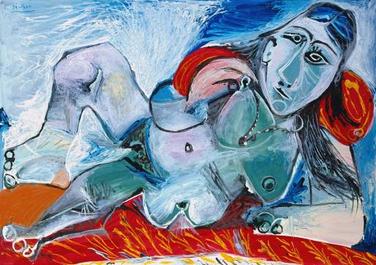
The rejection of reverence for what is Good, Beautiful and True, necessarily is an action towards disunity which masquerades as diversity (or Dieversity), ugliness and raw physical stimulation. How you can observe the disprogress of the 20th century from the heights of Bouguereau or Godward to Munch, Piccaso and Pollack and conclude anything else, is thoroughly baffling to me. To compare the world formed with a sensible conception of religion, and one after it has been rejected, lets have a look, shall we?


(sorry, I couldn't bear to post Pollack - follow the link if you've got the stomach for it)

Which would you prefer to live in? For an interesting discussion of Art, see the ARC philosophy.

To state that Christianity gave birth to the individual as a category or idea is false… To state that Christianity gave birth to the individual as a category or idea is false but even if it were true it would have no bearing on the question if god exists or not, let alone the myth of the Jewish space-zombie god.”

Space zombie? I’ll just leave that one to speak for itself. Allo gives a number of historical references for other cultures who amazingly noted the existence of the individual, including Cicero (whom I thoroughly enjoy and admire - good luck finding a reference to heaven and hell prior to him, btw), and other religions, and then the fifteen hundred year gap from 1 B.C. until individualism began to gain any real recognition in the west. His historical ramble through all things individual, could have been expanded even further to that of Pharaoh Akhenaten Amenhotep IV of 1,350 B.C. Egypt, what historian James Breasted referred to as "the first individual in history, possibly the first monotheist even the first scientist and the first romantic", possibly raising the first monotheistic religion – some have even tried to tie him to Moses. And of course, Socrates clearly alludes to a single God - but all the same, the obvious point is, to what avail? They didn’t get any further than they did because… why? Allotetraploid, you ignored my argument for the three legged stool of Reason, by declaring that one leg didn’t produce a stable stool all on its own. Pardon me while I just note,

Duh!!!

It didn’t give birth to the individual all on its own, but it gave to the emerging western culture an avenue and focus for recognizing the divine within each Individual, yet without the other areas of western thought, philosophy and science, it was a message limited by what it lacked – or rather an inspiration in potential, unrealized, without corresponding support from philosophy and science, and the physical opportunity for it being actualized.

What I’ve aimed to show is only that there is no direct connection between the Christian ideology as such and the rise of civil liberties. Correlation doesn’t per se imply causation.”

Neither does declaring an expulsion from causation because it doesn’t correlate into your own dogma. Ignoring the fact that I haven’t been arguing for Christianity per se, but for Religion itself as being not only unavoidable, but a necessary one of three legs of Reason, and that Christianity, which is the Religion of the West and has served to channel a reverence for the Individual and is unique among competing cultures. But more to the point, all three legs have existed to one extent or another in the past, it wasn’t until they all came together within one culture and struck a spark from their mutual presence, that we see the emergence of, and the fruits of the Enlightenment - excluding the damnable Rousseauian fork - from which all you argue for descends from - in more ways than one (BTW, your reference to Martin Luther, who referred to Aristotle as ‘lice and vermin’ – yeah... he's not one of my favorites).

I find it tragicomic that an citizen of this nation built on the very denial of belief in belief (“E Pluribus Unum” in 1782) should so easily fall prey to the recently introduced denial of the same (“under god” in 1954 and “In god we trust” in 1956).”
Again, see my previous post “What never was and never will be: Modern Madness pt 7”. To either make the assertion that America was founded as an exclusively Christian society, or as a secular and atheistic society, are both easily shown to be nothing but the selective and equivocative dogma of their mutual proponents, over the clear and easily discoverable facts of history. BTW, the original push for the pledge of allegiance was put forward by one of the Bellamy bros., an archetypical leftist, progressive, socialistic fascist – I think its interesting how the antibodies of American culture took in that subversion and cleansed it – and yes, religion – the reverence for Truth, was one of those antibodies.

I think I present a difficult target for Allo to pin his strident athiestic bromides and darts upon. I don't present an entirely welcome resting place for the religious minded either. I accept that I am an odd duck, I know of no religious people, in my physical vicinity, who would consider me religious, and my Objectivist inspirations would reject my views as mystical. But obviously, I don't. I've arrived at my views through a thoroughly objective examination of the evidence of history, philosophy and poetics. I suppose if I were to be labeled, I would reject religionist and atheist, but would accept Poeticist - (partly because it doesn't exist and so I can define it as I wish!)

Saturday, February 02, 2008

My Idiopathic Misadventure

Last Sunday, I was minding my own business, reading and poking the boobs on Amazon's 'Liberal Fascism' threads (I've much to post on this book when I'm done, conveying in greater detail much of what I'd posted on a year or two back - Stormcrow is my moniker there, btw), when I suddenly began to feel nauseous, had a head rush, and more intense nausea. I left my bat cave (see my profile pic) and came upstairs where my wife the nurse checked my blood pressure & heart rate. I noted a little extra steadiness in her features, but she said the BP was fine.

I sat there at the table for a few minutes, and then thought that maybe I just needed lunch and put some leftover spaghetti & meatballs in the microwave. While waiting... wo... the world began going white... I said "I think I'm actually going to pass out..." and a moment later, I did.

I dimly heard Carol hollering for the boys to come and help, and then nothing. Two minutes later I woke up on the couch with some very concerned looking faces leaning over me and Carol on the phone to 911 getting the paramedics over.

They checked heart rate and BP again, took blood sugar, EKG, all fine... with the oddity that my heart rate was 48. Great if you're a tri-athelete... not so great if you're a computer geek. Figuring that if you're going to be worried anyway, you might as well have a bunch of data to be worried with, we took me to the hospital ER, where they hooked me up to a nifty bed with all the heart & BP gizmos whirring and pumping and beeping every few minutes, and my favorite, the alarm that sounded as soon as I began to calm down again and my heart rate fell below 50 ...

'Beeeeep! Beeeeeeeeeeep!

Very soothing.

'Why is that beeping?'

'Your heart rate is abnormally low''

'Ah. Thanks.'

It was a while before they figured out that when I heard that beep, I thought that that meant imminent death,

'No, not critical, just odd. We should give you a thorough check out.'
'Ah. Thanks.'

And so I got a nifty room up on the cardiac floor - coincidentally right where my wife works, and I spent the next two days taking every possibly relevant test to figure out what the heck was happening. I also got a roommate who liked nothing better than to watch every Jerry Springer’ish kind of show available on TV throughout the day and night with his wife (picture principal Rooney’s secretary in Ferris Bueller) there with him commenting on every interesting development.

Ah… rest and relaxation.

I've had EEG's, EKG's, mucho many needles inserted (2:00 a.m. seems to be the best time to do this) to do full blood workups, treadmill stress tests to let you experience utter exhaustion on differing inclined angles, with ultrasounds (cold goo pressed against your startled skin) of the heart before, during and after, Doppler’s of the carotids, CT scans of the head where they slid your head into a very angry sounding round machine that looks like the portal for Stargate SG-1, a tilt table test which tests your ability to withstand boredom while strapped to a flat board and tilted at various angles intermixed with nitro-glycerin spritz's and more automated blood pressure tests (this should be understood to mean 'squeeze REAL tight, get all blood out of your arm, all of it... ok, start letting it back in... rats, it's back). And of course after each test sizable chunks of arm and chest hair must be ripped out for maximum effect.

All of which can be summed up as 'yeah your heart rate is low, but seems to be normal for you, you respond just fine to all changes and exertions. We've got a cool term to describe your passing out, its called Vasovagal Syncope brought on by Idiopathic (it crossed my mind that maybe he was one of the Amazonites insulting me, but I don’t think so) causes, which of course means - 'we've no clue why you passed out, but we do recommend you don't do it anymore.'
Ok, I'm on board with that.

Reality did pop in before I left, just to make sure that I do keep my thoughts affixed to mortality; while I was waiting to get my final results, my roommate was rushed in a flurry from our room for emergency triple bypass heart surgery. His wife, remained behind for a few minutes to call their children and friends in heart rendingly tearful sobs, barely managing to give them the news "It looks bad, the Dr. said they'll do what they can... Oh My God...". I witnessed the instant transformation for me, of what moments before was a person of annoyance, almost a characiture of a person, into a real human being, a sympathetic person with intense cares and loves and desperate fears, whom I felt utterly helpless to assist or soothe as I watched and listened to her experience the destruction of their life and love... his wife... this time... could have been mine....
Reality. It’s all around you.

I’ll accept the Idiopathic diagnosis, but I’d be an idiot to think that THAT was the important thing for me to learn from my experience.

Saturday, January 19, 2008

A Summary – Reasons of Reason

Hope you don’t mind my diving right in, it’s a deep pool. Our grasp of the Universe boils down to three axioms; 1)The universe exists, 2)consciousness is our faculty of grasping that, and 3)in the process of that grasping we discover identity: that that which exists, exists as some thing and not at the same time some other thing.
More succinctly:

Existence exists—and the act of grasping that statement implies two corollary axioms: that something exists which one perceives and that one exists possessing consciousness, consciousness being the faculty of perceiving that which exists.

They are axioms, because they can not be broken down any further, they are implied in everything you can say and do, and they can not be refuted without resorting to their use.
They are, and they are there at all times, no matter the state of Human development, they are the key foundations of the operations of our mind, and are beneath all we are and all we seek to be. Without the reality of this triune structure, nothing Poetic, Religious or Scientific, exists or can exist.

Human beings evolved in someway or another over the course of a million or so years, and for at least 100,000 years (probably more, but we have record to that point), we existed in recognizable appearance to modern humans. But that appearance, I believe, was a visual similarity only, inside, what makes us recognizably Human, as opposed to very clever and able apes, was not there, and would not be there, or at least appear and leave a recognizable trace of its development, until about 40,000 years ago.

It is from those literally unknown times, when humanity consisted of the associations of packs of clever apes, that is the level of humanity which is discoverable by, and no further, through studies such as biological and experimental psychology; stimulus response studies, the effects of synaptic responses – all very remarkable facts of our neural system, but they take us only up to and no further, than that level we reached in roving bands of clever apes about the savannah’s or wherever it was that we walked upon. The vaunted ‘discoveries’ of experimental psychology, or the stimulus response of ‘attitudes’ and ‘values’ as explanations of consciousness and psychology which Allotetraploid so enjoys, and which our moderns so proudly claim as new and ideal revelations of social evolution … are what we as a species overcame and left behind 40,000+ years ago.

The sad truth is that the so-called ‘Moderns’ are only the latest in Primitives.

What we recognize as Humanity, was created, was evolved, was brought into being – artificially, through our own conscious grasp of some higher abstractions, and when that happened, Then it

let there be light!

As light isn’t reducible to the components of a light bulb, they are only the requirements for it, life itself isn’t reducible to chemical reactions, chemical reactions are only the requirements for it. So too, consciousness isn’t reducible to life, life is only the requirement for it, and civilization and civilized people in the manner recognized, cherished and taken for granted by us, isn’t reducible to mere consciousness, consciousness is only the requirement for our civilized world to exist – it is not equivalent to it.

Somewhere between 100,000 and 40,000 years ago, something developed in humanity that was Humanity. I suspect that after our minds gathered enough words, possibly with the addition of (my unverifiable bet) past and future tense, but however the opening occured it, I suspect that it enabled our consciousness access to our full mental faculties and the ability to grasp our own thoughts, and the change that that wrought, in the lives of those who experienced it, must have made all of the changes and transformations we’ve seen in the last century pale in comparison.

At the risk of heresy, I don’t think that the distinctive feature of our brains that makes us us, is completely unique to us. Huh? There is no end to the ‘discoveries’ that scientists hungrily make almost on a daily basis that lab animals such as chimps hug, act for the benefit of others, ‘talk’, ’problem solve’, ’ count’, etc, but I think that while we do do those things better, it isn’t the doing of them that is unique to us, but the depth with which we can do them. The open-ended potential that allows unending self structuring is, I think, our trick pony. Our minds organization around concepts – created by, and representing not only what was seen in the world (but through our ability to intentionally create them) what is imagined internally, allowed us to see into reality and ourselves at the same time, it allowed us to organize information indefinitely, without being thrown by the shear size and quantity of information being dealt with.

This can sort of be seen at work by placing three manila folders upon a table, maybe labeled "Poetics", "Philosophy", Science" , they can easily be seen, reordered and opened via language, and even though each contains numerous papers and also contains several additional manila envelops, and within each, numerous more documents and numerous more file folders, etc, etc etc, they are easily grasped and manipulated through the use of the file within a folder within a folder structure. We can take this another step towards MS Windows, by placing on many of the folders, images, pictures to recognize them by, Icons – and add to that a myriad of seemingly incidental associations of memory & emotion, and we begin to see the structure of our unconsciousness as well, consisting of those ever-present, but not always seen, relationships.

So our mind not only had what must have been a very early invention of language, the ability to represent things, it also enabled us to discuss those things, not just in the flat fashion of papers horizontally strewn about the table top, but in depth, and with depth, arranging and grasping material Vertically at the same time they are ordered Horizontally. Grasping those three folders which are laid flat upon the table, is at the same time to grasp their contents in a vertical manner, and with depth readily available, deeper and deeper, as you grasp, discover, and look deeper into them. The process can, and perhaps does, go on infinitely, though no single mind would be able to grasp all of the detail, it is still able to grasp it all via the outer folders, conceptually, Vertically.

Something else this made possible, was the ability to not only tell about what was visibly seen, but to tell about what happened, in a way that included not only horizontal facts, but to pass on a Vertical sense, to convey a sense of actually having been there - to pass on a semblance of experience, that most difficult of attainments, via words in story.

Where prior to the Poetics of story, to teach someone to hunt, you had to have someone who knew how to hunt, had survived hunting, take someone with them on a hunt, to watch and memorize the steps of hunting. Because of the nature of hunting, the need for unobtrusive amounts of people, and people already skilled in silence, this meant that teaching someone to hunt was exceedingly difficult, and a proposition of years - and if the chain was broken - the teacher killed - life was a dangerous proposition always in jeopardy.

With the discovery of Story, suddenly massive amounts of information was able to be conveyed en masse, via the story, and the ability to convey the substance of those folders via campfires or mothers milk, enabled people to grasp reality, gain mastery of it, and to slowly create depth into themselves which matched that of how they managed reality.

That existence exists, grasping it is what our consciousness does, and what we grasp is not only what it is, but the act of bringing it into ourselves - recreating reality in all of its depths within us - enabled us to begin grasping the never ending information that is the world, and the never ending depths that is ourselves.

These stories gave us huge power to confront and dominate the world, and even gather an importance in many respects, more valuable to the growing community of people, than perhaps individual people might have to that community. In short, they were worth dying for, because they made living possible, and living for those stories, made your life potentially greater than it otherwise could or would be.

As these stories grew, and their file folders grew in quantity and depth, so did their ability to be contained within others, and eventually, I think, it became obvious that they should also be contained within One. The file cabinet of all that is, just as the three axioms are our grasp, irreducible to, but undeniably of, One world, they are our best grasp of IT ALL.

As our discovering and filing of files and folders deepens, WE came into being as the Humans which we would recognize to be Humans. We began to not only pass on those stories, but to identify ourselves as those who told particular types of tales, and we began to tell the story in ways other than only words, we began to convey them through actual physical imagery, through artistic objects, and finally paintings, such as in the caves of Lascaux.

I've heard it argued that what we are, now, today in the West, people with a grasp of Self, didn't exist a few thousand of years ago, does not in fact exist now in places such as stone age cultures of New Guinea, etc, or even five hundred years ago in the West... yet I can see that in many ways, it did exist with the Greeks of Aeschylus’s day or hundreds of years later in Rome with Cicero and Virgil and Livy - their stories, plays, philosophies, their deeper understanding uploaded into them the upgraded Human 2.0 program that was on a par with modern man – lacking only a service pack, and it seems to me, that one of the burning revelations of that service pack, Christianity, was that it pointed out the existence and importance of YOU, of a Self that exists within you and is important to a Greater Self within you.

To my way of thinking, WE, as humans, our self awareness, and grasp of ourselves and the world, does always exist, has always existed, even 40,000 years ago - but whose existence and realization is only implied within our structure. We are implications logical to developing from those three axioms, a One that isn't fully realized into us, until consciously brushed up against, dusted off, and clearly identified and practiced. Potentially, anyone at anytime can become all we are now, or will be 40,000 years from now (and probably with an equivalent rearview disdain) – if any community of infertile parents from our time went back 40,000 years and raised a temporally local children, they would match and be of the culture which the parents transmitted to them.

Break that sequence however, interrupt the transmission of those stories and manners, and the volatile RAM memory of Humanity 2.0 or Humanity 2.1 or some future cultural Humanity 3.0 – will be lost, the deep storied understanding which imbues us, defines and is defined by us - will be lost. When that identification, and system of filing and transmitting data and its relations which are conveyed and maintained through the structure of our stories - when that transmission breaks - then the upgraded modules and service packs are lost – or non-techily, the dust gathers again and the ancient structures and works of art recede into mere bumps and ridges in the landscape awaiting the spades and brushes of the critical awareness to reveal again the intricacies of finely wrought sculpture. Those who claim the Judeo/Christian self, but neglect the Greco/Roman – are less than they otherwise could be – they lack density, integration and substance.

As our identification of our ideational documents improves, and our ability to order, to disentangle our files and folders progresses, we better grasp the actual existence and structure of reality, and our internal ideal representation of it improves as well. Reason, in its pre-upgraded state, is the natural faculty or edge of cleverness, the stool that enabled us to rise over our fellow apes, and the rest of the animal world, it enabled our relatively frail bodies to exert our control over them. That natural ability in its raw state is the result of our physical development, the reality of our horizontally evolved selves, our stimulus/response, animal like natures. But in its original equipment form, it only comes with one leg.

It was not enough to lift us above that level. We, with the three legged stool of Reason we (can) enjoy today, is a creation of that poetic leap far above that of our clever one legged Reasoning forebears. Adding the Poetic leg to our stool enabled us to climb above the level of conceptual-auto-impressions and reflexive data filing and retrieval, to manually, conceptually creating and grasping the world into our imaginations, that has created Humanity, independently of pure nature. Any Wild Boy case history will demonstrate the truth of this. Without our stories, without the proper transmission of our stories, parent to child, community to person and person to community, we - the Humanity we know and love (!) would cease to exist, just as it ceases for any child raised without human interaction - we revert back to our natural state of clever animals, one with the forest about them and little or nothing of what we would recognize as Human within them.

We are creatures of self made soul, making use of cultural poetic shareware to import and inscribe ever more substance into ourselves. The better our stories not only convey all that our community is, but ability to understand and control reality, then it also enables us to understand each other and poetically evolve the structure and depth of our filing systems - and further develop newer and more consciously created and evolved understandings of ourselves.

Poetics were a fabulous benefit, but also a danger. The world is. We see it, we experience it. I reject the Kantian notion that we are ‘never able to grasp reality as it is”. Within the range our senses are sensitive to it, we get it wholly and completely as it is. We are not blind because we have eyes to see, deaf because we have ears to hear, ignorant because we have a mind to know. Yes, our perception of the world is within a defined range, such as our perceivable light wave range stops at the visible, to us, red range, yeah, true, true, but the very fact that we know that, gives truth to the lie that we can’t know it.

But.

We also can assume through our poetics, there to be or not be additional facts and meanings which are not there accept within our assumptions. This is where the Greeks, as with Aristotle’s logic, made such a breakthrough – with it we could verify whether or not our senses and assumptions jibbed and was in fact, warranted.

The inestimable contribution of the Greeks advanced understanding of Poetics through Tragic Drama, Philosophy and History, enabled Humanity to make another advance outwards and inwards. The inestimable value of a formalized system of Logic as perfected by Aristotle, enabled huge advances, without that, we would not be. It gave us a way to not only deepen our filing systems via its natural iconic-imagistic filling methods, but to extend our self made evolution another level, giving us the ability to mark, identify, and cross-file our system of folders and files - to cross relate and self correct our system of filing and of thinking. The direct result of this, and that responsible for our modern world, was Science. Without that, we simply would not be.

The error of science however, is its tendency to think that IT is THE containing folder of our knowledge, rather than one of many contained within others – it is a way of navigating and ordering our system, it is not the system, or even THE way of navigating it. Sciences inability, or refusal to see, that it is even more artificial, and far more brittle, than the poetic iconic-imagistic organizing of our files, and though it can exist within our poetic filing system, can be secure in its more clarified grasp of reality, when it attempts to remove the imagistic stickers from our conceptual filing system, it doesn’t see that it removes with them their hidden image-mapped system of links and gno-how with which our stories create our culture, and then the order decays and that which keeps us together, which creates community, and which creates and orders ourselves, falls apart, the files are emptied into a flattened horizontal pile, nothing structured within anything else, and we fall apart.

Such disintegrated confusion, if continued much further, will eventually be irretrievable and make the scattered contents worthless, and all will be brushed aside as useless clutter – and humanity will need to endure the passage of another thousand years to rediscover itself again.

Now, I don't say that early man, certainly not men 40,000 years ago grasped this, in this way or likely in any way similar, but I do believe that it is a natural implication of our minds, and the way we grasp reality, of our conceptual structure, that it is implied in our very being. It evidences itself to those who do, and who are capable of looking, and guided by that implicit structure, our knowledge is structured by, and reveals it, and us, to us, in every thought and idea we have. Even error, depends upon the same structure, and honest examination of reality, will eventually correct misapprehensions.

Our knowledge, reveals us to ourselves, and our relation to reality - and its reliability requires that there be a relation to how things actually are. Obviously, those file folders, and the documents within them, can be miss filed. People are free to mistake folders for files, and files for folders, and even insist on trying to scatter all upon the floor and deny the existence of the folders and their relation to themselves - but they can't do that without also using the structure and ideas which they are so busily rejecting.

Few things are more amusing than watching a mega anarcho-leftist consciously denying the existence of consciousness, declaring the invalidity of Logic, through the use of logical arguments, or declaring that "There is no such thing as Truth! It's the Truth! There is no Truth!" One is reminded of Monty Pythons skit from the Holy Grail, the Knights of Ni! locked into eternal damnation for hearing and saying the forbidden word "It"


Arthur: No, it is far from this place.
Knights of Ni: AAAAH! AAAAAH!
Head Knight: Stop saying the word! The word the Knights of Ni cannot hear!
Arthur: Oh, stop it!
Head Knight: AAH! He said it again! AAAH! I said it! OOOOH! I said it again! That's three "it"s!


...and so on.

In just such a way, they deny the existence of our way of knowing the world, of our way of knowing ourselves. They deny, and through that denial are perhaps no longer capable of even detecting, conceptual hierarchy, of higher Truth. They grab onto all the artifacts of modern Western Culture, the results of our long and deepward journey, and attempt to swing them about as if they can continue to work without their meaning being understood. As if something like a constitutional representative republic can endure without a firm grasp of all the facts and meanings resulting from three thousand years of discovery and understanding which went into creating it. As if creating laws which are unlawful, can long uphold a system based upon Law. As if an education that does not Educate, can produce a people civil enough to govern, when they haven’t been educated sufficiently enough to be able to stand on their own. As if they can make claims to higher purposes, without any regard for what is highest within themselves or within their culture.

Discard the religious, discard the poetic, discard the stories, discard the manners and civilities, discard the roles and habits of a culture – and you discard civilization. At that point you’d better be prepared to live contained within that stimulus and response world which will be all that remains of what once existed as this world. And it will remain to a new, and much later group of people to rediscover the implications of the existence we are conscious of facing.

The poetic doesn’t exist to tell us what to do, it exists to give us the perspective to be able to grasp the world and see for ourselves what to do. It is the space within which we think, and without which, our thought becomes cramped and lacking in depth. The poetic forms, the religious tales give a location for timeless consideration – they give a place for the establishment of that which will remain timeless to refer to and guide you for all your time. Without them, you are lost in the flatland of the moment.

At some point, for me at least, this contemplation of the three axioms, and of consciousness as such, it's singular existence above the flat material world, leads me to suspect that it doesn't only begin and end with our lives, but extends into our lives as the structure becomes able to host it. Life is, and consciousness is thickest where there is the structural depth capable of supporting that depth.

I suspect that Consciousness is like a light blazing outside of a ball, we are like pinholes that allow that consciousness to stream into the interior of the ball. Perhaps in some way that is ungraspable, as two dimensions are to one, three are to two, or some fourth or fifth dimension to our three dimensions, that ball is not only what radiates the light outward, but is the structure of the ball, an unending stream of light on the outward side, and penetrating into its center, through the openings of life….

Yes speculation, a poetic representation, a two dimensional sketch of a perceived three dimensional world to which we are blind to. But I swear… we do bump around in it, and though we can not see what we touch, it seems that we do sense something in that inner reach towards further inwards, it seems to me, sometimes it manages to reach outside the ball.

But here's what I also hasten to state. These reaches inwardly outwards, are experienced as individual excursions for private consumption and contemplation, describing as they do our personal experiences of that which we all can reach towards… but privately. They may be interesting – to me, but incomprehensible to you. They do not provide for the building of a common world. They are for our personal stretching of hands out in darkness to touch and feel, but as we can convey nothing but impressions of such a thing, and so it is for us alone. The poetic, the religious, is that basic distillation or thought and idea that can be communicated to, and grasped – by the outer folder – by all within a community, and with which each can grasp it in hand and as they are able, open up the folders, read what is inside, look into the inner folders, and the folders within the folders, and see their interpretations of the pinholes of light, in manners which seem sensible to them, while still being able to have a common communication with the others in their community and culture.

We discard those timeless structures at our peril.

Be that all as it may be, reality is, and our existence and betterment inwards and outwards, depends upon our clearly and honestly grasping and dealing with it. It requires that we identify and distinguish between our files and our folders, and that we not make the basic logical mistake, of comparing a document within a third level-in folder, with a first level folder, as if there were no folders separating them. A literal interpretation of the Bible or of any other religion or myth, does just this, and whether the error is made by believer or non-believer, it is just as much an error, wrong, and detrimental to all involved – a journey gone awry.

That such an understanding, and adherence to reality and its structure outside and within us, is not followed very often by either scientists, or religionists, merely means that we either do not yet have all of the materials gathered and identified necessary to easily understand it all, or we are engaged in too many other misfilings, so as to make as yet impractical all of the file managing, sorting and structuring that is necessary to be done, before we will routinely be able to make those necessary distinctions, and so cast disbelieving glances towards either form of the literalist statement.

Apocalypse, that dreaded foreshadowing which every culture and religion (consciously religious or secular) anticipates, the destruction of the world, is probably better thought of expressed as the destruction of the ‘Words with which we know’, and with the loss of the stories we know through them, the world we know would vanish and come to an end.

Ultimately however, I AM is implicate in the axiomatic triune structure of our brains, and given enough time, someone will become some One again, will grasp a higher level abstraction, and slowly, with their applied free will and expanded worlds of poetic story, civilization would eventually be reborn anew.

But eventually can be a very, very, very long time. Pull up a stool and have a seat.

In short, it is Still earlier than we think.