Showing posts with label Literature. Show all posts

Thursday, October 06, 2022

The 1st lesson from the dark wood of School Reform: Good intentions make a map to Hell unnecessary

“Midway upon the journey of our life
I found myself within a forest dark,
For the straightforward pathway had been lost.

Ah me! how hard a thing it is to say
What was this forest savage, rough, and stern,
Which in the very thought renews the fear.

So bitter is it, death is little more;
But of the good to treat, which there I found,
Speak will I of the other things I saw there.

I cannot well repeat how there I entered,
So full was I of slumber at the moment
In which I had abandoned the true way.

But after I had reached a mountain's foot,
At that point where the valley terminated,
Which had with consternation pierced my heart,

Upward I looked, and I beheld its shoulders,
Vested already with that planet's rays
Which leadeth others right by every road....

Dante - Inferno , Canto I The Dark Wood
It is true that politics is downstream of culture, but there's something that's upstream of both - Education - and when educators acquire the power to not just transmit, but to alter and 'reform' the nature and content of that culture as they see fit, it becomes an unhealthy process, metastasizing into something cancerous to both culture and politics, and to the people themselves. When those I've termed our Founding Reformers, Noah Webster, Dr. Rush, Ben Franklin, and likeminded others, first began reforming the nature and purpose of getting an education (disastrously, IMHO), they unquestionably did so with the very best of intentions for America and its people. The same cannot be said of all of those who've followed in their footsteps, but nevertheless, both sets of intentions ultimately stray into the midst of the same dark wood, the straightforward pathway having been lost.

Just how lost our educational system has become - not simply inept, but willfully misleading us - began to become apparent to many during the covid pandemic's remote learning, when parents, grandparents, and the public at large were shocked to hear for themselves how their student's daily lessons were implementing the bizarre sounding theories of CRT & SEL. But it wasn't until after having seen that those were formulated by Marxist ideologues, and then seeing how adamantly that their own school districts, school boards, media, politicians, and even the FBI, were opposing their efforts to remove those lessons and materials from their schools, that people might finally have begun realizing just how far we've all wandered off into the deep dark of the ideological woods.
Blumenfeld's Hillsdale College address


But simply realizing that we're lost, as we've periodically done since as early as 1920, is not enough to put us back on the right path. Neither will our pointing out how radical this person or that policy is, get us any less lost. The truth is that such people and policies didn't simply 'get in' to our educational system, they are themselves the effects of it - political ideologies, artistic sensibilities, economic beliefs, Marxist or otherwise, are not themselves causes, they are the downstream effects of what is taught in our educational systems, and that has been under the guidance of philosophies that are hostile to the Greco-Roman/Judeo-Christian culture of Western Civilization, and just as effects don't precede causes, focusing on effects won't make their causes go away.

Keep in mind that for every one person who comes out and identifies as being a Socialist, Marxist, Woke, etc., there are far more 'moderates' who'll pragmatically nod along with their positions as 'having a good point', and it's that pragmatic slumber which has become the unconscious norm in our society, and that, even more so than the more radical ideologies, is what has enabled us to stray so far from the straightforward path. IOW, there's something else that precedes, enables, and encourages the views of the Socialist, Marxist, and the Woke, and to be blunt, what's caused us to become so lost, is us. We The People. Our carelessness towards the nature and consequences of our own thoughts, and those philosophies that we've permitted to guide the development of our educational systems, is the root cause to blame - the radicals couldn't have gotten into our schools without our assent and neglect - and until we get back on the right path, how can we not remain lost?

Effects don't precede causes - if we want to make anything great again, we need to learn to recognize the wrong paths of thinking that have led us astray, stop using their shortcuts, stop excusing those who'd deliberately lead us down them, and start making the effort to retrace our steps so that we can find our way back to the straightforward pathway. Retracing our steps is what we've been doing in this series of posts, which so far has been showing where we unwittingly began straying from the right path, and what we're going to begin looking at more closely in this and following posts, is where and how we began deliberately abandoning the true path of education, for a very different path, with very different purposes for those educated through it.

Retracing our steps
The first significant figure in education reform to come along after the Founders, as noted previously, was Horace Mann, who in the name of helping people become better Americans, had begun working to put them under a political system of state boards of education that was based upon the Prussian model (conceived of by Fichte & others with the intention of destroying Free Will and instilling obedience to the state), which was and is alien to America's founding ideals.

Why would he choose and commit to reforming our form of education, in that direction? I think a clue lies in a comment that Horace Mann wrote to a friend, where Mann noted that
"...Having found the present generation composed of materials almost unmalleable, I am about transferring my efforts to the next. Men are cast-iron; but children are wax. Strength expended upon the latter may be effectual, which would make no impression upon the former..."
, the ugliness of which is made clearer when echoed in a comment attributed to Vladimir Lenin a century later:
“Give me four years to teach the children, and the seed I have sown shall never be uprooted”
I'm less interested in comparing Mann to Lenin, than in noting the similarity in how their personal ends justified their public means, and however much their personal aspirations & character may have differed, their intentions were more alike than different, as both were seeking the power to reform the world into their own image for it, and to use other peoples' children to accomplish that. Both of them realized that while adults were more difficult to impose their will upon, those same adults could be manipulated by their own best intentions for their children, into allowing those same reformers to literally reform their own children - for the greater good... and good things do not follow from such actions, no matter how good their intentions. It should come as no surprise that figures as varied as Robespierre, Noah Webster, and Rousseau, had made essentially similar statements in varying states of civil undress, as have countless other reformers from before their time, on up to ours, and no matter how their 'best intentions' might vary, the usual means by which those intentions naturally progress, paves a rather wide highway to the same hellish destination that all such good intentions naturally lead to.

The next and most significant school reform figure to follow after Horace Mann, was John Dewey, who, convinced that his own newly concocted and adopted ideals were superior to the traditional American & Western understandings that were developed over a few millennia of history, began to actively and deliberately exit the true path - no doubt with the best of intentions - which included purposefully turning popular opinion against the traditional ideals of education and wisdom, against principled thinking (the quip that Dewey's philosophy of Pragmatism 'is opposed to Principle, on principle', is spot on), against America's founding ideals, and against the very nature of Greco/Roman-Judeo/Christian Civilization itself. Although Dewey's name may be the most recognizable to us today, he was far from being alone in his goals and efforts, and we'll work through some of the reasons for making that charge in the posts to follow this, but as you can see from Samuel Blumenfeld's address to Hillsdale College back in 1985, I'm far from the first or only one to make it:
"...Dewey’s joining Cattell and Thorndike at Columbia brought together the lethal trio who were literally to wipe out traditional education and kill academic excellence in America. It would not be accomplished overnight, for an army of new teachers and superintendents had to be trained and an army of old teachers and superintendents had to retire or die off..."
Wiping out traditional education and killing academic excellence is no idle charge; the efforts of those two fellow reformers of Dewey's, James McKeen Cattell and Edward Thorndike, were central to disabling American's ability to read (more on that to come as well), and those new Superintendents he notes, one of whom I've mentioned here before, Elwood P. Cubberley, were instrumental in spreading that disability far and wide. Cubberley was a leading figure in redefining what those new school superintendents were expected to do, and what their school systems were expected to become, and how those schools were to be redesigned (reformed) to operate under innovations such as classes segregated by age groups, rung in and out by periodic alarms, as well as the nature of the textbooks and tests to be used within such schools.

The contemporary admirer of Dewey which this history teacher is quoting in his article on how Dewey's ideas damaged American education, is Cubberley:
"...To respond to those changes a political movement grew. The historian’s shorthand term for this movement is progressivism. If Horace Mann set out education’s goals, then John Dewey provided the progressive methodology. The following comes from an admirer and contemporary of Dewey’s:
The foremost interpreter, in educational terms, of the great social and industrial changes through which we have passed, and the one who has done more since 1895 to think out and state for us an educational philosophy suited to the changing conditions in our national life, is John Dewey…. Believing that the public school is the chief remedy for the ills of society, he has tried to change the work of the school so as to make it a miniature of society itself.[1]
Those changes which they brought to education, swept across the nation, both in and out of school, not only because of how they'd altered the lessons taught in our classrooms, but what with our Founding Reformers having altered the nature and purpose of education itself, the efforts of those who'd previously led in educational matters, the community's religious and/or moralist leaders, were unwittingly led into factional battles against each other, unaware that they were both aiding and abetting a new amoral player in the contest, 'Progress', who'd soon see each of them escorted off the field altogether.

Understanding how our schools have gotten into the dark wood we find them in today - and I don't think you can succeed in putting matters right if you don't - requires some familiarity with how we became so lost in the first place, not just so that we can recognize the names and faces of which particular false guides have been misdirecting us, but in order to prevent ourselves from being led down such paths again. That'll be the focus of the next several posts, in hopes that we'll finally 'learn from the lessons of history' and find our way out of the dark wood that we have, with the very best of intentions, wandered ourselves into... and learn how to stay out of them.

Thursday, August 11, 2022

Never forget that 'Education Reform' is about reforming you

As noted previously, the good intentions that our Founding Reformers had in mind when they began the movement towards reforming education in the late 1790s, had a lot in common with our own good intentions today, but those good intentions are just about the only point to be found in common between their time and ours in regard to the what, how, and why, of the content being taught, and how long it took to teach it. That the content and methods of teaching have changed between then and now is unlikely to raise any eyebrows, but shouldn't it be surprising for us to learn that their students spent far less time in school learning far more than we do, today? At the time when our education reform process first began, Noah Webster, who'd been a teacher, thought schools should need no more than "...four months in a year...", beginning with students no younger than eight years of age, and "...completed by the age of fifteen or sixteen...", meaning that they successfully taught the 3R's (and substantially more than that) in half as many months per year, and did so in at most only eight of those half-length years. Our educational system has shaped our peoples' thinking across a sizable stretch of time - we should be paying closer attention to what shape it's being reformed into.

For a very different approach to mathematics, here's John Adams' personal copy of "Cocker's decimal arithmetick",
and for everything else there's Thomas Jefferson's suggested reading list
Learning their 3R's as was once done through actual works of literature and history (from the Bible, to Thucydides, Livy, Cicero, Plutarch, Shakespeare, etc.), meant that those eight or so years would invest them with not only the ability to read, write, and calculate, but would also orient themselves within the landscape of a history whose landmark places, names and dates, were more meaningful for them than any number of 'key facts' memorized for a quiz, ever could be. Learning meaningful lessons, rather than focusing primarily on skills based exercises, gave students a sense of what the men & women populating their historical landscape had accomplished, and under what conditions, and in identifying where their behavior was admirable, or despicable (or both), they developed an appreciation for the good, the beautiful, and the true, a revulsion for the lie and the ugliness of evil, and an understanding of why it was important to distinguish between them. And to point out a sometimes startling bit of obviousness, that ability to discern and understand such matters, was something which the student did not have within them before being taught them, IOW: students are changed by their education.

Too often when speaking of education reform, we seem to focus on schools, teachers, and books, and lose sight of the fact that we send a student to school in order to change them. Learning the 3Rs is not only about gaining useful skills, but using them to put information, ideas, and habits, into students in order to change their thinking and behavior. What basis do you have for assuming that the latest reform's changes will be for the better? What guides the changes that are being made? What ideals are they aiming towards? Are those ideals admirable? Mundane? Ugly? If textbooks are primarily what those changes are being made through, which form do you think they are more likely to take?

More than homework strategies, test scores, job skills and what facts students might be able to repeat on demand, prior to the modern reform era, learning the 3R's often involved committing to memory various passages from significant and meaningful works and poems so as to furnish their minds with valuables that would inform their thinking and provide them with something worth reflecting upon at timely moments for the rest of their lives, and there is nothing trivial about that - it both anchored and added something of permanent substance into their very selves. My grandmother caught the tail-end of that practice when she was in grammar school, around 1910, and just before her death at 103, she recited one of those poems to me from memory, Thanatopsis, and though she could barely see at the time, her eyes lit up with what she was seeing within her as she recited it to me. Contrast that to the little that students commit to long-term memory today, which typically is trivial, and is less likely to come from school than from the Top 40 songs and movie tag lines of pop-culture - a good measure of just how empty and impoverished we have been made by the 'good intentions' of our educational reforms, can be had by comparing what you or your child can recite from memory today, to even a single poem like Thanatopsis.
A rendering of 'Thanatopsis'


Don't neglect the obvious here: an education involves nothing less than terraforming the student's interior as well as building structures upon it - will the resulting mental and spiritual landscapes be barren, or fertile? Will their inner landscape be dotted with soaring structures, or a shambles of scattered sheds and rusting machinery? Will the foundations of those structures be set in solidly reasoned ground, or shifting about upon the sands of popular opinion?

Am I being overly dramatic? Dramatic, yes, but overly? Given the stakes? No. Those who're being educated with Social Studies, DEI, CRT, etc., - their education is forming the nature of the mind which their thoughts will inhabit from then on, will that be an inviting place for them to explore, will it map a correspondence between what is within them, to what is real and true outside them - will it help them come to 'Know thyself', or will it shunt them off to wander about aimlessly lost within themselves for the rest of their lives (see woke activists for reference)? The reason why an education used to involve the finest examples of our culture's history, literature, religion, folklore, music, was to help in forming that inner landscape, familiarizing and equipping the student with the means to navigate through life, shorn up by, illuminated by, and adorned with, what were known to be the priceless jewels of the highest and best of the Greco/Roman-Judeo/Christian West. Is your child's education helping to form their mindscape into a hospitable place for living a good life, or one which they'll be desperately seeking to escape from for the rest of their lives?


Past is prologue
Sometimes I'm asked why I dwell so much on past reforms instead of focusing on the latest ones (Common Core? CRT? DEI? SEL? 'School Choice'?), and my reaction is to wonder why ya'll are dwelling upon the distractions and ignoring the underlying substance that they are distracting you from? I'll give you two points to illustrate what I mean. Firstly, with parents today who are being bullied by the woke scolds of CRT & DEI 'toleration' in the media and establishment, and feel as if this is something that's never happened before, allow me to take you back to the beginning of the experiment in using school for purposes other than education, to when Lyman Beecher was leading an effort to reform the newest school reforms in the 1820s:
"... the press belched and bellowed, and all of the mud in the streets was flying at us... There was an intense, malignant enragement for a time. Showers of lies were rained about us every day. The Unitarians, with all their principles of toleration, were as persecuting a power, while they had the ascendancy, as ever existed..."
, parents, do those 'principles of toleration' sound familiar? Sure, the details and perhaps the intensity might be different today, but the form is the same, and nearly two hundred years later I think we can safely say that his efforts to reform the details of the latest reforms, failed to 'fix' the schools, as has every effort since then - so why would you want me to repeat the same error? Where is the wisdom in focusing on the latest details of the moment, when the underlying substance of them has persisted through to the present day by shrugging through one guise of details after another, year in and year out, since the 1820s!? The details are distractions that come and go, the devil isn't in them, but in what conveys and is concealed by them.

The second point comes from my own experience, from when we were challenging DESE during their attempt to roll out Common Core back in 2013, and there was a young father there who was astonished at my opposition to Common Core's claims to promote 'skills for the 21st century!', and he actually said to me:
"But I want my child to be able to decode informational text, and to learn the skills she'll need to succeed in the 21st century!"
, and as we spoke it became obvious (to both of us) that he had little or no understanding of what he meant by that - he couldn't tell me what he meant by 'informational text' or how 21st century 'thinking skills' differed from those of the 18th century, but he'd heard from people he trusted at his child's school that they were important, and so he wanted his child to have them, so that she could succeed in life. His concern was an example of the very first reform of our Founding Reformers - which took no law to put into place - in action; that belief that education could and should be for some other purpose than the child's education, that is what birthed the beast, and most people today still nurture it along. That unthought-through 'oh!' is how the reformers gather political power to their reform by coupling the parent's sense of their own ignorance, together with their hopes & fears for their child's future, to secure the support needed for reforms which will make very real changes in their child's life and future. Whether those changes will prove to be for better or worse, is an unknown variable of each reform's experimental nature, which is something that most reformers know all too well, and few parents even suspect.

Here's some 'informational text' which that dad would've done better to consider: Slave masters did not severely punish people for teaching slaves to read because they worried that their slaves might read the informational text of instructions on how to operate and maintain their master's machinery or learn better recipes for baking their master's bread, but to ensure that they didn't get a hold of the ideas that Fredrich Douglass found contained within books like 'The Columbian Orator', which helped in his becoming the pillar of fire that helped burn their tyranny to the ground. Alexis de Tocqueville wasn't awed at the prospect of education no longer being the sole province of the rich & powerful because he thought that the public might learn how to become as proficient at buying, selling, and bargaining as those who'd acquired their educations at great expense, but because he knew that a liberal education was the key to living lives worth living and the best way to escape from being the pawns of those who had wealth and power. Neither King Alfred the Great nor Emperor Charlemagne had expended massive amounts of time, effort, and wealth, on establishing schools that recovered and taught the classic works of the West, so that they could maintain a technological edge over the Vikings, but to reclaim and re-establish a civilization's wisdom wherein a person's life could amount to more than a bitter fight for survival.

The sad fact is that this dad's focus on 'informational text' was enabling his school to trade away what little still remained of the old lessons that aimed at helping to develop a child's ability to reason by identifying theme, plot, and character development in a story, in exchange for the hunter-gatherer skills of ferreting out information such as the number of grams of iron noted in a breakfast cereal's nutrition label to support its claims for being 'more nutritious!'. It is that persistent approach of going to school for *reasons* other than the students education which shapes 'education reform' and provides it with the camouflage of the latest in popular distractions - from 'values!' to 'informational text' to securing the 'skills of the 21st Century!' - various skills & benefits do of course result from educating our youth, but they are effects of an education, and not the causes or purposes of one, and that attempt to reverse cause & effect is what has led to the disastrous state of our schools today, where somehow losing still more ground is an ever present feeling of Deja-vu all over again.

I continue to point out the mistakes of the past, because it's those mistakes that we keep repeating under differing guises in the present, over and over again, and that battling the many-headed hydra of popular
Battling the many-headed hydra
distractions, only helps the beast to grow stronger and more entrenched. Until we learn to recognize that those earlier fundamental errors lurk behind whichever new mask of buzzwords they're wearing today, then each and every effort we take to 'fix' the latest issue, will do little more than make matters worse, as was the case with the 'informational text' dad above, and as has been the case for well over a century. Parents are too quick to accept the promises of new more 'rigorous' metrics for students, without sufficiently questioning what purpose is being served through
such 'rigors' as those that promote the idea of having grade level expectations (from kindergarten on) of students demonstrating their passionate activism in service to causes they know next to nothing of. Rarely do we question what vision of the world, and of those trying to live lives worth living within it, is being served by exposing kindergartners to transgender story hour, or secretive discussions about 57 genders?

The current system which increasingly focuses on inflaming passions and feelings, with open hostility to substance and merit, brings to mind two comments from Edmund Burke and Thomas Jefferson, who, though they differed on many things, especially as the French Revolution got underway, they were in agreement upon at least one sound and salient theme, in which Edmund Burke said that:
"...It is ordained in the eternal constitution of things that men of intemperate minds cannot be free; their passions forge their fetters..."

, and Jefferson's bullseye which is a fine complement to that:
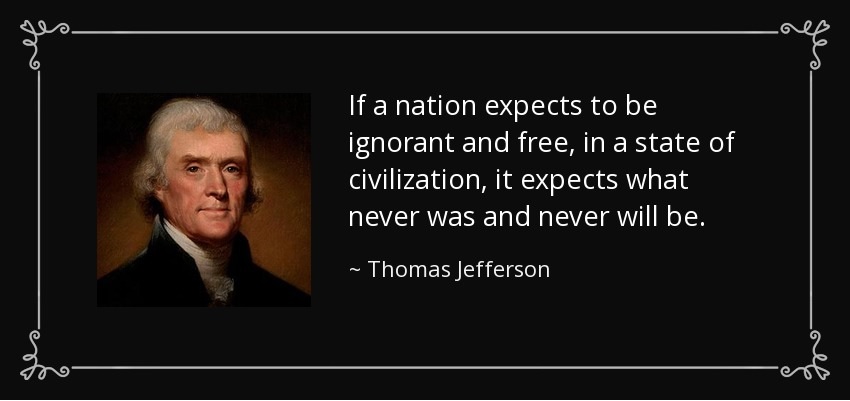
'If a nation expects to be ignorant and free, in a state of civilization, it expects what never was and never will be'
, do you suppose that most educational reformers today are more likely to heed those two warnings, or treat them as threats to their reforms? The reason why Fichte wanted to use a more scientific approach to education that "...completely destroys freedom of will...", the reason why Dewey proposed the aim of "Teaching how to think, not what to think" while ensuring schools rid themselves of materials which thoughts worth thinking might accidentally develop from, the reason why DEI trains everyone into the guilt of systemic racism, is to raise up a safe and useful populace who're full of relevant information but unfit for either freedom or civilization, and devoid of any wider knowledge that would interfere with their ability to serve 'those who know best', in a state ruled over by themselves, for the greater good.

... is the definition of insanity
How anyone expects our youths today to demonstrate an education's important secondary effects: civility, manners and morality, without their cause: an understanding of what those are and the knowledge of how and why they should be central to your life, is beyond me, but that - seeking effects without causes - is a hallmark of modernist pro-regressive thinking, and you should not forget that the effects of past education reforms are all around us today. When we encounter rude, uncivil, even brutally violent behavior, that is the harvest of past school reforms that we're reaping. Those are the ideals that 'decolonizing' our libraries have been aiming at - people who've never learned what civilized behavior entails are not going to behave in a civilized manner when it matters, let alone as Westerners or as Americans - and what kind of mind expects accomplishments such as that to come from nothing?

The answer to that, of course, is that they are the kind of minds and ideals who, since Rousseau, have extolled the 'noble savage' to us because they don't think of The West, or of America, as being worthwhile accomplishments. While that is (or at least should be) sickening and disturbing, it shouldn't be all that surprising, but what should be at least as surprising and even more disturbing, is how any of us ever imagined that some other outcome than the anti-Western and anti-American beliefs and behaviors that we are facing today, would follow from educating our youths minds, with such ideals as those from those minds? It should be no surprise that savage behavior follows from those who've been taught to revere the 'noble savage' - it's only natural - and yet we do behave as if we are surprised by it. Whether through tuition or taxes, we pay, and even go into debt in order to teach our students wrongs as rights, we fund 'scholarly efforts' to portray pure ugliness as a nuanced form of literary appreciation (such as this paper on a barbaric poet of hate, by my current troll, a he/him/his 'gradual student' who teaches Drama to students at the University of Washington), which is taught to our K-12 & college students as being worthy of their admiration, and then we are somehow shocked that our colleges graduate wave after wave of students who are sympathetically aligned with Antifa & BLM rioting in our streets, and who help to spread the mentally and spiritually twisted messaging of groomers in our classrooms.

What is truly unnatural, is our expecting that a course of training which ridicules the idea of objective truth, exalts utilitarian thinking skills, derides wisdom, and holds up tyranny as an ideological ideal, could lead to something other than cleverer devils for us to contend with when societal frictions bring us face to face with the inner barbarian that we've awarded them diplomas and degrees for cultivating. Such 'scholarly' cleverness is in some ways worse than enslavement, as a slave can still recognize, admire, and yearn for what is good, beautiful, and true, while those who've been 'educated' into appreciating such a state of lies are unlikely to even attempt to escape the ideas that bind them. The barbarians outside our gates have become less of a concern to our life, liberty, and happiness, than the native-born barbarian hordes that we're going into debt to 'educate!' alongside us within those gates.

To repeat myself yet again, the skills and facts which are needed to get an education, are not the equivalent of one, and confusing the two - perhaps modern education's most pernicious notion - is not just an ancillary error, it entails abandoning and subverting education's actual purpose, that being to improve the student's grasp of how best to be human - to be an informed, virtuous person, capable of thinking reasonably, and able to live a life worth living in liberty and society with their fellows. But 'education reform!' is and always has been about reforming us into something very different from that, something empty of, and hostile to that, and whatever pretext is used to justify the reform with - whether that be to improve civic understanding, achieve economic success, beat the Russians, etc., - means using state power (even with private and church schools) to transform our youth into the material means of serving those other ends (to the tune of tens of thousands of dollars per child) - we need to learn how to avoid doing such things 'with the best of intentions'.

Because of the good intentions of the past 200 years of education reforms, many of our kids today fail to learn even their 3Rs in the establishment schools (public, private, and church) which take charge of their lives for twice as long per year, and for four more years than pre-reform schools thought necessary. Additionally, most of those students graduate with a barren internal landscape, and even as the popularity of Marvel, DC, and Star Wars 'universes' demonstrate their thirst for meaningful stories in their lives, the cultural stories that arguably form much of an education's greatest value - the knowledge of how to find your place in, and successfully navigate through life - play little or no part in their 'education' (see 'The Story Killers'). As a result of the modern progressive education's 'hunter-gatherer' approach to cramming 'key facts' & skills into short-term memory, the lives and minds of our leading people today truly lack a worldview within them that's worth viewing anything from - it adds little or nothing to their inner life to make their lives more endurable, enjoyable, and meaningful, and provides them with no worthwhile perspective for understanding the world and their place within it.

One thing we can say for sure about education reform is that it has undoubtedly worked - it is how we've come to accomplish so much less, with so much more. Unfortunately, of course, saying that has been a good thing, would be an especially ugly lie - our education today alienates us from both who we are, and from who we should be. Amazingly, we continue to employ it, even today, while expecting different results - how does repeatedly doing the same thing while expecting different results, differ from what they say is the definition of insanity? On the bright side, our history provides us with enough examples of these reforms that their pattern is easy enough to spot, and if we can do so before our own good intentions are turned against us once again, that'd be one lesson of history that a brighter future could come from learning. We'll take a closer look at that, in the next post.

Friday, July 01, 2022

Disorienting America - the modern thinking behind abandoning True North

We've already noted the abundance of good intentions that patriots like Noah Webster, Dr. Rush, and Ben Franklin had when urging a 'New!' system of education upon us as a means to improve people and fit them to secure their new Republic, much of which sounded a lot like what 'conservatives' often say today. But were you aware that they also expressed some intentions which many would find to be not just at odds with the more liberty oriented ideals of our Founding Fathers, but which sounded more than a little bit like what we'd expect to hear from a Hillary Clinton or a (former) Gov McAuliffe?

I've picked on Noah Webster enough already, here're two quotes off the top from another one of our Founding Reformers, Dr. Rush:
"...Let our pupil be taught that he does not belong to himself, but that he is public property..."
, or of education for political and ideological purposes:
"...From the observations that have been made it is plain that I consider it as possible to convert men into republican machines. This must be done if we expect them to perform their parts properly in the great machine of the government of the state..."
, and similar statements can be found from Noah Webster, and Ben Franklin, though in their defense, it doesn't take much reading of the rest of what they had to say to realize that they didn't intend those statements to be as alarming as they are to anyone who knows the history that has followed in the wake of such statements, but the more important thing to note is how easily their good intentions concealed even from themselves, the radical nature of the unstated assumptions that are inherent in what they'd proposed. We, OTOH, don't have their excuse, as their theoretically potential future is our actually documented past (and present), and we should know that, and we should know its effects on our past, and present, and how it is likely to affect our future.

The fact is that despite the very American sentiments that were 'in the air' at the end of the 18th century, there was something else in the air that was exerting a more southerly pull upon the compass arrows of those who came within its influence, and though it had many sources, where they all first came together most prominently at, was through the celebrated scribblings of Jean-Jacques Rousseau.

Despite the glowing captions you'll undoubtedly find around his smiling face in most of your kids Social Studies textbooks, where he's usually portrayed as a champion of 'Rights!' and a leader in 'The Age of Reason', it was Rousseau who infamously described the man who engages in the process of reasoning as being 'a depraved animal' (which should raise some questions about the rest of those textbooks as well).
"...a state of reflection is a state against nature, and that the man who meditates is a depraved animal..." Discourse on the Origin of Inequality Jean-Jacques Rousseau
Rousseau was a determinist, a 'necessitarian', believing that a person's life was not what results from the character, understanding, and judgement which their own choices had fashioned for them, but that 'free will' was an illusion and their lives were but the necessary products of the circumstances of their environment [Clarification: Rousseau didn't claim to be a determinist, he wrote often and much about reasoning and making choices, but the truth is that Rousseau denied the value of reasoning, reviled what came of it, and believed that people were, in later terms, 'products of their environment'. What he claimed in the pretty phrases, he denounced and denied in the details, which I've walked through before here. Occasionally a troll has a good point, I should have made a clear distinction between Rousseau's stated position, and my assessment of it. Do yourself a favor, and look closer at his words, start to finish - do they add up?]. While I can easily imagine why Rousseau would want to blame his own character & choices on the environment to explain why he prowled through the streets at night in search of young women to expose himself to, or to explain why he took each of his six infant children from their mother's breast and sent them off to certain death in a foundling hospital, but exactly which environmental issues would cause that sort of behavior against a person's will, escapes me.

What textbooks should instead be making known to students about Rousseau, is that he was one of, if not the first, major figure to denounce Western Civilization as being a mistake, and to glorify the primitivism of the 'noble savage' as being superior to it; and to deride property and property rights as mistakes that were the root of all evil, and to condemn the institutions of marriage and the family, and to promote a modern sense of Fascism wherein those who thought and spoke in disagreement with the General Will of the state - that they "...will be forced to be free..." (hence The Terror and the Guillotine of  Robespierre & Marat in the French Revolution), and he was one of the first to seek to radically reform the purpose and means of educating the young ('Emile; or, On Education') so that they'd better fit into his ideal mold for them. In short, he was more Marxist than Marx, before Marx was even born, and it is no stretch at all to say that without Rousseau, there would have been no Marx, as the German philosophers who Marx learned from, were rooted in the ill-reasoning mind of Rousseau.

Rousseau's darker intentions fed the roots of German philosophy via the likes of Immanuel Kant, who idolized him, and it was Kant's convoluted philosophy that declared that the problem with philosophy was that reality, 'the thing itself', was ultimately unknowable to man, and so Reason had to be destroyed to save appearances (more on that in coming posts). Another was Johan Gotleib Fichte, an influential follower of Kant's, who said that it wasn't really a problem that we couldn't know reality, because our own thoughts were the only reality that really mattered. And then there's his density himself, GWF Hegel, who scoffed at both reality and traditional philosophy's concerns over 'mere Aristotelian contradictions', as he claimed that the only 'reality' that really mattered was what emerged from his form of the 'Dialectic' begun by Kant & Fichte, for 'resolving' contradictions, a process that was popularized (by Fichte) as "Thesis, Antithesis, Synthesis".

That 'new reality' of the German Method filled the philosophically charged atmosphere of the early 1800s, and young American scholars breathed it in deep while taking the popular 'European tour',
"...The impact of German university scholarship upon nineteenth-century American higher education is one of the most significant themes in modem intellectual history..." Higher education in transition: a history of American colleges and universities
and its innovations were everywhere, from the University of Berlin's (re)introduction of 'Phd' certifications, to the fashion of giving everything a more scientific air as men in lab coats were going about subjecting everything from poetry to history, and the classroom as well, to laboratory experimentation. Those results were compiled and quantified and analyzed into claims of having accurately measured people's thoughts and behavior (see Wilhelm Wundt) well enough, to be able to 'improve them' by 'scientifically' managing and improving every aspect of society (hello 'Social Science' and "...Social studies emerged as an attempt to use education as a vehicle to promote social welfare..."). Age-old wisdom, such as Aristotle's observation that:
"...it is the mark of an educated man to look for precision in each class of things just so far as the nature of the subject admits; it is evidently equally foolish to accept probable reasoning from a mathematician and to demand from a rhetorician scientific proofs..."
, were shrugged off as 'old fashioned' fears whose contradictions to their new ideas, were being resolved through their Dialectical process, and synthesized into new more useful terminologies & practices (what Nietzsche's line has quipped into "They muddy the water, to make it seem deep.").

Few works will give you a clearer sense of the practical nature of these new ideas than a series of popular lectures that Fichte had given on education in 1810, his 'Addresses to the German People', in which he urged that schools be used to create a stronger and more secure state through a more scientific application of education, affirming that a:
"... new education must consist essentially in this, that it completely destroys freedom of will in the soil which it undertakes to cultivate, and produces on the contrary strict necessity in the decisions of the will, the opposite being impossible..."
Fichte wanted to establish a compulsory system of education that would destroy its student's free will, not because he intended to form the German nation into a people who would be the perfect tools for the rise of national socialism (though of course, it did help to do that), but as his solution to what he saw as the cause behind the recent humiliating defeats of the German states and Prussian army & society by Napoleon. He believed that students who were given a liberal education thought too much, and so were too likely to 'choose wrong' in the face of threatening situations. Fichte's solution to ensure that would happen never again, was to prevent them from 'thinking too much' by scientifically controlling what materials students were exposed to and forcefully filling their heads with what experts had pre-determined to be 'the right' ideas, answers, and responses, and testing and re-testing those results into habits of mind, so that they would not be able to make wrong choices in the future.

Fichte's ideas were more than simply new educational reforms, they were emblematic of those who were expert in the new ideas of a more malleable reality, one in which the modern man, the new man, had recast Metaphysics from the old Aristotelian study of what reality is, into convoluted assertions of modernity, that we cannot ever really know what is, or if anything really exists at all. Such views hammered away at reforming our understanding of how we know what is true, forming into competing epistemologies which, in the end, tend to conclude that ultimately we can know nothing beyond our own subjective opinions (if the relevance escapes you, pay attention to the footnotes, CRT would not, could not, exist as it does today without that as its foundation).

It should surprise no one that those who want to feel freed from the constraints of reality and its requirements for reasonable proof, will latch onto whatever 'reason' seems to justify demanding that other people accept their subjective whims as facts. For those who respect reality and value what is objectively true, the person making such claims as 'because it's true for you, doesn't mean it's true for me' reveal themselves to be unwise, and those seriously making such assertions can have no love for wisdom. But then again those willing to accept that reality can't really be known, are not concerned with wisdom, and aren't in the habit of questioning whether or not what they want to believe is actually true, and so when presented with arguments and evidence for what is 'objectively true', they'll wave if off with 'that's just like your opinion, man'.

Of course if those who disregard truth & wisdom actually believed their own words, they'd be dead, as 'your truth' that you can fly wouldn't save you from having leapt off of a cliff, but again truth was never their real concern, getting away with lies, was; and much like the child who, seeing that their parent is too occupied to punish them for the cookie they see them stealing, will reach into the cookie jar for yet another cookie. Sure, they'll get punished later, but for now they're eating cookies.

They aren't interested in reality or conforming to it, they are interested in change, and you are the reality that they want to see changed, not themselves, and certainly not what they so want to believe as being *true*. Modernity's new North is that what is valid is not measured by 'truth', but by having sufficient quantities of likeminded people to force others to change; that's the only measure of 'respect' for 'truth' they have (oh, hello political polling), and they'd do so without concern for whether or not 'the Gods of the Copybook Headings with terror and slaughter return' - maybe they will return, but in the meantime they're eating cookies.

Under such influences as those in the minds of 'those who know best' in society, the end of 'The Age of Enlightenment' brought an end to philosophy as 'the love of wisdom', as Hegel put it in the preface to the Phenomenology of Spirit,
“To help bring philosophy closer to the form of Science, to the goal where it can lay aside the title of ‘love of knowing’ and be actual knowledge — that is what I have set before me”
, whatever 'good' his intentions aimed at, he and his fellows transformed philosophy into a 'misosophy', the hatred of wisdom, and as society's compass needle wandered steadily further from True North, the ethical compasses of the well intentioned reformers of the period wandered right along with them, pleased to begin taking their own good intentions as newly fixed stars to steer by, and thrilled to teach their new stars as being reliable guides for generations yet unborn to use in navigating their lives by.

As the saying goes: "Thar be dragons".

How the new maps were made to reorient around their new more southerly (and sulphureous) headings, is what we'll begin looking more closely at next.

Thursday, June 30, 2022

Foundations & Compasses - Books are never 'Just books'

From John Adams to John Quincy Adams, Philadelphia August 11. 1777:
I wish to turn your Thoughts early to such Studies, as will afford you the most solid Instruction and Improvement for the Part which may be allotted you to act on the Stage of Life.

There is no History, perhaps, better adapted to this usefull Purpose than that of Thucidides, an Author, of whom I hope you will make yourself perfect Master, in original Language, which is Greek, the most perfect of all human Languages. In order to understand him fully in his own Tongue, you must however take Advantage, of every Help you can procure and particularly of Translations of him into your own Mother Tongue...
"
The one thing that Americans' ideas of education today have in common with those Americans of the 1830's, are the good intentions of its education reformers. With the very best of intentions of wanting their kids to get a 'good education', they, as we, sent them to school while intending to:
  • ensure students know key facts,
  • teach students useful skills to get a good job,
  • boost the economy
  • track students' progress and test their comprehension,
  • give students an understanding of what being an American means,
  • solve social issues,
, and if you share those good intentions, then you too are part of the problem that is our 'educational system' of today.

Wait... what? Yep. And the sad truth is that in addition to the Marxist professors we're so eager to heap the blame upon (with good cause), much of your Chamber of Commerce and other well intentioned fellows also share in the blame for why so many students today not only can't read & write, but don't want to.

Sure, it is reasonable to want students to enjoy some or all of those benefits from having gone to school, but while those could be results of having been educated, they are not causes of, or purposes for, becoming educated, and treating them as purposes and causes can even work against that goal.

For instance, being able to identify what facts are key to great works such as those of Thucydides' History of the Peloponnesian War, is to be expected of a good education, but simply memorizing 'key facts' from a textbook's summary of such works, is not going to cause the modern student to become educated in the way that John Adams' son had been. It's not facts, not even 'key facts', that makes those great works great, and extracting those facts for students to memorize, instead of studying the works themselves (''Thucydides...make yourself perfect Master..."), keeps students from engaging with that greatness, and awarding them an 'A' for what they've memorized, misleads the student into thinking that they've mastered something worthwhile... and helps ensure that they never will. The popular summary phrase of "Dewey said that schools should teach children not what to think but how to think" may sound wise, witty & even cute, but without teaching students solid content to think with (which in many cases, especially with traditional content, Dewey preferred to be excluded, see coming posts, or read him), that phrase reveals itself to be a deceptive method for training students in exactly what to think (or not), and how to think it, by not engaging them with the very materials that are most worth thinking through.

Our 'well intentioned' pursuit of educational effects without regard for their causes, has played a significant role in turning our schools away from that which the Adams' had enjoyed; turned it away from what Alexis de Tocqueville had praised (see previous post) for finally breaking the elitist's monopoly over education by putting "within the reach of the people" the capacity for conceiving of and striving for liberty; and turned it into one who's answer to how a student is doing in school, will be a transcript certifying how well they've learned what their school district has determined to be those 'key facts' which establish a basic minimum competency, which - good or bad - any competent school administrator is also going to be able to use to influence parents and business leaders to expand their school system further still. The graded pursuit of such easily quantified, tested, and graded facts, as if they could cause what they are but a minor effect of, has transformed our system into one that is educational in name only, and that same system will, when it's discovered that not one in twenty 'straight 'A' students!' can explain what those 'key facts' were key facts of, or why they mattered, will loudly call for new reforms with better textbooks, increased testing, more homework, and of course more stringent teacher accountability.

It should be no surprise that just as our Founding Reformers' good intentions led America down a very different path than that which they'd intended, those same good intentions are likely to lead us and our progeny down more ominous paths than we can imagine. Why do the good intentions we share with them, lead so very far from where they, we, intend them to lead us? Because they reorient the 'N' on their, our, your, educational compass, from True North, as if locked onto a glittering anomaly which wanders increasingly south of where True North truly lies.

Now if you were to ask me how I know that (apart from what this ongoing series of posts has and is still to answer to that), I'd try to resist asking you what it is about our schools that causes you to doubt it, and instead suggest that if we sight between what can be seen of education on the ground, and what it aimed towards before these good intentions became the norm, and where both are and aim towards now, it will at least be clear that they point in two very different directions. Which, if either, is True North, we'll work through in subsequent posts.

With that in mind, we can see that where education aimed at in our Founder's era (Dr. Johnson defined it as ranging from forming manners, to developing reason for judging '...rightly between truth and error, good and evil.'), can be got at from the direction of education's etymological roots in educere, educare, and educatus, roughly meaning “to learn”, “to know” and “bring out, lead forth” (I took a 'short' dive here, and a loOong dive here, into that), so that a liberal education sought the light of truth in an understanding of what in reality is objectively true, and so served to liberate a person from the shackles of ignorance & falsehood, so as to bring clarity and order to their lives.

For a prime example of what education looked like on the ground in that era, I'll submit the letter linked to at the top of this post, from John Adams' to his son John Quincy.

For the objector's part, I think it's generally accepted that what education aims at today are those bullet points above, which are what most people do answer, Left & Right, when asked why they send their kids off to school to get an education. And we get a prime example of what that sort of education looks like on the ground today, is what this undoubtedly smart student describes in his strategy for efficiently skimming for answers in the 'Grade A!' scavenger hunt:
"...Joe O’Shea was president of the student government at Florida State and a Rhodes Scholar. At a lunchtime gathering for leaders to the university he boasted:
I don’t read books per se. I go to Google and I can absorb relevant information quickly. Some of this comes from books. But sitting down and going through a book from cover to cover doesn’t make sense. It’s not a good use of my time as I can get all the information I need faster through the web. (As quoted in Jacobs 72)
Professor Jacobs comments that Joe O’Shea was “obviously a very smart guy” and “has an excellent strategy”; however, his viewpoint suffers from thinking of reading simply “as a means of uploading data.

That said, the ability to upload data is often precisely what the educational world wants students to do. This can be indicated by the nature of the tests that are given at the end of a unit. If students have successfully uploaded the relevant information, they will pass these tests, no matter how they did so...”
Clearly Adams & O'Shea describe two very different approaches to education, and I think it's a safe bet to say that O'Shea is just the type of 'scholar' which caused Albert Jay Knock's visiting Italian nobleman to ask why he'd met no educated people in America born after the 1890s. To skim for 'relevant information' in books, textbooks, and the like, rather than bothering with attentively reading books, is the very thing that Charles Dudley Warner had warned against as the folly of taking literature too lightly, believing that "... this most important former of the mind, maker of character, and guide to action can be acquired in a certain number of lessons out of a textbook!...". Warner's essay from the 1880s, "The Novel and the Common School", foresaw that the (then) new idea of 'progressive education' would transform 'education' into what it is today:
"...The notion that literature can be taken up as a branch of education, and learned at the proper time and when studies permit, is one of the most farcical in our scheme of education. It is only matched in absurdity by the other current idea, that literature is something separate and apart from general knowledge. Here is the whole body of accumulated thought and experience of all the ages, which indeed forms our present life and explains it, existing partly in tradition and training, but more largely in books; and most teachers think, and most pupils are led to believe, that this most important former of the mind, maker of character, and guide to action can be acquired in a certain number of lessons out of a textbook!..."
Along those lines, it's worth noting that while understanding does require information, simply recalling information does not require understanding, and equating the two will lead you down two very different paths. In what way does our schools path of educational good intentions, as exemplified by O'Shea's hunter-gatherer approach to information, have something in common with the approach of either Warner's or Adams' day? I think it's painfully clear that these two paths are oriented towards very different ideas of where True North lies, and they do so because they have very different destinations in mind.

When those who value information over understanding run the schools (such as these so-called 'English teachers' who aren't interested in reading books), the educational path that they're going to want to lead students down, is one that tells them which 'key facts' they are to accept as acceptable answers, and which ones to reject, without ever fully understanding why - which is a system that info hunter-gatherers such as O'Shea will likely thrive in. OTOH, students who've learned to habitually root their knowledge in what they understand to be true, are going to notice when those in authority give them information that doesn't 'add up'. Of those two, those who're in charge of selecting the information they teach because they see it as being useful for 'the greater good' of the society that they're so intent upon reforming, are not spending millions of our tax dollars on building and expanding our school systems so that they'll produce more of the latter types of students who'll question them on what doesn't 'add up', what they do want, are the former types of students who'll seek and accept the approved information as being useful, and there are few better ways of encouraging more of those types of students, than by tying bullet points from textbooks, to grades, and test scores, and diplomas.

As Hannah Arendt put it:
"The aim of totalitarian education has never been to instill convictions but to destroy the capacity to form any."[The Origins of Totalitarianism]
, that ability to destroy the capacity to form convictions, is what has transformed modern educational systems into the power tool of choice for those seeking the power to say what is, and is not, for 'the greater good' of a more stable State (with themselves in power over it).

The process of moving an educational system away from the pole star of what is good and true, is accomplished through having school reformers selling ever more 'useful answers!' which gradually nudge its lessons further into the orbit of utility until that society's educational system is no longer providing the form of education (that of developing the reasoning for judging '...rightly between truth and error, good and evil.'), which sound convictions can be formed through. Possibly the most important lesson to be learned from the history of school reform in America, is that the very first reforms of our Founding Reformers, whose good intentions we still share in today, began altering our understanding of what Education is, and is for, which began fracturing the foundations which America was understood to be founded upon. The subsequent cycle of school reforms that have each promised to 'fix' whatever was visibly seeping in through the cracks that could be seen, drove those unseen fractures ever deeper into the foundation, and each new reform, each built upon the last, layer after layer after layer, has studiously built it up into a veritable leaning ivory Tower of Babel.

No further reforms - leftist or conservative - added onto that fractured foundation, can hope to steady its structure or prevent its inevitable collapse. It's not possible to 'fix' the swaying of a tower built upon a fractured foundation, without first fixing the foundation, but such an obvious fact is too easy to ignore, as is ignoring the fact that ignoring that will also increase its instability and hasten its ultimate collapse. No further educational reforms - no, not even 'educational choice' (how can either choosing a private school that more effectively teaches the same errors, or insinuating govt oversight into what had been sound schools, be helpful?) - can help, unless first its foundation are fixed and its lessons are realigned with True North.

The choice we need to face up to making today, is to discard those good intentions which cause more harm than good, and restore the proper purpose and content of education - then, with a stable foundation to stand upon, we can look at reclaiming what we can of what has been built upon it. If we don't do that first, the relentless pull of intellectual gravity will eventually succeed in collapsing our educational system, and how such a colossal structure as that can avoid collapsing into a black hole from which no light can escape, is hard to imagine.

To succeed in repairing that foundation, we need to inspect its cracks and determine what caused (and still causes) them, and the reorienting of our educational compass, which we'll begin looking closer at in the coming posts.

Friday, April 01, 2022

Remove this dangerous technology from the classroom: Textbooks

The fact that even with twelve plus years of schooling, many of our students today can't or won't read, or write, or count, says all that should need to be said about the methods of modern schooling in general and of public education in particular. What more does need to be said, is that it's not the students, or even the teachers, who are most to blame for our modern 'educational system', but 'We The People' who've failed them by continuing to perpetuate this phenomenally failed political experiment known primarily as 'public education' (more on that to come). One of the central tools in this process is related to the concerns that many today have about technology in the classroom, but although their concerns tend to focus on technologies that students have some control over, such as smartphones and apps like Instagram and Twitter, their concerns would be better placed if they'd give more thought to the most prevalent tech of all in our schools, that particular piece of modern technology which controls what and how they learn, and which was singled out for condemnation as early as 1893: Textbooks.

I don't mean those technical compendiums of references & standards that you might find in an engineering textbook, but those which digest volumes of literature down into the dense matter which 'Social Studies', 'English', and other such textbooks are formed from. This bit of unassuming tech was one of the earliest products of our endless 'education reforms', and one which Noah Webster particularly helped advance towards its modern format of providing 'brief essays of fact', with the good intentions that students would then begin learning from:
"...A selection of essays, respecting the settlement and geography of America; the history of the late revolution and of the most remarkable characters and events that distinguished it, and a compendium of the principles of the federal and provincial governments, should be the principal school book in the United States. These are interesting objects to every man; they call home the minds of youth and fix them upon the interests of their own country, and they assist in forming attachments to it, as well as in enlarging the understanding..."
Once again (see previous post), as good as that might sound on the surface, what did he mean by it, and how do you know that? Consistent with his disdain for students 'wasting time' reading that literature which he and his fellow reformers had themselves been educated from, he wanted to have nameless people skilled in summarizing selected topics in a format which students could more quickly study and be quizzed and tested upon.

Impatient to produce the desired results in students - knowing important facts - he sought the effects of an educated understanding, without attending to its cause: having enough familiarity with the material and the ideas and methods involved within it, so that you would be able to state a brief summary of it along with its key facts. But memorizing the facts without having the understanding which enabled them to be sifted out and cited, was, and is, an empty sham.

Or how about his assumption that a textbook of these essays would or could be interesting to the minds of youths - have you found that youths are typically interested in reading or committing lists of features, names, dates, and rules to memory? Are textbooks what you see people bringing to the beach to read for personal benefit and enjoyment? On the contrary, our experience with such materials is that the 'pre-chewed' information that textbooks provide, are inevitably poorly and unimaginatively written - typically by committee - and are less likely to put down roots of interest in a student's mind, than to turn them away from, and even against, any whiff of such subjects in their future (say hello to: "I just hate history!").

This textbook processing of education shortchanges students of worthy materials, while at the same time giving them the impression that they know something that is important about a subject, thanks to the metrics of quizzes & tests that *prove* that they know what is important to know. But their confidence comes at the price of never having understood what was valuable about the subject which those facts were extracted from,
  • Yes, Athens and Sparta defeated the Persians, and then warred with each other. And...?
  • Yes, Cicero wrote many legal arguments, speeches and popular essays, and was a Consul... and? He matters... why?
  • Yes, the (a) Magna Carta was signed and sealed by King John at Runnymede in 1215. And...? What of it?
The textbook can inform the student that "Cicero wrote important texts such as 'On The Laws', 'On Duty', and the 'Philippics'", and can even tell them what they were about, but those students will never gain any sense at all of what it was about his reasoning and eloquence that inspired those, like John Adams, who had their lives not only enriched, but the courses of their lives changed because of the experience they found in their consideration of them.

Students are not educated through textbooks into an understanding of a subject, they aren't led into developing the habit of considering various perspectives and vantage points to enable them to "See things as they are", the technology of the textbook reduces a mass of literary text to a few condensed facts, and trains the student to mistake the skill of skimming for, recalling, and repeating other people's opinions of what those facts are facts of, as their own understanding, while never actually coming into contact with what was valuable in them, themselves. Absent such active contact, those facts can make no deeper impression upon their minds than the short-term memory needed to pass the next test, and the dimness of their understanding is inversely proportional to the impression of brightness that the student is given of their own abilities via their test scores. The dangerous side of technology has always been that we become distracted by its benefits, and fail to notice that when technology is doing what it does for us, it's at the very same time taking something else away from us, and the textbook is a... well... a textbook example of that. Textbooks, factual or not, are someone else's narratives, scenic postcards given out in lieu of hiking through the actual landscape, and our students are given grades and diplomas as merit badges for having hiked a landscape they've never set foot within.

Less understood is the fact that textbooks efficiently perform their dis-educational effects, no matter what pedagogy or reforms might currently be guiding their use. Whether it's the '1619 Project' textbook, or whatever textbook moderates and conservatives would rather have being used in schools, they all tell students what to think, and keep them from having the experience of actually thinking such matters through - such an education does not part or even thin the shadows, but thickens them, begetting less wisdom & virtue in students, than folly & bravado from the feeling of knowing what they in fact know little to nothing of. The textbook is the modern technology that projects shadows on the walls of The Cave, and blinkers the eyes of those who might have noticed their thinness. The fact is that Textbooks, and the schools which rely upon them, are veritable engines of Dunning-Kruger-ism, whose products are then graduated into our society, year after year, after year.

Putting skills to the test - que bono? Who benefits?
Our Founding Reformers wanted to focus education on more 'useful skills', to benefit the working man and the economy, but they failed to consider what benefit such a focus would actually bring, or who would benefit most from trading those 'elitist works' away for more utilitarian skills. Alexis De Tocqueville noted in his 'Democracy in America' in 1835, in Book One, Introductory Chapter, he notes that once
"... the exercise of the intellect became the source of strength and of wealth, it is impossible not to consider every addition to science, every fresh truth, and every new idea as a germ of power placed within the reach of the people. Poetry, eloquence, and memory, the grace of wit, the glow of imagination, the depth of thought, and all the gifts which are bestowed by Providence with an equal hand...."
, it was through a liberal education that the people as a whole gained access to the valuable and powerful qualities of mind that had once been the real advantage which the elites had always had over the 'working man', and that education,
"...even when they were in the possession of its adversaries they still served its cause by throwing into relief the natural greatness of man; its conquests spread, therefore, with those of civilization and knowledge, and literature became an arsenal where the poorest and the weakest could always find weapons to their hand....."
Far from being 'elitist material' of little worth, that literature is what first alerted and armed the working man against the predatory tendencies of those with more wealth and influence than they had. A person armed with such an education is generally able to not only respect and recognize threats to the quality and maintenance of justice, but is competent enough to learn the skills of most any trade as need arises for whatever time and circumstance they find themselves at in life.

But how easily can someone who's been trained mainly in vocational skills, 'pick up' the ability to free themselves from the darkness of popular opinion, ignorance and prejudice, which are 'skills' that a republican form of governance relies upon 'We The People' having? Those skills are best developed during school age, and can't easily be picked up later in life - not even in college. As reported by those few remaining professors who have something worthwhile to profess, our new educational dark age of useful skills has even elite college students demonstrating their skills along with an utter lack of what an education should have, and should be, providing them:
"...The students in his Shakespeare class undoubtedly boast a median verbal SAT score in the upper 700s (out of 800). The large majority probably received a perfect score of 5 on the AP (Advanced Placement) English exam. If any group of college students should be capable of deciphering complex texts, writing incisive expository prose, and constructing compelling analytic arguments, it is they. But apparently they’re not.

To understand how this predicament came to pass, one needs to understand how students manage to get into places like Harvard or the Claremont colleges in the first place. It is not by learning how to read, write, or think. It is by jumping through the endless series of hoops that elite college admissions offices have developed over the decades to winnow down their skyscraper stacks of application folders.

To win a place at such a school, students most receive top grades in a broad range of AP courses, show evidence of participation in a dozen or more extracurricular activities—sports, arts, student government, et al.—demonstrate “leadership”, engage in “service”, and gather experiences, often through purpose-built programs, to write about on their personal essays, statements designed to convince the admissions officer of the existence of an actual human being beneath the credentials. To do all this, they will work without cease for years on end, sleeping little and foregoing the freedoms of adolescence.

This is not a system that’s designed to foster intellectual engagement. Students learn to skip and skim, not just their assigned readings, but everything. Everything is done at maximum speed and with the least possible effort. Curiosity and passion must be actively suppressed. Students become experts, not so much in subjects as in working the system..."
[emphasis mine]
Today, when both 'working man' and college elite have spent their valuable school-age years learning 'skills', whether mechanical, narrative, or 'critical', rather than a deeper understanding of the nature of life and reasonings most effective role in it, what happens when the world changes and those 'skills' become less or no longer useful? What happens is what has happened, whether their economic plight comes from those skilled jobs having gone over seas, or from 'anyone but liberal arts degree!' students getting hired, they are left defenseless against the language and designs of demagogues seeking to transform their plight into power over them, for the demagogue's advantage.

Who it is that benefits most from an 'education' of Textbook centered schooling, are those in positions of power, or seeking to gain power over their fellows - they have a vested interest in having 'skilled students' who know little or nothing of what enabled our Founding Fathers to establish this nation, which is the one thing that our schools are successful at producing.

The slow-motion trainwreck of our educational transformation was accomplished by building upon the good intentions of our Founding Reformers 'adding' some useful skills to the educations that they themselves had received, and that turn towards the 'skills & facts' view of education, began a gradual process of eliminating that form of Education which had not only distinguished the West from the rest of the world, but which when properly taught (logic through grammar, the method of reasoning through the consideration of plot and theme, the ability to discover and communicate the essentials through rhetoric, an appreciation of truth and beauty through the contemplation of style, structure and meaning of a story, and the lessons that nature to be commanded must first be logically understood) that form of education is what established the Greco/Roman-Judeo/Christian West, and made it possible for America to be founded in the first place.

Webster's 'brief essays of fact', although a boon for the publishing world and to those 'educators' who write the textbooks that the schools which students are required to attend, require their students to buy, have progressively devolved into the standard form of 'Textbook' used today, which are segmented, often non-sequential (especially in History/'social studies'), poorly written, boring and expensive tomes for testing a fleeting appearance of knowledge of what students actually know very little about - a self-reinforcing system for the mass production of Dunning-Kruger-ism which is one of the deadliest fruits of our modern educational system, and something which the Pro-Regressive Administrative State could not exist without.

Learning to fail the test
But how did a once educated people sell themselves on this course? Why, they followed the 'science!', of course - or at least the scientistic appearance of its methods, quantifications, and statistics of test scores, that frauds in lab-coats use to reassure the unwary that all is well. The wary, OTOH, weren't as easily misled, those like Charles Dudley Warner noted in an earlier post, or as mentioned in the previous post, Albert Jay Knock and the Italian nobleman he spoke of in 1931, who'd wondered why he'd met no educated Americans under 60 years of age. BTW - how do you suppose Knock's Italian nobleman determined that? Do you suppose that he quizzed each person he met on their recall of Social Studies facts & conclusions? As the Positivist 'science' of 'Social Studies' didn't exist at all prior to the 1800's, and didn't become commonly accepted until into the 20th Century, my bet is that Social Studies wasn't the yardstick he used to measure the educations of Americans by.

Or do you imagine that he tested them on their 'Critical Thinking' skills? Well... seeing as their conversation occurred prior to 1931, and 'Critical Thinking' wasn't concocted until 1945 (by a student of John Dewey), I'm going to go with 'no' on that one as well.

How do you tell whether or not someone is educated? More to the point, what if how you test their level of education, doesn't in fact test their level of education... what might be done to students by using false tests to guide them in their education?

To turn the uncomfortable questions towards what might be seen as 'my side' with traditional literature, do you suppose that he buttonholed hapless Americans and quizzed them on their knowledge of the Great Books of the Western World? Tallied up their dismal scores on 'key facts' of Dante & Milton and exclaimed 'Momma Mia are these American's uneducated!'?

While I'm a huge fan and proponent of most of the works typically categorized within GBWW, using those works as a database for quizzing people on what they know of them, runs contrary to the nature of what The Great Conversation which those works are a part of, is - such conversation isn't judged by the facts found in it, but by the depths of understanding confronted and revealed through it. It is a mistake to view what is available to be learned from, as being just as, or more, valuable than what there is to be learned - the evidence of an education is found in indications that a person has left The Cave, not in tallying up how much they've stuffed into their cave!

To put an education to such a quantifiable test as to presume that those who know more facts, are better educated, presumes that the student making a perfect score on an ACT/SAT exam, must be better educated than Shakespeare, or Cicero, or Aristotle, could have been, as they came along before most of the facts known to us were able to be known to them. How would such a view as that, view Plato, who when teaching his young student who was named Aristotle, knew nothing of the works which Aristotle would later go on to write? Or of Cicero who knew nothing of Petrarch, who in turn knew nothing of either Shakespeare, or much else of what we now refer to as 'The Great Books'? And of course though most of them understood Geometry well enough, those past masters could have known nothing of calculus, or even algebra, let alone 'Social Studies' or 'What are the 12 causes of the Civil War?'... are you getting the picture?

The notion that a standardized test could tell you something worthwhile about a person's education, is the modernist's view of asserting that everyone born prior to our time, knew only '...outmoded ideas of an agrarian people...', which, for anyone who cares to give it a moment's thought, it's a blitheringly idiotic notion. I strongly suspect that if you devised a test for Knock's Italian nobleman to take regarding his knowledge of the 'facts' of the GBWW, he'd recognize you as having been born long after the 1890's, shake his head and wander away, much like Prometheus did in Richard Mitchell's "The Gift of Fire".

So if all of our popular 'Educated Tests' fail the test as a test of a person being educated, how did our Italian nobleman conclude this about our great grand parents? He did it the old fashioned way, he talked to them. It wasn't because they lacked a recall of facts or skills, but because in conversing with them, he witnessed their habits of repeating the statements that others had made, the shallow reasonings they gave for them, and the ineloquent language they used to state them. As they demonstrated their lack of the habit of adequately questioning, assessing those ideas that they mechanically talked about in an unthinking repetition of follow-the-dots talking points, with the flow-chart imitation of logic that ties them together. Through the test of conversation, it became clear to him that they literally didn't know what they were talking about, which is a tell-tale sign of someone who is still dwelling comfortably deep within The Cave, and lacks the ability to see their way out of it (AKA: an education).

It's not just a matter of can they reason, but do they? As a matter of course? It's not just a matter of reciting the virtues, but of working at applying and living them. Getting a good education is not just about checking boxes of facts to know, or passing a test upon this or that collection of them, but on being able to observe, inquire, and relate the new, to the past, looking for what their contrasts can bring to light, and considering how best to go forward in light of both, and perhaps even imagining things anew. It's about the ability to be 'self-directed' by what is in reality true, and being able to do so while living in society with others.

If that's what you want for your child, and I would be amazed to hear the reasons of those who might not want that, the standard establishment schools are not where you're going to find it. Instead, you will find students who are being processed through a textbook education, who will spend more than a decade in them being trained to skim for, and memorize facts for recalling on quizzes and tests so they can get a good job and 'succeed in life!'... with little or no attention given to understanding what a successful life is, and depends upon. They might know about great works, but without actually knowing those great works, their minds will not have been challenged to pursue any depth of knowledge of what life could, and should be, or how and why to seek out and question the depths of their own knowledge - and politically ambitious men are taking note of how useful such minds as theirs will be to their own ambitions.

One of the more astounding things to me about our Founding Reformers, is that despite Webster and his fellows knowing first hand the danger of power having sway over the minds and actions of a people, nearly all of them wanted to empower legislatures in providing their idea of education, to the public. Even as Webster noted that,
"...In despotic states, Education, like religion, is made subservient to government...."
, as did John Adams with observations such as,
“Power always thinks it has a great soul and vast views beyond the comprehension of the weak; and that it is doing God’s service when it is violating all his laws.”
, somehow they managed to square the circle in their minds as they nearly all came together in sentiments similar to Webster's statement, that:
"...Education should therefore be the first care of a Legislature; not merely the institution of schools, but the furnishing of them with the best men for teachers. A good system of Education should be the first article in the code of political regulations;..."
Somehow they expected that we'd somehow escape the consequences of putting the process of educating future voters, under the political control of progressively more ambitious and ideological men. And sadly we have not. And as more and more Americans have been raised with progressively less and less familiarity with what had once been commonly understood, we've lost our grip upon what Jefferson had described as the common 'expression of the American mind', which has had profoundly dangerous ramifications to everything that our Founding Fathers had valued, cared about, sacrificed, fought and died for.

To our Founding Fathers' credit, it did take nearly two centuries for their good intentions to bring us down to the level we are at today, while in the birthplace of those endarkened ideas in Europe, those lessons began to bear their horrific fruit of slaughter and terror within just a few decades. But now that we've nearly caught up in the West's race to the bottom, it would be worth it to look at the nature of the education which we're being told will 'take it to the next level' by turning away from truth and towards power; and what a society looks like which condones and supports that - which we'll do in the next post.