Tuesday, August 23, 2022

Accepting the 'Science!' of Education Reform

How we came to accomplish so much less, with so much more, involves several popular buy-ins, first and foremost being the 'good intentions' we still share with our Founding Reformers (i.e.'go to school to get a good job'), which fundamentally changed education's purpose from being the development of the student, into its being a means to other 'more useful' ends, as determined by 'those who know best' (which, BTW, also transforms the students into being but a means to other more useful ends, AKA: '♫♪♬ just another brick in the wall ♬♪♫'). But as disastrous as that fundamental change was to how we think about education, and as popular as that was with those who saw themselves as being 'those who know best (who, BTW, are just as likely to be your neighbor, as some distant 'elite')', before 'education reform!' was able to proceed successfully step by pro-regressive step down the path of good intentions, it required a couple other buy-ins from us: First, the will to publicly propose forcing reforms upon society, Second, the willingness to actually impose such reforms upon others, and Third - toughest of all - popular acceptance of such reforms being imposed upon others and upon themselves.

Those immediately following our Founders' era at the opening of the 1800s were not lacking in the 'will' to call for forcing sometimes intrusive reforms upon their fellows, which comes as a bit of a shock to those of us who imagine that time to be predominantly populated with pure liberty loving patriots; nevertheless, there was no lack of people willing to force their views upon the public, in the name of liberty. You can get the sense of this from the do-gooders themselves, such as this popular set of essays of the time, from a moralist, Dr. James G. Carter, writing in 'Essays on Popular Education' (1826), that to preserve the republic:
"...The ignorant must be allured to learn, by every motive which can be offered to them, And if they will not thus be allured, they must be taken by the strong arm of government and brought out, willing or unwilling, and made to learn, at least, enough to make them peaceable and good citizens..."
. and,
"...The free schools of Massachusetts, as the most efficient means of accomplishing that object, should therefore be the property and the peculiar care of government..."
, and forcing the ignorant/stupid people into doing what was best for them, was something that many considered to be an acceptable and necessary thing for 'those who know best' to do (and who doesn't like to imagine that they are members in good standing with that group?).

With the popularity of utilitarian thinking growing significantly, peoples' various good intentions to 'save the republic!', 'improve citizenry!', 'improve morals!', 'achieve economic success!', 'save religion!', for the greater good of ____[insert your preferred pretext here]___", were easily used to justify acting (whether openly or out of sight) for 'the greatest good of the greatest number', because they'd come to believe that their ends really did justify the means. Even so, it took a couple decades for their thinking to make it into law. Why? While they had an abundant supply of the will to propose and implement reforms upon the ignorant and stupid people, they typically saw someone else as being the problem, not themselves; and if a reform involved them, well, that was clearly a reform that was misguided and unjustified - good 'for thee, but not for me', which added to the noise of the day, but not so much to the laws on the books. Yet.

Up until at least the 1820s, most such reforms were seen as but thinly veiled calls for using the power of government to impose one particular reformer's own religious views, over what they deemed to be the 'inferior' views being taught to the rest of the public (or like Horace Mann's branch of Unitarians, demanding that all doctrine be excluded... which *surprisingly* meant looking very much like Unitarian doctrine), or on the other hand, those reformers claiming that popular understanding of virtue and morality didn't measure up to their own secular expectations, should be banished from the public square - either one of those reformers stood a good chance of getting themselves run out of town by those who didn't want to be reformed by them. In fact,  both such reforms would soon be imposed, but something else would need to fall into place first, before all sides of the issue would support imposing them upon each other and themselves.

The acceptability of imposing such reforms upon others and upon themselves as well, began to spread more rapidly as American scholars began returning home from their European tours, and began dressing up their good intentions for the greater good as a more modern and scientific approach to education (remember Fichte). 'The Myth of the Common School' gives a detailed account of the period, and pg. 98 has one of the new 'science!' of education appeals that had begun taking shape, with Brown University President Francis Wayland, stating:
"...We have assembled today, not to proclaim how well our fathers have done, but to inquire how we may enable their sons to do better.... we, at this day, are, in a manner, the pioneers of this work in this country. Education, as a science, has scarcely yet been naturalized among us. Radical improvement in the means of education is an idea that seems but just to have entered into men's minds.... God helping us, then, let us make our mark on the rising generation."
Wayland was asserting, it should be noted, not that education itself was unavailable or in short supply - he knew perfectly well that almost universal literacy was the rule in New England - but that the science of education was undeveloped; this led to limited capacity to make an impact on the next generation..."
It wasn't so much that they were proposing to dress education up in lab coats & microscopes (that was still a few decades in the future), but that no matter whether their calls for 'education reform!' were outwardly focused upon religion, morals, the weakness of government, or the need to strengthen the economy, each of their reforms intended to use education as an experimental means of affecting the 'output' behaviors of graduating students as a fix for whatever was seen as being the popular societal failure of the moment. IOW, schools were coming to be seen as a technology which looked upon teachers as levers and students as cogs and textbooks as fuel, in a machine for producing a cure-all for the problems of both 'the people' and society. It may not have been apparent to most people at the time, but this form of 'school reform!' wasn't simply 'improving' various features in our schools, it completely transformed our view of what education is, what schools are for, and of who we are and should be, and whatever good intentions had initially unleashed it, would be undermined and undone by it, the more they 'succeeded' in applying it. One clear eyed professor at Princeton, Samuel Miller(1769-1850), hit the nail on the head in sounding an early warning of this in 1805, in his "A brief retrospect of the eighteenth century",
"...This doctrine of the omnipotence of education, and the perfectibility of man, seems liable, among many others, to the following strong objections : — First. It is contrary to the nature and condition of man...."
I'll come back to more of what he had to say shortly, but the truth is that the condition of our schools today has less to do with the laws that have been passed, than with the altered state of mind that led us to pass them, and taken as we were with the promises of 'school reform!', we'd failed to question what was actually being accomplished with it - the condition of our schools today is simply the predictable effect which could not not result from those causes which we are still reaffirming today.

Had We The People kept in mind what education actually was, and what its purpose was, we might have seen far enough into the likely future to see that the promises of those initial reforms and goals would soon be forced out by what they were helping to unleash, but, with nearly everyone eagerly using education as a means to their own ends, be those economics, religiosity, morality, or assimilating immigrants, they were unable to foresee any effects beyond their own rhetoric. Despite their best intentions, as noted in a 1958 study by William Kailor Dunn, they soon saw "...religious themes increasingly replaced by moral ones...", and while the 'Morals!' side briefly surged in the 'key facts' being taught, both soon vanished almost completely from the textbooks and classrooms, as new 'key facts' & skills of the next wave of newly reformed reformers, took their place:
Textbook Content
YearReligion vs Morals
1775: 85%-8%
1775-1825: 22%-28%
1825-1875: 7%-23%
1875-1915: 1.5%-7%


Note: This wasn't a result of 'separation of church and state' challenges - that was still a century in the offing - these were the results of overtly religious and moralistic efforts, while trying to avoid contentious sectarian issues of doctrine, in service to the 'scientific!' mindset of using the schools to produce results other than the education of its students. By the time the contenders noticed that they were all being run out of town, it was too late. The famous 'free schools' run by protestant, catholic, or secular interests, had brought about the greatest literacy rate in history by educating students as they saw fit, but because the government run 'Common Schools' could only teach what no side objected to, and what all sides could agree upon in common was sadly lacking is educational worth, that meant that the only winners under those conditions were the economic and/or ideological interests which, following one form or another from Fichte, had an interest in eliminating educated people from the common mass of humanity - for the greater good and security of the state. The popular 'good intentions' of the moment had been transformed into the motive force of 'the ends' which justified whatever means seemed necessary, and, knowingly or not, produced the outcome that was noted by Albert Jay Knock's visiting Italian nobleman, as being the end of newly educated Americans, in America, by the 1890s.

There were other voices at the time beside Prof. Miller, trying to sound the alarm that:
"Doing right by wrong means, is worse than doing wrong"
, but unavoidably, as an educational form of Gresham's Law applied ('Bad money drives out good'), and with scientism (the dressing up of 'science!' in the robes of philosophy) leading the way, truth and virtue were forced out of what students were educated in. Good intentions abounded however, and when the reformers reforms were even vaguely associated with supporting 'science!', few wanted to be seen in even their own eyes as denying the science, enabling both the reformers and 'the stupid people' to see themselves as one of 'those who know best' which helped secure broad public acceptance for all manner of reform efforts - be they for helping the economy, making better citizens, strengthening the culture, or getting the better of foreign competitors.

The promises of 'school reform!' were of course launched with the very best of intentions by our Founding Reformers such as Noah Webster, Dr. Rush, and Dr. Franklin, who thought of their new education reforms, more as providing something 'in addition to' the betterment of the student, rather than as a tool for achieving something other than an education, and yet... their reforms intended to... use students... to ... resolve whichever issue beyond the student was the concern of the moment - be that Dr. Rush's '...to convert men into republican machines...', or Webster's 'create an American identity' and develop 'economic engines', or still others' call to 'improve the public's morals and virtues' - so that all that We The People needed to do next, was to prioritize which complaint the student's minds & lives should be adapted to fix first. However the particular 'sizzle' they were selling a reform with was dressed up as, it was the coupling of 'education reform!' with the appearances of a 'science!' of society, and the promise of more 'modern' and 'efficient' methods for achieving 'measurably improved results' through education, that was the spin that began to 'play in Peoria', and few seemed willing to consider any dangers that might be inherent in it.

What concerns which those first reformers may have had about what might result from their experiments, would have surely been eased by how the initial reforms seemed to follow in their own footsteps, such as with the proto-high school of Boston's 'English Classical School' in 1821 - which was conceived of as a useful step between grammar school and college levels. But of course those initial reforms were followed by others that incrementally nibbled away at the appearances of what had traditionally been associated with education - if you take a look at English Classical School's original curriculum, you'll see that it bears almost no resemblance to our high schools today - slowly, step by pro-regressive step, through successive waves of school reformers, each proposing their own experimental changes, each promising still 'more useful!' new directions in form and content, year in and year out, decade after decade, the reform process squeezed the 'old' classes in grammar, history, religion, and literature out, as more and more 'key facts' and 'new skills' were pro-regressively squeezed in, forcing the school year to be expanded by not just four to five more months per year, but by another four more of those newly expanded years.

The process behind those incremental reforms developed into a recognizable pattern, a template, through which we eventually reached the point where that proto-high school of 1821 - which most of today's college PhDs would be put to academic shame by - devolved into the failed institution that we call a 'High School' today. Those reforms, of course, were not confined only to our schools, but by the late 1830s they'd expanded into the laws we govern our entire society with, and had become so commonplace that few noticed that by 1920, they'd effectively eliminated parents' rights to raise their own children, and neutered the standing of everyone's individual rights as such, in the process.

Yes, our Founding Reformers would've recognized our good intentions today, but they wouldn't recognize what those good intentions have transformed our schools, or America, into, today.

Testing the Reform Template
When you keep in mind that accepting the utilitarian change to the purpose of Education, was the change of mind that ensured all of the disastrous reforms that would follow, it becomes much easier to see how we got from there, to here, through the pivoting and misdirection's inherent in implementing the reform template. The most obviously successful of those who first led the way in applying the 'reform!' template, was Horace Mann, a radical reformer with a knack for diverting the footsteps of our Founding Reformers into such unforeseen paths as would effectively conceal much of Fichte's Prussian System of education, under an Americanized veneer. His most significant 'achievement' in going down that path, was helping to bring about Massachusetts' first laws for establishing a mandatory public school system under a state board of education. It didn't take long for the people of Massachusetts to begin realizing what the semantics of 'a more democratic education!' had deceived them into establishing as law:
"...After all that has been said about the French and Prussian systems, they appear to your Committee to be much more admirable, as a means of political influence, and of strengthening the hands of the government, than as a mere means for the diffusion of knowledge. For the latter purpose, the system of public Common Schools, under the control of persons most interested in their flourishing condition, who pay taxes to support them, appears to your Committee much superior. The establishment of the Board of Education seems to be the commencement of a system of centralization and of monopoly of power in a few hands, contrary, in every respect, to the true spirit of our democratical institutions; and which, unless speedily checked, may lead to unlooked-for and dangerous results..."[emphasis added]
, but the deed was done, and they weren't successful in undoing it, as at each turn in the process, the objections of those with eyes to see, were brushed away as being over reactions, and those listening were given assurances of "Oh I'm sure they don't mean that!". The problem was (and is) that such a system as that, had to mean exactly "that!", and no matter how good the intentions of 'fitting youth to the machinery of government' might have been to begin with, such ideals as those are fundamentally incompatible with the 'old' pursuit of enabling students to develop an educated grasp of, and love for, what is real and true. Then, as now, the point of 'school reform!' was to reform the collective population into the image the reformers had in mind for them, and then as now, data and data collection were key to how a bureaucracy gains power over those it's supposed to serve. From pg. 123 of "The Myth of the Common School':
"...Virtually the only power that Mann and the board possessed was that of requiring annual school returns of statistics and othe information, and Mann had used this aggressively to collect the information that he then used with great effect in his celebrated annual reports (Complaints about such data-collection activities have not abated over the years!)

Mann's requests for information, and use of the information he received, were in some respects the key elements of his influence over the development of the common school...

... Mann also was in the habit of sending out questions that sought information of a more subjective nature, generally in anticipation of basing policy recommendations on responses whose tenor he anticipated; there are no instances in which such responses appear to have caused him to change his mind about an issue!...."
Mann helped spur that progressive reorientation further onwards through another European innovation that he championed, that of replacing the traditional oral examinations between a teacher and each one of their students, with identical written tests given to the entire class at the same time. In oral examinations, teachers would ask each individual student questions, which they'd answer in their own words, which led to more questions, and answers, and so on, giving the teacher a solid understanding of how well that student understood the material they'd been covering in class, and how best to approach what they would be covering in class next, or next year.

That was not what Horace Mann was interested in, it was too individual, and contributed nothing towards using education to bring about the changes he wanted to see made in students, teachers, and the public. The answer he saw as being more of what he was looking for, lay in written tests,.
"... after visiting schools in Europe in 1843, returned convinced that written exams were superior. He wrote: “When the oral method is adopted, none but those personally present at the examination can have any accurate or valuable idea of appearance of the school…Not so, however, when the examination is by printed questions and written answers. A transcript, a sort of Daguerreotype likeness, as it were, of the state and condition of the pupils’ minds, is taken and carried away, for general inspection..."
, with written tests, Mann could replace the individual process of oral exams, a process that was itself educational, with printed tests, whose generic questions required students to recall similar (and eventually identical) answers that were pre-determined 'by those who know best' to fit the 'answer key', and which all of the other students would be trained to answer with as well. Tests such as those could be mass produced, and their scores tabulated (another form of data-collection) to give 'exact measurements' of what students knew, and which teachers were or weren't 'being helpful' (to the student, or the reformers?), so as to use the 'progress measured' to further their reforms by goading public opinion into line with it.

It should be no surprise to anyone that pursuing results without regard to their causes, leads to unforeseen consequences, and as historian William J. Reese, author of 'Testing Wars in the Public Schools: A Forgotten History', wrote in a New York Times essay,
"...What can we learn from the advent of what we learned to call “high-stakes testing”? What transpired then still sounds eerily familiar: cheating scandals, poor performance by minority groups, the narrowing of the curriculum, the public shaming of teachers, the appeal of more sophisticated measures of assessment, the superior scores in other nations, all amounting to a constant drumbeat about school failure....”
Do you see the seeds of a familiar pattern in that? The promised panacea, accusations of fault over related failures, calls to increase and expand their efforts, and so on? Still more benefits found with testing, was the ability to use both the tests, and their results, to target those teachers, parents, and students, who hadn't yet been reformed into Mann's ideal image for them. The community wasn't blind to what he was doing, there was controversy and outrage over what he did, and over his pressing for still more and more reforms, efforts that clearly came at the expense of those students and teachers that his test results had unfairly targeted. As matters heated up, he temporarily scaled back his efforts, before soon pushing for still more. Eventually the public did tire of Mann and he lost his re-election - but the tests, and their uses, and the data-collection, remained, expanded, and grew to the point that they are now everywhere.

The reform pattern is difficult to miss in that description of how written tests were introduced with 'proven value' from European uses, followed by the 'unforeseen consequences' of students cheating on tests, followed by the need for progressively more tests, which then led to standardized tests, then state testing, and finally to nationwide testing standards. Once you notice it, it becomes hard to miss, is even a little bit fractal in its nature, in what's presented in all educational reform:
  1. Propose a goal from the latest educational experiment to be 'given a shot' at training kids in far more useful answers and skills,
  2. Trot out experts from state and commerce to brush away concerns with 'oh, they don't mean 'that!', while assuring the public that they're needed for 'the greater good' of society and its workforce.
  3. That reform - whether it succeeds or fails - justifies calling for still more radical reforms to follow and be normalized into our educational system,
And when some portion of the 'that!' which opponents warned about actually occurs, or an even worse side-effect follows from it, simply rinse and repeat as you double-down with the same three steps as necessary, until the 'that!' which people were originally concerned with, gradually becomes what is in fact normalized and implemented everywhere.

Step 1 in the pattern, despite its lofty sounding goals always involves providing students with less and less of substance, such as worthwhile literature, to think with, under the cover of providing 'more rigor' that drills students in 'key facts' & 'new skills' which support whichever ideological issues the 'greater good' requires them to serve. The pattern as a whole is something of an Americanized version of Fichte's methods for using schools to destroy free will and socializing conformity in a manner that effectively prevents 'wrong think'. And whether the goal of the moment has been to produce a 'new man', or economic utility, or governmental cogs, or more activists, the new ideal of going to school to 'get good grades and get a good job!', gradually forced out the original True North ideal of equipping a person to be a knowledgeable and moral individual who is capable of insightful thought and self-governance, as it had to - the two are incompatible contradictions that no amount of dialectical thinking could resolve.

Meanwhile, at the other end of the schooling spectrum, one of those enthusiastic students who'd taken the European Tour, Charles W. Elliott, had since become a professor at Harvard, gained his own PhD, and graduated to being the president of Harvard, at which point he introduced the radical new notion of 'elective classes'.
"...Contending that higher learning in the United States needed to be “broadened, deepened, and invigorated,” Eliot demanded a place for the sciences as well as the humanities in any sound program of liberal education. To counter the rigidity of the Harvard curriculum—which, following what was then general practice, was then almost totally prescribed—Eliot eliminated required courses. Under his successor, A. Lawrence Lowell, a balance was struck between required and elective courses..."
That 'reform', in and of itself, was both an expression and a consequence of the transformation of Education - under the old view, those with something meaningful to teach, knew what they needed to teach to those who did not yet know it, and so students came to learn that from them. Under the new form, the students came to learn what they'd already decided would be useful for them to know, and they chose what classes seemed most interesting or useful for that, while grudgingly enduring 'that other stuff' they had to sit through to get their degree. That of course required not only adding more 'interesting classes' to the school curriculum to keep student's attention (and their parents $) on task, but also soon developed into budgeting 'uninteresting' classes out of the courses that the college offered, a cycle which within a century would see those classes which had originally been the central purpose of that college, entirely dropped from being taught in those colleges.

Now that's education reform.

In the end, all of 'school reform!' is about reforming you into something useful to something else
Earlier in this post I mentioned a review of significant developments of the 1700s, given at the opening of the 1800s, by a professor from Princeton, Samuel Miller. One issue he mentioned in that review, was two pages of concerns he had over innovations in education that were developing in the late 1700s, that were intending to use education as a means towards 'the perfectibility of man', which Prof. Miller saw as being '...contrary to the nature and condition of man...'. His concerns are well worth reading and thinking through, even today, particularly as he identified that what those new theories:
"... depicted in philosophic dreams is an absurd portrait of knowledge without real wisdom, of benevolence without piety, and of purity and happiness without genuine virtue..."
, and at the close of his comments on education, he sadly concludes, accurately, that:
"...The doctrine of human perfectibility however, is too flattering to the pride of man not to have considerable currency among certain classes of society. Accordingly, the effects of this doctrine may be distinctly traced in many parts of the civilised world, from its influence in seminaries of learning, on the general interests of education, and on many social institutions. That this influence is unfavourable, will not be questioned for a moment by those who consider truth and utility as inseparably and eternally connected..."
, and while I disagree with at least one of his points (having to do with Malthus), that last point above, the folly of failing to view "... truth and utility as inseparably and eternally connected..." - that is a truth that for the most part is not only no longer recognized by us today, but if you tell someone that today, it's likely that they'll be surprised that you'd say such a thing. That shouldn't be surprising, because when someone is saying we need to be 'practical', or 'pragmatic', or that we should 'pay less attention to worrying about what's right and focus on what's useful!', they are declaring their own implicit belief that Truth and Utility have no intrinsic connection, that they have no real relation to each other. Behaving as if Truth and Utility are separable, is what our Founding Reformers first 'reform' helped make into a norm for us, as their promises of prosperity which helped 'school reform!' to become a thing 200 years ago, nudged us into ignoring the fact that we were attempting to reverse cause and effect, and it's that assumption, and our willingness to look at what we're being promised, and not at what is being assumed and done in the name of that promise, which has led to the unending stream of dis-educational policies and laws that we've been imposed upon ourselves, since then.

The denial that "... truth and utility as inseparably and eternally connected...", is a tenet of 'Utilitarian' belief, which is something, IMHO, that is not only unwise for individuals to accept, it is disastrous for a society to adhere to - the world we're dealing with today is a result of attempting to treat it as an idea that 'works' - how does that seem to be working to you? It doesn't work, of course. But naively believing it will, causes us to redouble our efforts when we see that the policies that we've enacted on its promises, are failing - we think it's us that've failed, rather than suspecting that the 'truth' of it is a lie.

But point out to people today - whether Left, Right or Center - that "... truth and utility as inseparably and eternally connected...", and you'll typically be met with an exaggerated eye-roll and muttering about the need to be practical and get 'results!'. How many of those on 'The Right' who are upset over the state of our schools today, realize that 'Common Core' and SEL originated in the 'school reform!'s called for by the Right in the late 80s and 90s, which were capitalizing on exactly that reaction? And yet most of us today - Left, Right or Center - still think that we can pass laws to 'restore our schools', completely unaware that they are actively engaged in the very same pro-regressive effort to reverse cause and effect, that brought us to where we are.

Before we go demanding yet another 'school reform!', we need to realize that our past 'school reform!'s have reformed us into a people who don't even think twice about how divorced our good intentions are from reality, and until we fix that, 'school reform!' will continue doing what 'school reform!' has always done - reforming 'We The People' away from who we once were, into who we are becoming today.

And that's school reform.

Thursday, August 11, 2022

Never forget that 'Education Reform' is about reforming you

As noted previously, the good intentions that our Founding Reformers had in mind when they began the movement towards reforming education in the late 1790s, had a lot in common with our own good intentions today, but those good intentions are just about the only point to be found in common between their time and ours in regard to the what, how, and why, of the content being taught, and how long it took to teach it. That the content and methods of teaching have changed between then and now is unlikely to raise any eyebrows, but shouldn't it be surprising for us to learn that their students spent far less time in school learning far more than we do, today? At the time when our education reform process first began, Noah Webster, who'd been a teacher, thought schools should need no more than "...four months in a year...", beginning with students no younger than eight years of age, and "...completed by the age of fifteen or sixteen...", meaning that they successfully taught the 3R's (and substantially more than that) in half as many months per year, and did so in at most only eight of those half-length years. Our educational system has shaped our peoples' thinking across a sizable stretch of time - we should be paying closer attention to what shape it's being reformed into.

For a very different approach to mathematics, here's John Adams' personal copy of "Cocker's decimal arithmetick",
and for everything else there's Thomas Jefferson's suggested reading list
Learning their 3R's as was once done through actual works of literature and history (from the Bible, to Thucydides, Livy, Cicero, Plutarch, Shakespeare, etc.), meant that those eight or so years would invest them with not only the ability to read, write, and calculate, but would also orient themselves within the landscape of a history whose landmark places, names and dates, were more meaningful for them than any number of 'key facts' memorized for a quiz, ever could be. Learning meaningful lessons, rather than focusing primarily on skills based exercises, gave students a sense of what the men & women populating their historical landscape had accomplished, and under what conditions, and in identifying where their behavior was admirable, or despicable (or both), they developed an appreciation for the good, the beautiful, and the true, a revulsion for the lie and the ugliness of evil, and an understanding of why it was important to distinguish between them. And to point out a sometimes startling bit of obviousness, that ability to discern and understand such matters, was something which the student did not have within them before being taught them, IOW: students are changed by their education.

Too often when speaking of education reform, we seem to focus on schools, teachers, and books, and lose sight of the fact that we send a student to school in order to change them. Learning the 3Rs is not only about gaining useful skills, but using them to put information, ideas, and habits, into students in order to change their thinking and behavior. What basis do you have for assuming that the latest reform's changes will be for the better? What guides the changes that are being made? What ideals are they aiming towards? Are those ideals admirable? Mundane? Ugly? If textbooks are primarily what those changes are being made through, which form do you think they are more likely to take?

More than homework strategies, test scores, job skills and what facts students might be able to repeat on demand, prior to the modern reform era, learning the 3R's often involved committing to memory various passages from significant and meaningful works and poems so as to furnish their minds with valuables that would inform their thinking and provide them with something worth reflecting upon at timely moments for the rest of their lives, and there is nothing trivial about that - it both anchored and added something of permanent substance into their very selves. My grandmother caught the tail-end of that practice when she was in grammar school, around 1910, and just before her death at 103, she recited one of those poems to me from memory, Thanatopsis, and though she could barely see at the time, her eyes lit up with what she was seeing within her as she recited it to me. Contrast that to the little that students commit to long-term memory today, which typically is trivial, and is less likely to come from school than from the Top 40 songs and movie tag lines of pop-culture - a good measure of just how empty and impoverished we have been made by the 'good intentions' of our educational reforms, can be had by comparing what you or your child can recite from memory today, to even a single poem like Thanatopsis.
A rendering of 'Thanatopsis'


Don't neglect the obvious here: an education involves nothing less than terraforming the student's interior as well as building structures upon it - will the resulting mental and spiritual landscapes be barren, or fertile? Will their inner landscape be dotted with soaring structures, or a shambles of scattered sheds and rusting machinery? Will the foundations of those structures be set in solidly reasoned ground, or shifting about upon the sands of popular opinion?

Am I being overly dramatic? Dramatic, yes, but overly? Given the stakes? No. Those who're being educated with Social Studies, DEI, CRT, etc., - their education is forming the nature of the mind which their thoughts will inhabit from then on, will that be an inviting place for them to explore, will it map a correspondence between what is within them, to what is real and true outside them - will it help them come to 'Know thyself', or will it shunt them off to wander about aimlessly lost within themselves for the rest of their lives (see woke activists for reference)? The reason why an education used to involve the finest examples of our culture's history, literature, religion, folklore, music, was to help in forming that inner landscape, familiarizing and equipping the student with the means to navigate through life, shorn up by, illuminated by, and adorned with, what were known to be the priceless jewels of the highest and best of the Greco/Roman-Judeo/Christian West. Is your child's education helping to form their mindscape into a hospitable place for living a good life, or one which they'll be desperately seeking to escape from for the rest of their lives?


Past is prologue
Sometimes I'm asked why I dwell so much on past reforms instead of focusing on the latest ones (Common Core? CRT? DEI? SEL? 'School Choice'?), and my reaction is to wonder why ya'll are dwelling upon the distractions and ignoring the underlying substance that they are distracting you from? I'll give you two points to illustrate what I mean. Firstly, with parents today who are being bullied by the woke scolds of CRT & DEI 'toleration' in the media and establishment, and feel as if this is something that's never happened before, allow me to take you back to the beginning of the experiment in using school for purposes other than education, to when Lyman Beecher was leading an effort to reform the newest school reforms in the 1820s:
"... the press belched and bellowed, and all of the mud in the streets was flying at us... There was an intense, malignant enragement for a time. Showers of lies were rained about us every day. The Unitarians, with all their principles of toleration, were as persecuting a power, while they had the ascendancy, as ever existed..."
, parents, do those 'principles of toleration' sound familiar? Sure, the details and perhaps the intensity might be different today, but the form is the same, and nearly two hundred years later I think we can safely say that his efforts to reform the details of the latest reforms, failed to 'fix' the schools, as has every effort since then - so why would you want me to repeat the same error? Where is the wisdom in focusing on the latest details of the moment, when the underlying substance of them has persisted through to the present day by shrugging through one guise of details after another, year in and year out, since the 1820s!? The details are distractions that come and go, the devil isn't in them, but in what conveys and is concealed by them.

The second point comes from my own experience, from when we were challenging DESE during their attempt to roll out Common Core back in 2013, and there was a young father there who was astonished at my opposition to Common Core's claims to promote 'skills for the 21st century!', and he actually said to me:
"But I want my child to be able to decode informational text, and to learn the skills she'll need to succeed in the 21st century!"
, and as we spoke it became obvious (to both of us) that he had little or no understanding of what he meant by that - he couldn't tell me what he meant by 'informational text' or how 21st century 'thinking skills' differed from those of the 18th century, but he'd heard from people he trusted at his child's school that they were important, and so he wanted his child to have them, so that she could succeed in life. His concern was an example of the very first reform of our Founding Reformers - which took no law to put into place - in action; that belief that education could and should be for some other purpose than the child's education, that is what birthed the beast, and most people today still nurture it along. That unthought-through 'oh!' is how the reformers gather political power to their reform by coupling the parent's sense of their own ignorance, together with their hopes & fears for their child's future, to secure the support needed for reforms which will make very real changes in their child's life and future. Whether those changes will prove to be for better or worse, is an unknown variable of each reform's experimental nature, which is something that most reformers know all too well, and few parents even suspect.

Here's some 'informational text' which that dad would've done better to consider: Slave masters did not severely punish people for teaching slaves to read because they worried that their slaves might read the informational text of instructions on how to operate and maintain their master's machinery or learn better recipes for baking their master's bread, but to ensure that they didn't get a hold of the ideas that Fredrich Douglass found contained within books like 'The Columbian Orator', which helped in his becoming the pillar of fire that helped burn their tyranny to the ground. Alexis de Tocqueville wasn't awed at the prospect of education no longer being the sole province of the rich & powerful because he thought that the public might learn how to become as proficient at buying, selling, and bargaining as those who'd acquired their educations at great expense, but because he knew that a liberal education was the key to living lives worth living and the best way to escape from being the pawns of those who had wealth and power. Neither King Alfred the Great nor Emperor Charlemagne had expended massive amounts of time, effort, and wealth, on establishing schools that recovered and taught the classic works of the West, so that they could maintain a technological edge over the Vikings, but to reclaim and re-establish a civilization's wisdom wherein a person's life could amount to more than a bitter fight for survival.

The sad fact is that this dad's focus on 'informational text' was enabling his school to trade away what little still remained of the old lessons that aimed at helping to develop a child's ability to reason by identifying theme, plot, and character development in a story, in exchange for the hunter-gatherer skills of ferreting out information such as the number of grams of iron noted in a breakfast cereal's nutrition label to support its claims for being 'more nutritious!'. It is that persistent approach of going to school for *reasons* other than the students education which shapes 'education reform' and provides it with the camouflage of the latest in popular distractions - from 'values!' to 'informational text' to securing the 'skills of the 21st Century!' - various skills & benefits do of course result from educating our youth, but they are effects of an education, and not the causes or purposes of one, and that attempt to reverse cause & effect is what has led to the disastrous state of our schools today, where somehow losing still more ground is an ever present feeling of Deja-vu all over again.

I continue to point out the mistakes of the past, because it's those mistakes that we keep repeating under differing guises in the present, over and over again, and that battling the many-headed hydra of popular
Battling the many-headed hydra
distractions, only helps the beast to grow stronger and more entrenched. Until we learn to recognize that those earlier fundamental errors lurk behind whichever new mask of buzzwords they're wearing today, then each and every effort we take to 'fix' the latest issue, will do little more than make matters worse, as was the case with the 'informational text' dad above, and as has been the case for well over a century. Parents are too quick to accept the promises of new more 'rigorous' metrics for students, without sufficiently questioning what purpose is being served through
such 'rigors' as those that promote the idea of having grade level expectations (from kindergarten on) of students demonstrating their passionate activism in service to causes they know next to nothing of. Rarely do we question what vision of the world, and of those trying to live lives worth living within it, is being served by exposing kindergartners to transgender story hour, or secretive discussions about 57 genders?

The current system which increasingly focuses on inflaming passions and feelings, with open hostility to substance and merit, brings to mind two comments from Edmund Burke and Thomas Jefferson, who, though they differed on many things, especially as the French Revolution got underway, they were in agreement upon at least one sound and salient theme, in which Edmund Burke said that:
"...It is ordained in the eternal constitution of things that men of intemperate minds cannot be free; their passions forge their fetters..."

, and Jefferson's bullseye which is a fine complement to that:
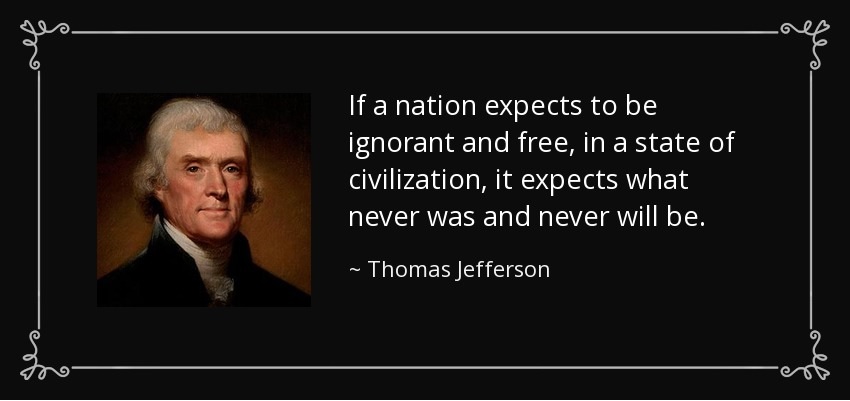
'If a nation expects to be ignorant and free, in a state of civilization, it expects what never was and never will be'
, do you suppose that most educational reformers today are more likely to heed those two warnings, or treat them as threats to their reforms? The reason why Fichte wanted to use a more scientific approach to education that "...completely destroys freedom of will...", the reason why Dewey proposed the aim of "Teaching how to think, not what to think" while ensuring schools rid themselves of materials which thoughts worth thinking might accidentally develop from, the reason why DEI trains everyone into the guilt of systemic racism, is to raise up a safe and useful populace who're full of relevant information but unfit for either freedom or civilization, and devoid of any wider knowledge that would interfere with their ability to serve 'those who know best', in a state ruled over by themselves, for the greater good.

... is the definition of insanity
How anyone expects our youths today to demonstrate an education's important secondary effects: civility, manners and morality, without their cause: an understanding of what those are and the knowledge of how and why they should be central to your life, is beyond me, but that - seeking effects without causes - is a hallmark of modernist pro-regressive thinking, and you should not forget that the effects of past education reforms are all around us today. When we encounter rude, uncivil, even brutally violent behavior, that is the harvest of past school reforms that we're reaping. Those are the ideals that 'decolonizing' our libraries have been aiming at - people who've never learned what civilized behavior entails are not going to behave in a civilized manner when it matters, let alone as Westerners or as Americans - and what kind of mind expects accomplishments such as that to come from nothing?

The answer to that, of course, is that they are the kind of minds and ideals who, since Rousseau, have extolled the 'noble savage' to us because they don't think of The West, or of America, as being worthwhile accomplishments. While that is (or at least should be) sickening and disturbing, it shouldn't be all that surprising, but what should be at least as surprising and even more disturbing, is how any of us ever imagined that some other outcome than the anti-Western and anti-American beliefs and behaviors that we are facing today, would follow from educating our youths minds, with such ideals as those from those minds? It should be no surprise that savage behavior follows from those who've been taught to revere the 'noble savage' - it's only natural - and yet we do behave as if we are surprised by it. Whether through tuition or taxes, we pay, and even go into debt in order to teach our students wrongs as rights, we fund 'scholarly efforts' to portray pure ugliness as a nuanced form of literary appreciation (such as this paper on a barbaric poet of hate, by my current troll, a he/him/his 'gradual student' who teaches Drama to students at the University of Washington), which is taught to our K-12 & college students as being worthy of their admiration, and then we are somehow shocked that our colleges graduate wave after wave of students who are sympathetically aligned with Antifa & BLM rioting in our streets, and who help to spread the mentally and spiritually twisted messaging of groomers in our classrooms.

What is truly unnatural, is our expecting that a course of training which ridicules the idea of objective truth, exalts utilitarian thinking skills, derides wisdom, and holds up tyranny as an ideological ideal, could lead to something other than cleverer devils for us to contend with when societal frictions bring us face to face with the inner barbarian that we've awarded them diplomas and degrees for cultivating. Such 'scholarly' cleverness is in some ways worse than enslavement, as a slave can still recognize, admire, and yearn for what is good, beautiful, and true, while those who've been 'educated' into appreciating such a state of lies are unlikely to even attempt to escape the ideas that bind them. The barbarians outside our gates have become less of a concern to our life, liberty, and happiness, than the native-born barbarian hordes that we're going into debt to 'educate!' alongside us within those gates.

To repeat myself yet again, the skills and facts which are needed to get an education, are not the equivalent of one, and confusing the two - perhaps modern education's most pernicious notion - is not just an ancillary error, it entails abandoning and subverting education's actual purpose, that being to improve the student's grasp of how best to be human - to be an informed, virtuous person, capable of thinking reasonably, and able to live a life worth living in liberty and society with their fellows. But 'education reform!' is and always has been about reforming us into something very different from that, something empty of, and hostile to that, and whatever pretext is used to justify the reform with - whether that be to improve civic understanding, achieve economic success, beat the Russians, etc., - means using state power (even with private and church schools) to transform our youth into the material means of serving those other ends (to the tune of tens of thousands of dollars per child) - we need to learn how to avoid doing such things 'with the best of intentions'.

Because of the good intentions of the past 200 years of education reforms, many of our kids today fail to learn even their 3Rs in the establishment schools (public, private, and church) which take charge of their lives for twice as long per year, and for four more years than pre-reform schools thought necessary. Additionally, most of those students graduate with a barren internal landscape, and even as the popularity of Marvel, DC, and Star Wars 'universes' demonstrate their thirst for meaningful stories in their lives, the cultural stories that arguably form much of an education's greatest value - the knowledge of how to find your place in, and successfully navigate through life - play little or no part in their 'education' (see 'The Story Killers'). As a result of the modern progressive education's 'hunter-gatherer' approach to cramming 'key facts' & skills into short-term memory, the lives and minds of our leading people today truly lack a worldview within them that's worth viewing anything from - it adds little or nothing to their inner life to make their lives more endurable, enjoyable, and meaningful, and provides them with no worthwhile perspective for understanding the world and their place within it.

One thing we can say for sure about education reform is that it has undoubtedly worked - it is how we've come to accomplish so much less, with so much more. Unfortunately, of course, saying that has been a good thing, would be an especially ugly lie - our education today alienates us from both who we are, and from who we should be. Amazingly, we continue to employ it, even today, while expecting different results - how does repeatedly doing the same thing while expecting different results, differ from what they say is the definition of insanity? On the bright side, our history provides us with enough examples of these reforms that their pattern is easy enough to spot, and if we can do so before our own good intentions are turned against us once again, that'd be one lesson of history that a brighter future could come from learning. We'll take a closer look at that, in the next post.

Monday, July 04, 2022

Calvin Coolidge, Thomas Jefferson, James Otis, and remembering how dependent our Constitution & America is, upon our understanding of our Declaration of Independence!

Two points before getting to my annual reposting of Calvin Coolidge's speech on the "Inspiration of our Declaration of Independence", and to the Declaration itself- the first, which I went into a little bit of detail here, is that the Declaration of Independence is the vehicle through which we become one people, Americans, and that it's inheritance is not one of blood, but of ideals. To affirm:
'... these truths to be self-evident, that all men are created equal, that they are endowed by their Creator with certain unalienable Rights, that among these are Life, Liberty and the pursuit of Happiness...'
,is your ticket in to the American body-politic, it is your passport to recite the later phrases with the rest of us, so that 'We The People' are able to form a more perfect union because we do hold these truths to be self-evident. It is how we are made 'e Pluribus Unum - Out of many, One' people, and our diverse origins and differences are transformed into interesting footnotes to our lives, rather than defining - or dividing - features of them.

The second point, is that our independence wasn't begun on July 4th 1776, that was simply the end of the beginning. And in what seems more terrifyingly clear to me this year of 2022, more than any previous one in my memory, is how central to America that the Declaration of Independence is, and to there being Americans in it, and for either of those to continue on for long into the future.

I'm not talking about each person having a copy of it - the document itself is meaningless and useless without a people who understand it. The Declaration of Independence only came into being in the first place, because there was a people along the eastern seaboard who understood its meaning well before it was written. Thomas Jefferson later commented that he made no attempt to be innovative or 'revolutionary' when writing it, but only that he intended it "... to be an expression of the American mind..." - is it an expression of yours?

John Adams, in the first quotation below, recalled that in his opinion the American Revolution actually began in 1761, when James Otis spoke against the 'Writs of Assistance' to an assembled crowd, calling out a wealth of classical allusions and a sweeping summation of history and of legal gems, which roused all of his listeners through a torrent of eloquence so profound that Adams thought it had sparked the revolution 'then and there'. Otis too expressed only the common content and passions of "the American mind", and so I ask you, if a new James Otis were to speak to us like that today, how many people living here in America would recognize any of what he summarized or recognize why it was important? Would those modern listeners be more likely to be moved by his eloquence... or to shrug it away with a texted 'TLDR' ('Too Long Didn't Read')?

How likely is it that we can long have either America or Americans in it, without the Declaration of Independence being both known and understood by at least a majority of them? And how well can it be understood by a people who've been 'educated' out of any familiarity with that history, its important ideas, and a perspective that values profound truths eloquently expressed?

Don't bother muttering against our schools, they have dropped the ball, intentionally, and they cannot be looked to for help in picking it back up. It's you who needs to do this, beginning with yourself, and counting on no one else to fill the contents of your own mind with what it has until now lacked. The internet is open to you, and I've provide the links you need here to get started. You and no one else are responsible, for America continuing to be populated with Americans... or at least with one (who can then tell another).

July 4th 1776, was the end of the beginning of America's Independence, it's up to you to ensure that July 4th 2022 isn't the beginning of its end. And to ensure that... you need to start back at the beginning. And where our independence began, according to a fellow that was in attendance at both events, John Adams, was when James Otis spoke against King George's 'Writs of Assistance' back in 1761, which as Adams recalled it,
",,,But Otis was a flame of fire! With a promptitude of Classical Allusions, a depth of research, a rapid summary of historical events & dates, a profusion of Legal Authorities, a prophetic glance of his eyes into futurity, and a rapid torrent of impetuous Eloquence he hurried away all before him. American Independence was then & there born. The seeds of Patriots & Heroes to defend the Non sine Diis Animosus Infans; to defend the Vigorous Youth were then & there sown. Every Man of an immense crouded Audience appeared to me to go away, as I did, ready to take Arms against Writs of Assistants. Then and there was the first scene of the first Act of opposition to the Arbitrary claims of Great Britain. Then and there the Child Independence was born. In fifteen years i.e. in 1776. he grew up to Manhood, & declared himself free.,,,"[emphasis mine]
I point that out, because it underlines the importance of what is perhaps most remarkable about what the Declaration of Independence's author, Thomas Jefferson, considered to be the least remarkable aspect of it - that he intended the Declaration as an expression of ideas that were familiar and commonly understood, by the majority of Americans, of that time, as Jefferson wrote to a friend in later years, about what it was meant to accomplish:
"Neither aiming at originality of principle or sentiment, nor yet copied from any particular and previous writing, it was intended to be an expression of the American mind, and to give to that expression the proper tone and spirit called for by the occasion. All its authority rests then on the harmonizing sentiments of the day, whether expressed in conversation, in letters, printed essays, or in the elementary books of public right, as Aristotle, Cicero, Locke, Sidney, &c..."
That is why we are unique in the annals of human history, as being a nation founded upon ideas (those twits mouthing on about 'inherent American anti-intellectualism' can kiss my patriotic ass). And those common ideas, and their influence, continued to serve as strong guides for the later creation of our Constitution, can be easily found in even a cursory reading, between the charges of the Declaration of Independence against King George, and their reflection in our Constitution and the amendments to it, and ...
"To prove this, let Facts be submitted to a candid World."
"But when a long train of abuses and usurpations, pursuing invariably the same Object evinces a design to reduce them under absolute Despotism, it is their right, it is their duty, to throw off such Government, and to provide new Guards for their future security."
"HE has made Judges dependent on his Will alone, for the Tenure of their Offices, and the Amount and Payment of their Salaries."
  • The first three articles of our Constitution, divides Govt into three branches, which prevent any one person or wing from attaining a monopoly of power over the others.
"HE has erected a Multitude of new Offices, and sent hither Swarms of Officers to harrass our People, and eat out their Substance."
  • This is what our Constitution was expressly designed to forbid, which unfortunately is what the pro-regressive Administrative State, was erected upon it to encourage (as was our politically instituted educational system) - proof that Laws that do not live in the hearts and minds of the people, cannot protect them against themselves
"HE has kept among us, in Times of Peace, Standing Armies, without the consent of our Legislatures. HE has affected to render the Military independent of and superior to the Civil Power."
  • Congress has control of organizing and funding the military budget, and while the Executive has command of the military, he can not do much, for long, without the further consent of the people's representatives, and in all ways, the military is under civil control.
"FOR quartering large Bodies of Armed Troops among us"
"FOR protecting them, by a mock Trial, from Punishment for any Murders which they should commit on the Inhabitants of these States"
"FOR cutting off our Trade with all Parts of the World"
"FOR imposing Taxes on us without our Consent:
"FOR depriving us, in many Cases, of the Benefits of Trial by Jury"
, and if you take the time to read both, you will find many, many, more points of harmony between the two.

But enough, onto Calvin Coolidge's speech, and a happy Independence Day to you all!

The Inspiration of the Declaration of Independence
Given in Philadelphia, Pennsylvania on July 5, 1926:

President Calvin Coolidge
We meet to celebrate the birthday of America. The coming of a new life always excites our interest. Although we know in the case of the individual that it has been an infinite repetition reaching back beyond our vision, that only makes it the more wonderful. But how our interest and wonder increase when we behold the miracle of the birth of a new nation. It is to pay our tribute of reverence and respect to those who participated in such a mighty event that we annually observe the fourth day of July. Whatever may have been the impression created by the news which went out from this city on that summer day in 1776, there can be no doubt as to the estimate which is now placed upon it. At the end of 150 years the four corners of the earth unite in coming to Philadelphia as to a holy shrine in grateful acknowledgment of a service so great, which a few inspired men here rendered to humanity, that it is still the preeminent support of free government throughout the world.

Although a century and a half measured in comparison with the length of human
experience is but a short time, yet measured in the life of governments and nations it ranks as a very respectable period. Certainly enough time has elapsed to demonstrate with a great deal of thoroughness the value of our institutions and their dependability as rules for the regulation of human conduct and the advancement of civilization. They have been in existence long enough to become very well seasoned. They have met, and met successfully, the test of experience.

It is not so much then for the purpose of undertaking to proclaim new theories and principles that this annual celebration is maintained, but rather to reaffirm and reestablish those old theories and principles which time and the unerring logic of events have demonstrated to be sound. Amid all the clash of conflicting interests, amid all the welter of partisan politics, every American can turn for solace and consolation to the Declaration of independence and the Constitution of the United States with the assurance and confidence that those two great charters of freedom and justice remain firm and unshaken. Whatever perils appear, whatever dangers threaten, the Nation remains secure in the knowledge that the ultimate application of the law of the land will provide an adequate defense and protection.

It is little wonder that people at home and abroad consider Independence Hall as hallowed ground and revere the Liberty Bell as a sacred relic. That pile of bricks and mortar, that mass of metal, might appear to the uninstructed as only the outgrown meeting place and the shattered bell of a former time, useless now because of more modern conveniences, but to those who know they have become consecrated by the use which men have made of them. They have long been identified with a great cause. They are the framework of a spiritual event. The world looks upon them, because of their associations of one hundred and fifty years ago, as it looks upon the Holy Land because of what took place there nineteen hundred years ago. Through use for a righteous purpose they have become sanctified.

It is not here necessary to examine in detail the causes which led to the American Revolution. In their immediate occasion they were largely economic. The colonists objected to the navigation laws which interfered with their trade, they denied the power of Parliament to impose taxes which they were obliged to pay, and they therefore resisted the royal governors and the royal forces which were sent to secure obedience to these laws. But the conviction is inescapable that a new civilization had come, a new spirit had arisen on this side of the Atlantic more advanced and more developed in its regard for the rights of the individual than that which characterized the Old World. Life in a new and open country had aspirations which could not be realized in any subordinate position. A separate establishment was ultimately inevitable. It had been decreed by the very laws of human nature. Man everywhere has an unconquerable desire to be the master of his own destiny.

We are obliged to conclude that the Declaration of Independence represented the movement of a people. It was not, of course, a movement from the top. Revolutions do not come from that direction. It was not without the support of many of the most respectable people in the Colonies, who were entitled to all the consideration that is given to breeding, education, and possessions. It had the support of another element of great significance and importance to which I shall later refer. But the preponderance of all those who occupied a position which took on the aspect of aristocracy did not approve of the Revolution and held toward it an attitude either of neutrality or open hostility. It was in no sense a rising of the oppressed and downtrodden. It brought no scum to the surface, for the reason that colonial society had developed no scum. The great body of the people were accustomed to privations, but they were free from depravity. If they had poverty, it was not of the hopeless kind that afflicts great cities, but the inspiring kind that marks the spirit of the pioneer. The American Revolution represented the informed and mature convictions of a great mass of independent, liberty-loving, God-fearing people who knew their rights, and possessed the courage to dare to maintain them. The Continental Congress was not only composed of great men, but it represented a great people. While its members did not fail to exercise a remarkable leadership, they were equally observant of their representative capacity. They were industrious in encouraging their constituents to instruct them to support independence. But until such instructions were given they were inclined to withhold action.

While North Carolina has the honor of first authorizing its delegates to concur with other Colonies in declaring independence, it was quickly followed by South Carolina and Georgia, which also gave general instructions broad enough to include such action. But the first instructions which unconditionally directed its delegates to declare for independence came from the great Commonwealth of Virginia. These were immediately followed by Rhode Island and Massachusetts, while the other Colonies, with the exception of New York, soon adopted a like course.

This obedience of the delegates to the wishes of their constituents, which in some cases caused them to modify their previous positions, is a matter of great significance. It reveals an orderly process of government in the first place; but more than that, it demonstrates that the Declaration of Independence was the result of the seasoned and deliberate thought of the dominant portion of the people of the Colonies. Adopted after long discussion and as the result of the duly authorized expression of the preponderance of public opinion, it did not partake of dark intrigue or hidden conspiracy. It was well advised. It had about it nothing of the lawless and disordered nature of a riotous insurrection. It was maintained on a plane which rises above the ordinary conception of rebellion. It was in no sense a radical movement but took on the dignity of a resistance to illegal usurpations. It was conservative and represented the action of the colonists to maintain their constitutional rights which from time immemorial had been guaranteed to them under the law of the land.

When we come to examine the action of the Continental Congress in adopting the Declaration of Independence in the light of what was set out in that great document and in the light of succeeding events, we can not escape the conclusion that it had a much broader and deeper significance than a mere secession of territory and the establishment of a new nation. Events of that nature have been taking place since the dawn of history. One empire after another has arisen, only to crumble away as its constituent parts separated from each other and set up independent governments of their own. Such actions long ago became commonplace. They have occurred too often to hold the attention of the world and command the admiration and reverence of humanity. There is something beyond the establishment of a new nation, great as that event would be, in the Declaration of Independence which has ever since caused it to be regarded as one of the great charters that not only was to liberate America but was everywhere to ennoble humanity.

It was not because it was proposed to establish a new nation, but because it was proposed to establish a nation on new principles, that July 4, 1776, has come to be regarded as one of the greatest days in history. Great ideas do not burst upon the world unannounced. They are reached by a gradual development over a length of time usually proportionate to their importance. This is especially true of the principles laid down in the Declaration of Independence. Three very definite propositions were set out in its preamble regarding the nature of mankind and therefore of government. These were the doctrine that all men are created equal, that they are endowed with certain inalienable rights, and that therefore the source of the just powers of government must be derived from the consent of the governed.

If no one is to be accounted as born into a superior station, if there is to be no ruling class, and if all possess rights which can neither be bartered away nor taken from them by any earthly power, it follows as a matter of course that the practical authority of the Government has to rest on the consent of the governed. While these principles were not altogether new in political action, and were very far from new in political speculation, they had never been assembled before and declared in such a combination. But remarkable as this may be, it is not the chief distinction of the Declaration of Independence. The importance of political speculation is not to be under-estimated, as I shall presently disclose. Until the idea is developed and the plan made there can be no action.

It was the fact that our Declaration of Independence containing these immortal truths was the political action of a duly authorized and constituted representative public body in its sovereign capacity, supported by the force of general opinion and by the armies of Washington already in the field, which makes it the most important civil document in the world. It was not only the principles declared, but the fact that therewith a new nation was born which was to be founded upon those principles and which from that time forth in its development has actually maintained those principles, that makes this pronouncement an incomparable event in the history of government. It was an assertion that a people had arisen determined to make every necessary sacrifice for the support of these truths and by their practical application bring the War of Independence to a successful conclusion and adopt the Constitution of the United States with all that it has meant to civilization.

The idea that the people have a right to choose their own rulers was not new in political history. It was the foundation of every popular attempt to depose an undesirable king. This right was set out with a good deal of detail by the Dutch when as early as July 26, 1581, they declared their independence of Philip of Spain. In their long struggle with the Stuarts the British people asserted the same principles, which finally culminated in the Bill of Rights deposing the last of that house and placing William and Mary on the throne. In each of these cases sovereignty through divine right was displaced by sovereignty through the consent of the people. Running through the same documents, though expressed in different terms, is the clear inference of inalienable rights. But we should search these charters in vain for an assertion of the doctrine of equality. This principle had not before appeared as an official political declaration of any nation. It was profoundly revolutionary. It is one of the corner stones of American institutions.

But if these truths to which the declaration refers have not before been adopted in their combined entirety by national authority, it is a fact that they had been long pondered and often expressed in political speculation. It is generally assumed that French thought had some effect upon our public mind during Revolutionary days. This may have been true. But the principles of our declaration had been under discussion in the Colonies for nearly two generations before the advent of the French political philosophy that characterized the middle of the eighteenth century. In fact, they come from an earlier date. A very positive echo of what the Dutch had done in 1581, and what the English were preparing to do, appears in the assertion of the Rev. Thomas Hooker of Connecticut as early as 1638, when he said in a sermon before the General Court that:
The foundation of authority is laid in the free consent of the people

The choice of public magistrates belongs unto the people by God's own allowance.

This doctrine found wide acceptance among the nonconformist clergy who later made up the Congregational Church. The great apostle of this movement was the Rev. John Wise, of Massachusetts. He was one of the leaders of the revolt against the royal governor Andros in 1687, for which he suffered imprisonment. He was a liberal in ecclesiastical controversies. He appears to have been familiar with the writings of the political scientist, Samuel Pufendorf, who was born in Saxony in 1632. Wise published a treatise, entitled "The Church's Quarrel Espoused," in 1710 which was amplified in another publication in 1717. In it he dealt with the principles of civil government. His works were reprinted in 1772 and have been declared to have been nothing less than a textbook of liberty for our Revolutionary fathers.

While the written word was the foundation, it is apparent that the spoken word was the vehicle for convincing the people. This came with great force and wide range from the successors of Hooker and Wise, It was carried on with a missionary spirit which did not fail to reach the Scotch Irish of North Carolina, showing its influence by significantly making that Colony the first to give instructions to its delegates looking to independence. This preaching reached the neighborhood of Thomas Jefferson, who acknowledged that his "best ideas of democracy" had been secured at church meetings.

That these ideas were prevalent in Virginia is further revealed by the Declaration of Rights, which was prepared by George Mason and presented to the general assembly on May 27, 1776. This document asserted popular sovereignty and inherent natural rights, but confined the doctrine of equality to the assertion that "All men are created equally free and independent". It can scarcely be imagined that Jefferson was unacquainted with what had been done in his own Commonwealth of Virginia when he took up the task of drafting the Declaration of Independence. But these thoughts can very largely be traced back to what John Wise was writing in 1710. He said, "Every man must be acknowledged equal to every man". Again, "The end of all good government is to cultivate humanity and promote the happiness of all and the good of every man in all his rights, his life, liberty, estate, honor, and so forth . . . ." And again, "For as they have a power every man in his natural state, so upon combination they can and do bequeath this power to others and settle it according as their united discretion shall determine". And still again, "Democracy is Christ's government in church and state". Here was the doctrine of equality, popular sovereignty, and the substance of the theory of inalienable rights clearly asserted by Wise at the opening of the eighteenth century, just as we have the principle of the consent of the governed stated by Hooker as early as 1638.

When we take all these circumstances into consideration, it is but natural that the first paragraph of the Declaration of Independence should open with a reference to Nature's God and should close in the final paragraphs with an appeal to the Supreme Judge of the world and an assertion of a firm reliance on Divine Providence. Coming from these sources, having as it did this background, it is no wonder that Samuel Adams could say "The people seem to recognize this resolution as though it were a decree promulgated from heaven."

No one can examine this record and escape the conclusion that in the great outline of its principles the Declaration was the result of the religious teachings of the preceding period. The profound philosophy which Jonathan Edwards applied to theology, the popular preaching of George Whitefield, had aroused the thought and stirred the people of the Colonies in preparation for this great event. No doubt the speculations which had been going on in England, and especially on the Continent, lent their influence to the general sentiment of the times. Of course, the world is always influenced by all the experience and all the thought of the past. But when we come to a contemplation of the immediate conception of the principles of human relationship which went into the Declaration of Independence we are not required to extend our search beyond our own shores. They are found in the texts, the sermons, and the writings of the early colonial clergy who were earnestly undertaking to instruct their congregations in the great mystery of how to live. They preached equality because they believed in the fatherhood of God and the brotherhood of man. They justified freedom by the text that we are all created in the divine image, all partakers of the divine spirit.

Placing every man on a plane where he acknowledged no superiors, where no one possessed any right to rule over him, he must inevitably choose his own rulers through a system of self-government. This was their theory of democracy. In those days such doctrines would scarcely have been permitted to flourish and spread in any other country. This was the purpose which the fathers cherished. In order that they might have freedom to express these thoughts and opportunity to put them into action, whole congregations with their pastors had migrated to the colonies. These great truths were in the air that our people breathed. Whatever else we may say of it, the Declaration of Independence was profoundly American.

If this apprehension of the facts be correct, and the documentary evidence would appear to verify it, then certain conclusions are bound to follow. A spring will cease to flow if its source be dried up; a tree will wither if its roots be destroyed. In its main features the Declaration of Independence is a great spiritual document. It is a declaration not of material but of spiritual conceptions. Equality, liberty, popular sovereignty, the rights of man these are not elements which we can see and touch. They are ideals. They have their source and their roots in the religious convictions. They belong to the unseen world. Unless the faith of the American people in these religious convictions is to endure, the principles of our Declaration will perish. We can not continue to enjoy the result if we neglect and abandon the cause.

We are too prone to overlook another conclusion. Governments do not make ideals, but ideals make governments. This is both historically and logically true. Of course the government can help to sustain ideals and can create institutions through which they can be the better observed, but their source by their very nature is in the people. The people have to bear their own responsibilities. There is no method by which that burden can be shifted to the government. It is not the enactment, but the observance of laws, that creates the character of a nation.

About the Declaration there is a finality that is exceedingly restful. It is often asserted that the world has made a great deal of progress since 1776, that we have had new thoughts and new experiences which have given us a great advance over the people of that day, and that we may therefore very well discard their conclusions for something more modern. But that reasoning can not be applied to this great charter. If all men are created equal, that is final. If they are endowed with inalienable rights, that is final. If governments derive their just powers from the consent of the governed, that is final. No advance, no progress can be made beyond these propositions. If anyone wishes to deny their truth or their soundness, the only direction in which he can proceed historically is not forward, but backward toward the time when there was no equality, no rights of the individual, no rule of the people. Those who wish to proceed in that direction can not lay claim to progress. They are reactionary. Their ideas are not more modern, but more ancient, than those of the Revolutionary fathers.

In the development of its institutions America can fairly claim that it has remained true to the principles which were declared 150 years ago. In all the essentials we have achieved an equality which was never possessed by any other people. Even in the less important matter of material possessions we have secured a wider and wider distribution of wealth. The rights of the individual are held sacred and protected by constitutional guaranties, which even the Government itself is bound not to violate. If there is any one thing among us that is established beyond question, it is self government; the right of the people to rule. If there is any failure in respect to any of these principles, it is because there is a failure on the part of individuals to observe them. We hold that the duly authorized expression of the will of the people has a divine sanction. But even in that we come back to the theory of John Wise that "Democracy is Christ's government". The ultimate sanction of law rests on the righteous authority of the Almighty.

On an occasion like this a great temptation exists to present evidence of the practical success of our form of democratic republic at home and the ever broadening acceptance it is securing abroad. Although these things are well known, their frequent consideration is an encouragement and an inspiration. But it is not results and effects so much as sources and causes that I believe it is even more necessary constantly to contemplate. Ours is a government of the people. It represents their will. Its officers may sometimes go astray, but that is not a reason for criticizing the principles of our institutions. The real heart of the American Government depends upon the heart of the people. It is from that source that we must look for all genuine reform. It is to that cause that we must ascribe all our results.

It was in the contemplation of these truths that the fathers made their declaration and adopted their Constitution. It was to establish a free government, which must not be permitted to degenerate into the unrestrained authority of a mere majority or the unbridled weight of a mere influential few. They undertook the balance these interests against each other and provide the three separate independent branches, the executive, the legislative, and the judicial departments of the Government, with checks against each other in order that neither one might encroach upon the other. These are our guaranties of liberty. As a result of these methods enterprise has been duly protected from confiscation, the people have been free from oppression, and there has been an ever broadening and deepening of the humanities of life.

Under a system of popular government there will always be those who will seek for political preferment by clamoring for reform. While there is very little of this which is not sincere, there is a large portion that is not well informed. In my opinion very little of just criticism can attach to the theories and principles of our institutions. There is far more danger of harm than there is hope of good in any radical changes. We do need a better understanding and comprehension of them and a better knowledge of the foundations of government in general. Our forefathers came to certain conclusions and decided upon certain courses of action which have been a great blessing to the world. Before we can understand their conclusions we must go back and review the course which they followed. We must think the thoughts which they thought. Their intellectual life centered around the meeting-house. They were intent upon religious worship. While there were always among them men of deep learning, and later those who had comparatively large possessions, the mind of the people was not so much engrossed in how much they knew, or how much they had, as in how they were going to live. While scantily provided with other literature, there was a wide acquaintance with the Scriptures. Over a period as great as that which measures the existence of our independence they were subject to this discipline not only in their religious life and educational training, but also in their political thought. They were a people who came under the influence of a great spiritual development and acquired a great moral power.

No other theory is adequate to explain or comprehend the Declaration of Independence. It is the product of the spiritual insight of the people. We live in an age of science and of abounding accumulation of material things. These did not create our Declaration. Our Declaration created them. The things of the spirit come first. Unless we cling to that, all our material prosperity, overwhelming though it may appear, will turn to a barren scepter in our grasp. If we are to maintain the great heritage which has been bequeathed to us, we must be like minded as the fathers who created it. We must not sink into a pagan materialism. We must cultivate the reverence which they had for the things that are holy. We must follow the spiritual and moral leadership which they showed. We must keep replenished, that they may glow with a more compelling flame, the altar fires before which they worshiped.

***************
Happy Independence Day America! **************************

In Congress, July 4, 1776.

The unanimous Declaration of the thirteen united States of America, When in the Course of human events, it becomes necessary for one people to dissolve the political bands which have connected them with another, and to assume among the powers of the earth, the separate and equal station to which the Laws of Nature and of Nature's God entitle them, a decent respect to the opinions of mankind requires that they should declare the causes which impel them to the separation.
We hold these truths to be self-evident, that all men are created equal, that they are endowed by their Creator with certain unalienable Rights, that among these are Life, Liberty and the pursuit of Happiness.--That to secure these rights, Governments are instituted among Men, deriving their just powers from the consent of the governed, --That whenever any Form of Government becomes destructive of these ends, it is the Right of the People to alter or to abolish it, and to institute new Government, laying its foundation on such principles and organizing its powers in such form, as to them shall seem most likely to effect their Safety and Happiness. Prudence, indeed, will dictate that Governments long established should not be changed for light and transient causes; and accordingly all experience hath shewn, that mankind are more disposed to suffer, while evils are sufferable, than to right themselves by abolishing the forms to which they are accustomed. But when a long train of abuses and usurpations, pursuing invariably the same Object evinces a design to reduce them under absolute Despotism, it is their right, it is their duty, to throw off such Government, and to provide new Guards for their future security.--Such has been the patient sufferance of these Colonies; and such is now the necessity which constrains them to alter their former Systems of Government. The history of the present King of Great Britain is a history of repeated injuries and usurpations, all having in direct object the establishment of an absolute Tyranny over these States. To prove this, let Facts be submitted to a candid world.
He has refused his Assent to Laws, the most wholesome and necessary for the public good.
He has forbidden his Governors to pass Laws of immediate and pressing importance, unless suspended in their operation till his Assent should be obtained; and when so suspended, he has utterly neglected to attend to them.
He has refused to pass other Laws for the accommodation of large districts of people, unless those people would relinquish the right of Representation in the Legislature, a right inestimable to them and formidable to tyrants only.
He has called together legislative bodies at places unusual, uncomfortable, and distant from the depository of their public Records, for the sole purpose of fatiguing them into compliance with his measures.
He has dissolved Representative Houses repeatedly, for opposing with manly firmness his invasions on the rights of the people.
He has refused for a long time, after such dissolutions, to cause others to be elected; whereby the Legislative powers, incapable of Annihilation, have returned to the People at large for their exercise; the State remaining in the mean time exposed to all the dangers of invasion from without, and convulsions within.
He has endeavoured to prevent the population of these States; for that purpose obstructing the Laws for Naturalization of Foreigners; refusing to pass others to encourage their migrations hither, and raising the conditions of new Appropriations of Lands.
He has obstructed the Administration of Justice, by refusing his Assent to Laws for establishing Judiciary powers.
He has made Judges dependent on his Will alone, for the tenure of their offices, and the amount and payment of their salaries.
He has erected a multitude of New Offices, and sent hither swarms of Officers to harrass our people, and eat out their substance.
He has kept among us, in times of peace, Standing Armies without the Consent of our legislatures.
He has affected to render the Military independent of and superior to the Civil power.
He has combined with others to subject us to a jurisdiction foreign to our constitution, and unacknowledged by our laws; giving his Assent to their Acts of pretended Legislation:
For Quartering large bodies of armed troops among us:
For protecting them, by a mock Trial, from punishment for any Murders which they should commit on the Inhabitants of these States:
For cutting off our Trade with all parts of the world:
For imposing Taxes on us without our Consent:
For depriving us in many cases, of the benefits of Trial by Jury:
For transporting us beyond Seas to be tried for pretended offences
For abolishing the free System of English Laws in a neighbouring Province, establishing therein an Arbitrary government, and enlarging its Boundaries so as to render it at once an example and fit instrument for introducing the same absolute rule into these Colonies:
For taking away our Charters, abolishing our most valuable Laws, and altering fundamentally the Forms of our Governments:
For suspending our own Legislatures, and declaring themselves invested with power to legislate for us in all cases whatsoever.
He has abdicated Government here, by declaring us out of his Protection and waging War against us.
He has plundered our seas, ravaged our Coasts, burnt our towns, and destroyed the lives of our people.
He is at this time transporting large Armies of foreign Mercenaries to compleat the works of death, desolation and tyranny, already begun with circumstances of Cruelty & perfidy scarcely paralleled in the most barbarous ages, and totally unworthy the Head of a civilized nation.
He has constrained our fellow Citizens taken Captive on the high Seas to bear Arms against their Country, to become the executioners of their friends and Brethren, or to fall themselves by their Hands.
He has excited domestic insurrections amongst us, and has endeavoured to bring on the inhabitants of our frontiers, the merciless Indian Savages, whose known rule of warfare, is an undistinguished destruction of all ages, sexes and conditions.
In every stage of these Oppressions We have Petitioned for Redress in the most humble terms: Our repeated Petitions have been answered only by repeated injury. A Prince whose character is thus marked by every act which may define a Tyrant, is unfit to be the ruler of a free people.
Nor have We been wanting in attentions to our Brittish brethren. We have warned them from time to time of attempts by their legislature to extend an unwarrantable jurisdiction over us. We have reminded them of the circumstances of our emigration and settlement here. We have appealed to their native justice and magnanimity, and we have conjured them by the ties of our common kindred to disavow these usurpations, which, would inevitably interrupt our connections and correspondence. They too have been deaf to the voice of justice and of consanguinity. We must, therefore, acquiesce in the necessity, which denounces our Separation, and hold them, as we hold the rest of mankind, Enemies in War, in Peace Friends.
We, therefore, the Representatives of the united States of America, in General Congress, Assembled, appealing to the Supreme Judge of the world for the rectitude of our intentions, do, in the Name, and by Authority of the good People of these Colonies, solemnly publish and declare, That these United Colonies are, and of Right ought to be Free and Independent States; that they are Absolved from all Allegiance to the British Crown, and that all political connection between them and the State of Great Britain, is and ought to be totally dissolved; and that as Free and Independent States, they have full Power to levy War, conclude Peace, contract Alliances, establish Commerce, and to do all other Acts and Things which Independent States may of right do. And for the support of this Declaration, with a firm reliance on the protection of divine Providence, we mutually pledge to each other our Lives, our Fortunes and our sacred Honor.

Georgia
Button Gwinnett
Lyman Hall
George Walton

North Carolina
William Hooper
Joseph Hewes
John Penn

South Carolina
Edward Rutledge
Thomas Heyward, Jr.
Thomas Lynch, Jr.
Arthur Middleton

Massachusetts
John Hancock

Maryland
Samuel Chase
William Paca
Thomas Stone
Charles Carroll of Carrollton

Virginia
George Wythe
Richard Henry Lee
Thomas Jefferson
Benjamin Harrison
Thomas Nelson, Jr.
Francis Lightfoot Lee
Carter Braxton

Pennsylvania
Robert Morris
Benjamin Rush
Benjamin Franklin
John Morton
George Clymer
James Smith
George Taylor
James Wilson
George Ross

Delaware
Caesar Rodney
George Read
Thomas McKean

New York
William Floyd
Philip Livingston
Francis Lewis
Lewis Morris

New Jersey
Richard Stockton
John Witherspoon
Francis Hopkinson
John Hart
Abraham Clark

New Hampshire
Josiah Bartlett
William Whipple

Massachusetts
Samuel Adams
John Adams
Robert Treat Paine
Elbridge Gerry

Rhode Island
Stephen Hopkins
William Ellery

Connecticut
Roger Sherman
Samuel Huntington
William Williams
Oliver Wolcott

New Hampshire
Matthew Thornton