Showing posts with label Frederick Douglass. Show all posts

Monday, March 14, 2022

Our Founder's wrong turn towards Education today - The New Normal

American's changing understanding of what 'education' is and is for, has changed us from being a people who were literate enough for The Federalist Papers to be written for persuading the common farmer and 'man in the street' on adopting a constitution to secure their liberty, to a people who in far too many cases would rather argue that liberty requires making crude and pornographic materials available to students in the libraries of schools whose graduates are largely unwilling or unable to read The Federalist Papers (see initial post). Such radically different effects are the result of radically different causes, both seen and unseen, and the largest difference that's easiest to see, is that the educational success of early America came without any official educational system to cause it, while its current effects have resulted from a new system of education having been imposed where none had been before, in order to accomplish what had already been accomplished without one.

Can it be fixed simply by ending our public education system? Nope. As much as we do need to end it, and as much as we need to see a Separation of School & State, if what you want is to make education educational again, which I do, then no, that alone isn't going to fix what's been broken. Why? Because the unseen changes behind what our schools do and why they do it, are more significant than those that are so easily seen in which entity runs & funds a school - public, private, charter, or church - and so simply pulling your kid out of one instance, and putting them into another, is no guarantee that they'll get a good or even better, education.

Or maybe you hadn't noticed that our most barbaric antifa & blm activists tend to be the products of (expensive) private education and graduate from, or teach at, the likes of Berkeley and Harvard?
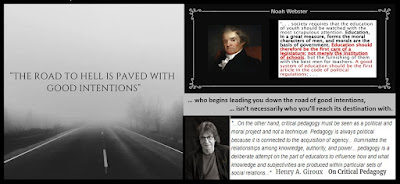
Because our schools today, public, private, charter and church, are staffed and run by 'education professionals' who've graduated from the same teachers colleges which largely teach the same radical leftist views on education, when you choose a school based mainly upon who runs & funds it, what you're most likely to find is that the private sector school will be managed more efficiently and use *better* materials, which means that your student's mind will be more efficiently injected with a purer form of the same poisonous ideas that the public schools are promoting. Say hello to Berkeley and Harvard.

The previous post went into what's changed in what we mean by Education itself, and which content we once knew was best for facilitating it, and that the inadequate new understandings of both had largely been institutionalized, and were self-evident to those who knew better, before the 20th Century even got underway. What enabled those changes to come about, came from a new purpose that had been adopted for education, which led to abandoning its traditional content, and introduced a new normal that has been accepted so completely, that few today even know that there once was an 'old normal', let alone how different the two are. That new normal has ensured that radically different outcomes would begin to follow from what had been the norm in our Founders era, and that shift had essentially been accomplished even before the 19th Century got underway.

Education's 'new normal' was encouraged and promoted by some of our most respected Founding Fathers, such as Noah Webster (yes, the dictionary guy), and it is what is most responsible, IMHO, for why our idea of Education was able to be changed into the worthless sham it has become today, and while Common Core & CRT are the most visible outgrowths of these changes, the new normal is a pervasive but mostly unseen presence in most schools today, *woke* or not, and it is one of the most significant reasons why the more easily seen differences of who it is that runs & funds a school - public, private, charter, or church - is the least telling aspect of what students will be taught in them, because the new norm is incorporated into the purposes and content of the most common understanding of education that students will receive in them today.

What might be the most dangerous aspect of the changes that've been made, is that the reasons for making them seem so sensible on the surface; they certainly seemed sensible enough to many of our Founders era who were far more educated than we are, and knowing nothing of the alternatives they seem entirely sensible to so many who are fighting so hard against what's happening in our schools today, unaware that they are repeating the same disastrous calls for reform that led to what they're fighting against today. See if any of these old calls for school reform sound similar to what we hear urged today:
  • to strengthen American's sense of identity,
  • to refocus lessons away from 'wasting time' on useless content,
  • to prove educational value by testing students on what facts they've successfully *learned* (momentarily memorized) about that content
  • teach more useful skills for *today's* workforce to boost the economy!
Those lines for reform began ringing out in our Founders' era, with our Founding Reformers. The one advantage we have over our Founding Fathers, is that, if we look, we can see what has actually resulted from such seemingly sensible ideas and good intentions, and so finally put a stop to repeating the same mistakes of history, it's not enough for us today to simply be upset and demand change, we need to know what we should change to, what changes are most important to make, and we especially need to know what we changed away from, and why they did so - otherwise we'll just continue to pour old wine into new skins.

What is seen, helps to conceal what goes unseen
The visible results of those good intentions are easy to see today in the standardization of schools, lessons, textbooks, and teachers. It's also easy to see that pro-regressive 'Progressive' figures such as Horace Mann played an early role in 'Progressive Education', and that the first mandatory Public School laws of Massachussetts were enacted in the 1840s to manage the public alarm over 'immigrants and other dangerous individuals' flooding into America, by promising that all students would come to have the same understanding of America (or, less charitably, to create a system for imposing conformity to the ideal of 'those who know best'). But those effects were made possible by earlier and more fundamental causes, and while it's true that those were significant turning points, they aren't where the turn towards the education system of today began, those were simply pretexts - easy answers - which capitalized upon, exploited, and repurposed, the changes that had already been put in place.

The radically different effects that we're seeing today, developed out of changes that didn't initially seem as noticeable or radical to them at the time; their progressively more radical nature was slowly revealed in bubbling up through the twists and turns of pursuing and covering for the good intentions that put cracks in the restraints upon power which they encouraged and concealed. It was the unintended consequences which followed from them, that enabled and encouraged still more radical reformers in the likes of Horace Mann, who were later able to take advantage of the good intentions behind mandatory school laws, and through those cracks they infiltrated through various other openings in our existing presumptions, and subverted them towards new ends... and so on, and on. and on,

That progressive process of transformative decay requires and depends upon people settling for easy answers - the more sensible they seem on first glance, the better. And so it's worth it to begin looking at the original good intentions of those good men who were trying to do the right thing with the wrong tools, to see how the results managed to go so very wrong, so that we might avoid yet another round of the endless cycle of sure-to-fail 'school reforms' that've plagued us for the last two centuries.

Although I'm going to focus on Noah Webster, my intention is not to impugn his character, in fact I think that my point becomes stronger, the stronger you think that his character was. Webster was a leading advocate for the importance of seeing to it that all American youth received a 'good education', he saw it as his mission, and he put a great deal of his own time and effort into reminding the public that:
“It is an object of vast magnitude that systems of education should be adopted and pursued which may not only diffuse a knowledge of the sciences but may implant in the minds of the American youth the principles of virtue and of liberty and inspire them with just and liberal ideas of government and with an inviolable attachment to their own country.”
But as good as his statement might sound, then as now, it's important that you define and clarify the terms & premises being presumed for you, for instance: what did he mean by 'a good education', and how do you know that? What was it which guided the purpose of he and his fellows education, and how did that differ from what he intended to alter it to?

Webster didn't just advocate for education, he took it as his mission to create a movement in educating and forming a clearer image for Americans of what it means to be an American. As noted (pg 4) in "The Forgotten Founding Father", when George Washington mentioned that he was considering asking a colleague in Scotland for recommendations for a tutor for his step-grandchildren,
"...A stunned Webster shot back, 'What would European nations think of this country if, after the exibition of great talents and achievements in the war for independence, we should send to Europe for men to teach the first rudiments of learning?"
Noah Webster's own education had acquainted him with those works which Thomas Jefferson had recommended as an essential reading list for students: Homer, Plato, Aristotle, Cicero, The Bible, Virgil, along with a knowledge of Greek & Latin, and yet he was dissatisfied with it, and complained that such literature was "... not necessary for men of business, merchants, mechanics, planters, &c. nor of utility sufficient to indemnify them for the expense...", and that studying them kept them from learning more useful skills. Of the time he himself spent acquiring them himself, he complained:
"...How superficial must be that learning, which is acquired in four years! Severe experience has taught me the errors and defects of what is called a liberal education. I could not read the best Greek and Roman authors while in college, without neglecting the established classical studies ; and after I left college, I found time only to dip into books, that every scholar should be master of; a circumstance that often fills me with the deepest regret...."
A couple questions come to mind from reading his opinion of the content, especially with Webster's own confessed failure to fully grasp the material, as well as his assumption that everyone else's ability must be equally as lacking as his own. It's also interesting that his concern for superficiality doesn't seem to extend to those skills that are likely to be taught by teachers who don't depend upon or use them themselves, which is not only itself superficial, but is the reason why apprenticeships were used in his time, and why they are becoming popular again in ours. But Webster wasn't alone in his opinion, being one of several of our Founders, such as Dr. Benjamin Rush, and Benjamin Franklin, even to some extent Thomas Jefferson, who wanted to 'reform education' to focus upon giving students more utilitarian, practical, and economically useful skills. While not alone in their opinions, they weren't by any means universal, and the reforms they proposed, although largely forgotten today, sparked debates whose sometimes fiery nature we'd recognize something of in our own day, even progressing to public unrest in the mid 1800s.

Yet despite their complaints about the content and purpose for learning it, one thing that didn't yet need to be 'fixed', because the system for learning it had not yet been broken, was that which enables the teaching and learning of everything else: the 3 R's of 'Reading, 'Riting, and 'Rithmatic. Webster and his fellows knew from their own experience that teaching those basics were an important but nearly trivial feat which was routinely accomplished in a few years at most, through the existing materials, and attention to grammar that they were already using.

Even so, Webster, who himself had been a school teacher, thought that it would be enough that each community:
"...should be furnished with a school, at least four months in a year;..."
, and beginning with students around eight years of age, their schooling should be,
"...completed by the age of fifteen or sixteen..."
Two points on that, first, "furnished" by who, is one of the questions that're typically either avoided, or assumed by the reformers to be their ideal systems that didn't yet exist. And second, take note that the reformers were aware that a sound grasp of the basics of the 3 R's (and substantially more than that) was able to be accomplished within about eight 'years' - consisting of school years that were at least half the length of our own today (how those eight half-years, became our twelve full-years, we'll cover in a post to come) - because it was already resulting in students who in making their way through a great deal of literature and history had actually learned how to read, write, and calculate, and most of whom could be counted upon to pursue a wider and deeper understanding of such works on their own, for the rest of their lives. Even so, what our Founding Reformers wanted to change, was how that was already being accomplished, and why, and who would determine it, and that's where we find the foundational cracks beginning to form, and would soon begin forming a system of them.

What seemed to escape our Founding Reformer's attention, is that learning the 3R's from the materials they did, in the manner they did, was an important factor in how the people of our Founder's era, became the people they were. But such an oversight is not that uncommon, historically, and is one of the causes for why the West has had to re-found itself several times over the last few thousand years. It's encouraging that many, such as this modern day Italian, Angelo Codevilla, are reminding people of what we forget about how much the materials we learn with, makes us into who we are (or are not):
"...Any civilization is the totality of the language, habits and ideas in which people live and move – the human reality that defines their practical limits. To see how grossly unequal to one another civilizations are, it is enough to glance at how much or little understanding of reality the languages they speak contain – what any given language enables, or not. We are accustomed to Greek, Latin, English, French, Italian, German, etc. with their massive dictionaries, full of definitions, pronouns, tenses, moods and concepts, all tied together by grammar that flows from logic. When we speak these languages correctly, we hardly realize that we are wielding powerful tools of reason, developed over thousands of years..."
Yet despite the role that traditional literature played in who our Founders became, the general attitude towards literature by those educational reformers amongst them, was akin to what Webster expressed in this complaint, that:
“The minds of youth are perpetually led to the history of Greece and Rome or to Great Britain; boys are constantly repeating the declamations of Demosthenes and Cicero, or debates upon some political question in the British Parliment. These are excellent specimens of good sense, polished stile and perfect oratory; but they are not interesting to children. They cannot be very useful, except to young gentlemen who want them as models of reasoning and eloquence, in the pulpit or at the bar.”
, so that what the traditional learning consisted of, came to be seen by them as 'elitist' materials that were too fancy for 'working people' who really just needed to know the basics in order to go out and get a good job (which, BTW, is a typically 'elitist' position to take), even as they were employing the knowledge and skills which they themselves derived from those classics, against them. What these reformers thought about the examples of reasoning and eloquence that 'working people ' had no need of, is all the more amazing in its dismissiveness, when you consider that there were innumerable instances, such as that of John Adams, who had intended to become a farmer, but then at some point on being exposed to the writings and speeches of Cicero, became inspired instead to study the law, and through that developed into the ideal of an American patriot... which was one of Webster's primary goals. There are numerous other instances of those who remained in a trade, and yet were themselves known as scholars on a subject, and even more of people who were happy to continue such pursuits for their own personal benefit and enjoyment.

Similarly, while Webster understood the importance of the Bible to a liberal education and to our republic, as he noted here:
"The principles of genuine liberty, and of wise laws and administrations, are to be drawn from the Bible and sustained by its authority. The man, therefore, who weakens or destroys the divine authority of that Book may be accessory to all the public disorders which society is doomed to suffer."
, he still didn't want that taught in school either (again, 'whose school?'), as he thought that school wasn't the proper place to learn it - a point which Ben Franklin agreed with him upon, and which Dr. Rush disagreed with.

Their attitude towards the classics becomes even more odd when you read what they themselves wrote, as with a speculative paper that Dr. Benjamin Rush wrote on "The influence of physical causes upon the moral faculty", which opens with numerous references to St. Paul, and to Cicero (in Latin, no less), in which he speaks of the "virtues of a Trajan" and "the vices of a Marius", and where in describing the goal of his paper, he says that
"...I feel as Aeneas did, when he was about to enter the gates of Avernus, but without a sybil to instruct me... "
, which to any person without a knowledge of those works and languages which he himself described as 'elitist', his own scientific papers would necessarily become meaningless to the very public that he wrote them for.

Odder still, is the fact that Webster & Dr. Rush and the others understood and believed that since 'We The People' were the heads of our government, they therefore needed to know those classic works, and needed to be familiar with the ideas they developed, in order for 'We The People' to be able to 'produce' good public servants, capable of governing themselves with. It's also worth noting that it was in this period that saw the popularity of Adam Smith's views on Natural Liberty, followed by Jean Baptiste Say's works on political economy, which conclusively showed that a booming economy is far more of a side-effect of good and limited governance, than of a people being supplied by the state with a few particular skills. They knew that, they said that, and yet they opposed the means of learning that literature in the way that it had been successfully done for them, in their own revolutionary generation.

I thoroughly enjoy one of John Adams' replies in a letter to Dr. Rush, as he deliberately mocks Rousseau, and tweaks Dr. Rush as well, for that very oversight,
"...What an ingrate was he to employ arts and sciences to abuse them? And are you much better, to use the knowledge and skill you derived from Latin and Greek to slander those divine Languages..."
What you begin to notice in their sentiments towards the literature which they themselves were educated from, is what may be best expressed with the truism that 'familiarity breeds contempt', for as much as they wanted those ideas to be understood, they didn't want to associate with them in 'their' schools, as they felt that teaching them was such a 'waste of time'. They seemed to take it for granted that Americans would always simply know and understand those works... somehow, as if the ability to understand those works which they understood that liberty depended upon, would always, somehow, be passed down through the bloodstream, and so they discounted the need to 'take up time' with them in school, when that time could be *better* used, in their humble opinions, for more useful, practical, and expedient purposes.

As noted in the essay by Warner in the previous post, those who gave more than utilitarian thought to the subject of education, understood that attempting to separate out facts from the literature that such facts are the fruit of, is absurd, and that
"...It is only matched in absurdity by the other current idea, that literature is something separate and apart from general knowledge..."
To try and be as charitable towards them as possible, it seems that they were dazzled by both the nation's newly won independence and by the unfolding advancements in science and technology, and that they, like moths drawn to the flames, began to focus in too closely upon the utilitarian and 'practical' skills (what we know today as "gotta learn the skills of the 21st century!" - same idea, different century) rather than what they themselves had learned, because as Webster put it:
"... young gentlemen are not all designed for the same line of business, and why should they pursue the same studies?..."
, and,
"... The rules of arithmetic are indispensably requisite. But besides the learning which is of common utility, lads should be directed to pursue those branches which are connected more immediately with the business for which they are destined..."
It's tempting to argue over how training such varied gentlemen in a few useful skills would be less wasteful than studying more closely what all of them have in common, but the real key to all of this is in that phrase there, 'should be directed to pursue', that is the beginning of the fateful turn and transformation of their world into ours - it doesn't exactly sound like a show-stopper though, does it?

Making the U-Turn from Progress to Pro-Regress
What that 'should be directed to pursue' is expressing, is an actual turn in the nature, and purpose, and direction, of education. If you don't see the issue, it is important to consider what it is it that you might be missing, and if you do see the issue, its important to realize how easy it is to presume and accept it as being sensible. Even so, it hardly seems on a par with discovering porn in the school library, does it? Yet the destructiveness of its unforeseen consequences have led us to exactly that sort of thing happening today, in much the same way that gravity gives no grace to your not intending to have stepped off of a cliff, if in fact you do leave the ground and step off into the air, down you go. As with the old joke of a fellow jumping from a skyscraper and is heard calling out "So far, so good!" as he hurtles past the floors below, at some point the "So far, so good!" will end in hitting the ground, and if the patterns and behavior your education has habituated you to seeking, are primarily focused on what is useful and satisfying, then over time that will inevitably degrade into the thirst for power, and that is the action of a mind hitting rock bottom (see SEL & CRT for reference).

However 'meh' that may seem to us here in the midst of the 'new normal', in the old normal, you learned the 3R's as a means of developing the habits of attention and reasoning and understanding (particularly through Grammar), so that you could read the jewels of Greco/Roman-Judeo/Christian literature, and reading and considering them, helped you to come to a better understanding of yourself, of life, and your place in it. An Education was itself a value, rather than simply a requirement imposed for being able to do something else; it mattered to you, and someone who had been educated, understood the importance of looking past appearances to find what is real and true. It was that conceptual turn towards the New Normal, that made it possible to begin referring to the 3R's of 'reading, 'riting, and 'rithmatic, as 'basic skills' to be acquired as a ' common utility' to satisfy other's external expectations, and from that point on, getting an education had been transformed into training in 'basic skills' that were necessary for acquiring other useful skills, for getting ahead in business in order to 'get a good life' ('good'? Or something (anything) else so long as it's useful?), such as accounting skills, and agricultural skills, and the like.

Those who are satisfied with what is useful, are the very ones in Socrates' parable of the cave, who are content to see only the shadows cast upon the cave walls to occupy their attention, and the truth is that for those who are put on, and stay on that path, it doesn't matter if you are slave or master, poor or wealthy, if the only thing you seek to learn are those skills that you are to be employed in performing, or comforting distractions from performing them, then in seeking only what you've been trained to see, you become psychologically enslaved to that. Those who do become aware of the nature of those shadows, but don't seek the light, turning away from it out of a desire to become one of the puppet masters casting the shadows that everyone else is enslaved to, become focused upon Power for power's sake, and they themselves become enslaved to the slaves... and hate them for that fact about themselves.

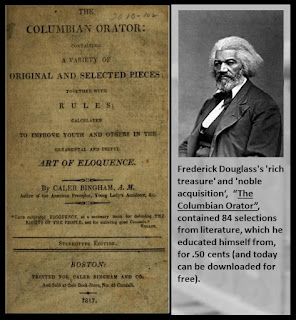
That was the cave that Frederick Douglass escaped from, first physically, and then mentally, by putting himself upon the 'Old Normal's path through his 'rich treasure' and 'noble acquisition' of classics that had been compiled into ' The Columbian Orator', and that path to 'light and liberty' is what the 3R's were for, not to gain 'basic skills', but so as to enable men such as himself to understand that men are more than animals, and that even when they must work, as we must, they are more than workhorses. As noted in the previous post, Douglass observed that:
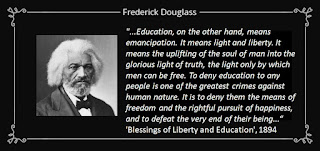
"...Education, on the other hand, means emancipation. It means light and liberty. It means the uplifting of the soul of man into the glorious light of truth, the light only by which men can be free. To deny education to any people is one of the greatest crimes against human nature. It is to deny them the means of freedom and the rightful pursuit of happiness, and to defeat the very end of their being..."
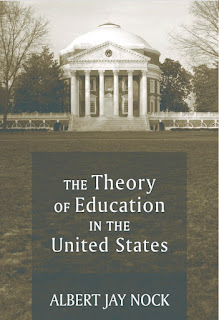
The old normal put you on a path whose destination urges you not to be delayed and distracted by seemingly scenic views, but to accustom yourself to, as Albert Jay Nock, in his "The Theory of Education in the United States" (a 'must read' BTW, but be prepared for many of your sacred cows being gored, butchered, and BBQ'd), quotes Plato's purpose to 'see things as they are'. OTOH, the path which Webster and his fellow reformers were proposing as the New Normal, intentionally or not, was where the purpose of Education was detoured onto that path which Douglass described as "... learning only those skills that were useful to their masters..." which would make them into men of the cave who lived chiefly,
"... within the narrow, dark and grimy walls of ignorance. He is a poor prisoner without hope..."
Brush aside all protestations of our Founding Reformer's good intentions of "not intended to diminish anything", the fact is that giving educational time and attention to acquiring those later skills, would necessarily entail taking time and understanding away from those materials of Western Civilization that had traditionally been used in the education of Western youth: Homer, The Bible, Thucydides, Cicero, Virgil, etc., not to mention the languages of Greek & Latin, as well as Hebrew, which was studied alongside them in many American colleges in the 1700s. Worse still, seeking to do so not only equates, but elevates, vocation over avocation, skills over wisdom, facts over truth.

It shouldn't need to be said, but of course acquiring vocational skills was and is a value, and there's no shame whatsoever in doing so, but to compare one with the other as equals, let alone trade one for the other, should be seen as not just wrong, but shameful. Far better to send your students to Mike Rowe for training in Dirty Jobs, than to Harvard or Berkeley for a slop of valueless values and supposedly high-paid skills.

That fateful turn towards the New Normal began our transformation from who we were, into who we are, by leaving us mentally & spiritually disarmed of the understanding which the literature of Western Civilization makes possible, and as we became less and less familiar with them, we became more and more vulnerable to, and unable to defend ourselves against its enemies, first in the Pro-Regressive 'Progressives', and then latter the Marxists, and now as those works are being purged from our libraries, we are prone to whatever worse variant is inexorably lowering us down to the level of actually debating whether or not having crude pap and porn available to children in their school's library, is a 'good' idea.

Our Founding Reformers took who they were for granted - taking both the literature itself, and the process that went into learning them and the habitual orientation towards what is true which resulted from that, for granted. The texts themselves were but raw diamonds, and only together with the process of learning them, did they become the polished jewels of Western literature - it takes both for the ideas to take root in heart and mind, and only then could they inspire the imagination of youths like Frederick Douglass, and John Adams before him. Even those less like them and more like Noah Webster, still benefited from the actions of becoming familiar with those ideas, as that was how Jefferson was able to write the Declaration of Independence as briefly stating "...an expression of the American mind...", whose 'harmonizing sentiments' derived from
"... the elementary books of public right, as Aristotle, Cicero, Locke, Sidney, &c..."
Those '... liberal ideas of government...', were only able to enter into the popular mind, because of those 'Elitist' works of literature, works that Webster and his fellows were themselves educated from and thoroughly familiar with... and yet were intent upon turning our education away from.

It is beyond ironic that Noah Webster, who wanted more than anything to establish the sense of an 'American Identity!', turned Americans away from the 'Elitist' works of Greco/Roman-Judeo/Christian literature that had enabled them to recognize and fight for those self-evident truths which those same Founders had sacrificed so much for - those Elite works (say it with pride and reverence), and not some accident of geography or handiness with skills, are what Americans' true identity sprang from.

Next time someone makes fun of the Indians for trading New York for a bag of Wampum, remind them that they at least traded stuff, for stuff, whereas America has traded away the accumulated wisdom of thousands of years, for a few skills that are useful only for the moment - and you may rest assured that those today who 'learn to code' will soon go the way of yesterday's buggy whip assembler. Our Founding Reformers overlooked the dangers of being misled by their own good intentions into perilous circumstances, and so following in the steps of Essau, in exchanging the harder lessons of "Know Thyself" for the easier path of utilitarian skills and goals, traded our birthright as Westerners and as Americans, for a swiftly coolly bowl of porridge.

It's difficult not to shake your head, when you consider that towards the end of his life forty years later in 1837, Noah Webster was utterly amazed over the general lack of knowledge, principles, and standards, in those who'd largely been educated in accordance with his own advice, as he wrote to Charles Chauncey, that:
“...Principles, Sir, are becoming corrupt, deeply corrupt; & unless the progress of corruption, & perversion of truth can be arrested, neither liberty nor property, will long be secure in this country. And a great evil is, that men of the first distinction seem, to a great extent, to be ignorant of the real, original causes of our public distresses...”
Again, my intention here is not to dump on or to portray Webster in a bad light, I'm trying to point out that solid and admirable men like Noah Webster, Dr. Rush, and Benjamin Franklin - men who were truly among the Founding Fathers of America - nevertheless are, then as now, prone to letting their pet assumptions run away with them under the power of their best intentions. And it is up to 'We The People' to question and slow them, but without the knowledge which their 'system of education' had made them less & less familiar with, we've progressively lost our ability to check the notions of 'great men' with good intentions, and one of the results of that, has shown itself as equating Liberty, with 'the right' to have porn in the school library.

By their fruits you shall know them
The truth is that it did not matter that our Founding Reformers intended to help Americans to become more successful, it didn't matter how certain Noah Webster was that he was going to be helping to plant, tend and grow giant Oak trees - the fact of the matter is that the seeds that they were planting, would reduce our forests to an expanse of weeds & thistles, and their 'New Normal' in education has produced ideas and practices that are deadly to the principles which Webster and his fellow Founding Fathers had helped to found America upon. Those weeds have taken root, they are darkening our councils, choking our discourse and spreading progressively further and deeper with each school years fresh crop of dis-educated graduates, as dandelions blown into the ranks of 'We The People'.

What began with the good intentions of an educated people who'd taken the source of their education for granted and attempted to 'add to it' some attention towards practical vocational skills, made enough of a crack in our foundation, for the yearly freeze & thaw of popular opinion to begin the never-ending process of education reform. In a dizzyingly short amount of time, the Pro-Regressive 'Progressive' educationists who followed after our Founders era, transformed Education from being a means to the light of truth which sets a person free from darkness and enabled them to live in liberty - an Elite ideal that America is unsustainable without - into the Power Tool of mandatory public school systems that form unseen political controls over 'We The People' and the thoughts they are led to think, so as to conform them to the ideals of 'those who know best'. In less than a century, that crack of adding 'useful skills' into education, had expanded into such a crevice by 1909 that Woodrow Wilson, while still president of Princeton University, would openly and confidently advise the Federation of High School Teachers that what was critical to what they taught and why, was that:
"...We want one class of persons to have a liberal education and we want another class of persons, a very much larger class of necessity in every society, to forgo the privilege of a liberal education and fit themselves to perform specific difficult manual tasks..."
That was and is the counter revolution that has been waged against America, manned by different factions over the years, factions who've warred even amongst themselves, but always against the Greco/Roman-Judeo/Christian traditions together, and they all are the fruit of our Founding Reformers 'New Normal', and their fruit is that of SEL & CRT, which they believe now has us in the 'End Game'.

Our Founding Reformer's would've done well to pay closer attention to a quote from Noah's cousin, Daniel Webster:
"...Good intentions will always be pleaded for every assumption of power; but they cannot justify it, even if we were sure that they existed. It is hardly too strong to say, that the Constitution was made to guard the people against the dangers of good intention, real or pretended. When bad intentions are boldly avowed, the people will promptly take care of themselves. On the other hand, they will always be asked why they should resist or question that exercise of power which is so fair in its object, so plausible and patriotic in appearance, and which has the public good alone confessedly in view? Human beings, we may be assured, will generally exercise power when they can get it; and they will exercise it most undoubtedly, in popular governments, under pretences of public safety or high public interest. It may be very possible that good intentions do really sometimes exist when constitutional restraints are disregarded. There are men, in all ages, who mean to exercise power usefully; but who mean to exercise it. They mean to govern well; but they mean to govern. They promise to be kind masters; but they mean to be masters. They think there need be but little restraint upon themselves. Their notion of the public interest is apt to be quite closely connected with their own exercise of authority. They may not, indeed, always understand their own motives. The love of power may sink too deep in their own hearts even for their own scrutiny, and may pass with themselves for mere patriotism and benevolence...."
From our end of history, their plans should serve as a textbook reminder of the unexpected power which 'new ideas!' can have over the minds of even great men such as Noah Webster, Dr. Rush, and Benjamin Franklin, who are just as often swept up in, and possessed by them, along with everyone else.

In the next post we'll look further into that most dangerous of new technologies which has eased the transformation of Education from what it was in our Founders era, into what it is today: the Textbook.

Wednesday, February 23, 2022

For an Education to be meaningful, its books must be more than 'just books'

"...As for literature--to introduce children to literature is to install them in a very rich and glorious kingdom, to bring a continual holiday to their doors, to lay before them a feast exquisitely served. But they must learn to know literature by being familiar with it from the very first. A child's intercourse must always be with good books, the best that we can find..."
-- Charlotte Mason - CHAPTER III - The Good and Evil Nature of a Child
The question of 'What do you mean by an education?', is one that's too rarely asked, and yet asked or not, it still shapes the answer to that question which is causing such an uproar today - what does and does not belong in a school library, and why (see previous post). When the question is asked, it's usually asked as you'd ask a baker about a cake - what ingredients were used and how was it prepared - which makes sense if the samples were tasty (and if not?). If we proposed that ingredients and preparation approach to education, to a schoolmaster like George Turnbull, it's unlikely that he'd permit the crude & pornographic ingredients found in many of our school libraries today, into his own, since as he put it in the overview to what his opening chapter of 'An Essay on Liberal Education'(1742)', would cover:
"Instruction in the science or art of right living is the chief lesson in education, to which all others ought to be rendered subservient, and what this science is, and what may justly be called false learning."
, he'd surely see such materials as those to be in conflict with the 'art of right living' and would be more likely to view them as the stuff of false learning, than as somehow being able to contribute to an actual education. But as we'll see, we don't have to travel all the way back to the 1700s to find that treating the nature, quality and content of books as if 'They're just books', as far too many librarians, educators and trolls do today, would have gotten you laughed out of school, and out of any & all polite conversations about them.

Unfortunately, that common sensibility began to change for far too many of us, as the understanding which our Founders' era had benefitted from, began to change, and changed further still, until ever more radical changes have brought us into such a state of flux that many community leaders and parents today, are eager to expose young children to the detritus of every momentary fad... for 'the greater good'... or at least to make a politically woke point.

The changes to how Americans educate themselves have taken us from being one of, if not the most literate and educated people at the opening of the 19th Century (with no official educational system); a people for whom Thomas Jefferson had earlier written the Declaration of Independence less as a means to instigate a revolution than to briefly state what was "...an expression of the American mind...", whose,
"... authority rests then on the harmonizing sentiments of the day, whether expressed in conversation, in letters, printed essays, or in the elementary books of public right, as Aristotle, Cicero, Locke, Sidney, &c..."
; a people for whom a couple of decades later The Federalist Papers would be written to inform and persuade the common farmer and 'man in the street' on the finer points of applying political philosophy and law to their own lives and to that of their posterity... to a people whose 'graduates' since the 20th Century have been mostly unwilling or unable to comprehend, or even to read, those works and ideas that were once the common fund of American thought, and many of whom are unaware of who our Founders even were, or have an understanding of what America is

All over the course of little more than a century - now that's revolutionary.

Because pulling weeds is a waste of time if you don't get at the roots, it's important to note that this didn't happen as a result of CRT or SEL, or Common Core, or the 1960s, and the fact that its roots run much deeper than that becomes self-evident with a comment made by Albert Jay Nock in the lectures he gave in 1931 at the University of Virginia ("The Theory of Education in the United States"), in relating what an Italian nobleman had told him of "a curious experience" that he had in our country, that:
"...He said he had been in America several times, and had met some very well-educated men, as an Italian would understand the term; but they were all in the neighborhood of sixty years old. Under that age, he said, he had happened upon no one who impressed him as at all well-educated..."
, in other words, whatever the ingredients that were used or how they were prepared, or how highly rated their educational baked goods were, when he sampled the results of our new educational recipe, he found it wanting and wondered what on earth had happened in our kitchens. Knock replied to him dryly, that the reason why was,
"... that our educational system had been thoroughly reorganized, both in spirit and structure, about thirty-five years ago, and that his well-educated men of sixty or so were merely holdovers from what we now put down, by general consent, as the times of ignorance..."
Two points to make on that: 
  • First, the time period of 'thirty-five years ago' which Knock mentioned, roughly 1895, was the height of the era of 'Progressive Education' sweeping through the classrooms of America, and while it may have taken decades more to complete the counter-revolution, the outcome of it was by 1931 already beyond question.
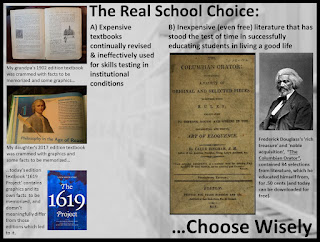
  • The second point is that most of those concerned about our schools today, would look at my grandpa's social studies textbook of 1902, and find it to be admirably full of facts to be memorized, 'rigorous' even, and would probably gladly trade my daughter's vapid and graphics laden social studies textbook of 2017 which also contains facts to be memorized, for it - and yet those of my grandfather's day were what had produced those which Knock's Italian friend had found to be so educationally wanting, and both of which led to the 1619 Project textbook which also contains facts to be memorized.
Facts aren't the issue... but facts alone and without a story to understand them within, might be
Those textbooks we utilize today may have fewer facts than those of a century ago, but facts aren't the issue with textbooks, though as facts alone are soon forgotten, that gets a bit closer to it (the details of that in the next post). Those textbooks which are our educational poison of choice today, may be less diluted with 'facts' than those of a century ago, but their function and form are the very same poison, and if we want to escape its ill effects, what we need is not a less potent form of the same poison that we're already poisoning ourselves with, but something that's different enough to actually contribute to our health, rather than assail it.

The questions we should be asking ourselves, are what it is that we mean by Education, and how to tell it from its counterfeit, and how an educated people permitted that revolution to be waged upon themselves? Answer those, and we'll begin to see how to rectify matters. Don't however, allow yourself to be misled by the answers that are typically given, that we needed to create an educational system (and political controls over the public) so that 'all Americans would have the same understanding of America' - that was and is more of a useful pretext, than a true reason for them. After all, if that had been their true motivation, then they would have simply used the public trough to fund teachers and the materials they preferred to teach from, so that they could continue to teach what they had been teaching so successfully, to any of the public that was missing out on being taught.

That could easily have been accomplished without having to change everything about how Americans had already made America the most literate nation in history.

But where's the fun in that, eh?

In this post I want to focus on what is meant by an Education, so I'll leave the details of who, how, and why we ended up with the educational system we have for the next post, but as it did help redefine what we mean by getting an education, two points need to be noted about the new system:
  • First, that the new system's signature intention was to focus students on learning more 'practical' skills - accounting skills, agricultural skills, etc. - as useful for more quickly entering into the economy (the 19th Century version of "gotta learn the skills of the 21st century!"), which progressively took more & more attention off of those 'harmonizing sentiments' which had earlier been generated by the integrated focus of a traditional education.
  • Second, the new system was sold as being more efficient and was to be proven effective through 'measurable testing' of how many facts a student retained within their head, which was to both enable schools to scientifically certify a student's 'level of education', and to help businesses with picking its employees, and improving the economy (ever wonder where quizzes, tests and grades came from?). Doing that required our dis-integrating the materials of education into discrete subjects that would be taught and measured separately - mathematics taught without relation to Music; something called 'English' to be taught separately from History; History to be replaced by the new 'science' of 'Social Studies', and so on - for both students and teachers.
What was not pointed out, except by those who were mostly ignored, was that the integrated understanding of self and society which had for so long been understood as a central purpose of education, was being abandoned for the economic 'greater good', though with the very best of intentions, of course.

And of course, the answer to whether or not our new system of education, was successful at educating either students or teachers, or if it achieved anything like 'a greater good', was, IMHO, best given by Knock's Italian nobleman. But answering the question well for us today, requires considering not just what is meant by getting a good education, but about what an education - good, bad or indifferent - is, and then how to know if one has one, or not.

What do you mean by an Education?
If we look to our dictionaries for help in defining 'Education', they are helpful only in pointing out the differences that it seems we're already aware of and divided over. Webster's Dictionary of 1828 (the irony will be noticeable in the next post) defined 'Education' as:
EDUCA'TION, noun [Latin educatio.] The bringing up, as of a child, instruction; formation of manners. education comprehends all that series of instruction and discipline which is intended to enlighten the understanding, correct the temper, and form the manners and habits of youth, and fit them for usefulness in their future stations. To give children a good education in manners, arts and science, is important; to give them a religious education is indispensable; and an immense responsibility rests on parents and guardians who neglect these duties.
, while Merriam-Webster's definition today, is more reflective of... today:
1a: the action or process of educating or of being educated
b: the knowledge and development resulting from the process of being educated
2: the field of study that deals mainly with methods of teaching and learning in schools
So we need to dig a little deeper.

Our word 'Education' comes to us by way of several Latin words: educere, educare, and educatus, meaning “to learn”, “to know” and “bring out, lead forth”. That is what Frederick Douglass was speaking of in 1894 as being the "Blessings of Liberty and Education", noting that those who lacked an education, learning only those skills that were useful to their masters, lived "... within the narrow, dark and grimy walls of ignorance. He is a poor prisoner without hope...", but that:
"...Education, on the other hand, means emancipation. It means light and liberty. It means the uplifting of the soul of man into the glorious light of truth, the light only by which men can be free. To deny education to any people is one of the greatest crimes against human nature. It is to deny them the means of freedom and the rightful pursuit of happiness, and to defeat the very end of their being..."
For clarity's sake, we should first separate what an Education is, from its quality - good, bad, or indifferent - and that is to inform and lead students into paths and patterns of thought and behavior for life. One implication of this is that what paths and patterns of thought and behavior that a school exposes a student to, whether in the classroom, or library, playground, etc., is educating them - and of course what the student engages in outside of school, also contributes to the education that they are receiving.

A Good education, such as what Fredrick Douglass was speaking of, is one that has a specific purpose that is in accordance with what is real and true, and utilizes materials that are suited to that purpose without at the same time detracting from it (which as Turnbull noted above, would justly be called 'false learning'). Those works then that are suited to leading the student up and out of darkness and into the light, by methodical attention to what is good, beautiful, and true, are going to be well suited to facilitating a good education, and those that do not, are not. Similarly with the character of their teacher and school staff.

An indifferent education will differ from a good one, by having no definite purpose or attention in its actions and probably makes little distinction between the materials it uses or provides (very much like the 'read any books, they're just books' attitude that satisfies so many of our librarians, educators and trolls today) to lead its students' thinking, behavior, and lives with; less interested in dispelling the dark, than in compensating for it by focusing on external conditions and pleasures. Very likely it also employs teachers and staff whose character fails to reinforce, or even undermines, what goals it may claim to have for their learning.

And a bad education, whether out of ignorance or deliberate design, will use those materials that treat the light of truth as being a threat to those shadows it prizes above all else (hello '1619 Project'), leaving its students in the dark about their own nature, and of any reality that conflicts with the pursuit of power over others and the trappings of that (hello SEL & CRT).

The materials that Frederick Douglass used to become one of America's greatest essayists and orators (and he was largely self-taught), was a collection of plays, speeches, poems, and other examples of quality literature, called 'The Columbian Orator', which Douglass called his 'rich treasure' and 'noble acquisition'.

What Douglass himself valued, was a product of a couple of thousand years of educational experience in the Greco/Roman-Judeo/Christian West, had shown that a good education was best provided to students by leading them through the best stories, inquiries (History), and orderly thought in action (geometry, music, poetry, philosophy, science,) - which broadly speaking all falls under the heading of Literature - and that guiding students through that literature had been the primary means of putting the student's thoughts and actions on the path towards becoming what Frederick Douglass spoke of and became, a person whose knowledge of what is true and worth knowing for living a good life, ran at least as deep as it did wide; someone marked by orderly thinking that was reflected in their admirable manners and actions; someone far seeing in their thoughts across time, and able to organize and express them clearly and persuasively.

Such a person as that, showed themselves in their manner and speech to be free - or at least freer - of the shadow of unexamined thoughts, ignorance and prejudice about them, which, as Knock's Italian Nobleman noted, is detectable from meeting with them. One question for us is, how likely is it that those qualities of purpose, wisdom, and virtue, can be detected by having them fill out a multiple-choice test?

What the Italian Nobleman's 60+ yr old acquaintances knew, that we've forgotten
Someone who still had one foot firmly enough in that older ideal of education, to be alarmed by the steps he could see being taken into that ideological future which has become our present day, was an essayist I first ran across about a decade ago, named Charles Dudley Warner, who, BTW, would have been roughly amongst those over 60 yr old educated gentlemen which Knock's Italian nobleman was speaking of. Warner is someone who had a good deal of sense to say upon the subject of education, and especially about the use/misuse of Textbooks, which today are questioned only in terms of whether a particular one is, euphemistically speaking, 'good' or 'bad', while few bother questioning whether or not that very modern technology known as 'Textbooks', are a value at all, or an insidious danger, to a good education.

One particular essay which Warner wrote in 1890, "The Novel and the Common School", conveyed the alarm he felt over the direction that education was heading in, and there's one particular paragraph of it which I think gives the gist of the problem he saw and tried to warn his fellows about, that I want to walk us through in this post, noting the landmarks and paying attention to the lay of the land that we are in the midst of today.

What I take to be Warner's key paragraph, begins:
"The notion that literature can be taken up as a branch of education, and learned at the proper time and when studies permit, is one of the most farcical in our scheme of education..."
One thing to note about that, is that the notion that an education can be had without the works and stories - literature - which convey it, is a novel and foolish practice that's barely a century old... and it has become the norm today. Another, is that the notion that what a literature transmits can be thought of as being only a 'branch' of education, rather than the soil, root and trunk of what an education is developed through, is, and was once widely understood to be, absurd. And that has absolutely become the norm today.

Of course if that's true, as noted, then the answer to the question of 'What do you mean by an education?', was once understood to be very different from our claim today that it can be defined by the memorization of facts & algorithms and certified by taking standardized tests upon them - and not just a little different, but entirely different - and why that is, is worth thinking about.

Warner expands on that in the next line of his essay:
" It is only matched in absurdity by the other current idea, that literature is something separate and apart from general knowledge. Here is the whole body of accumulated thought and experience of all the ages, which indeed forms our present life and explains it, existing partly in tradition and training, but more largely in books; and most teachers think, and most pupils are led to believe, that this most important former of the mind, maker of character, and guide to action can be acquired in a certain number of lessons out of a textbook!"
However alien it might seem to us today, and whether or not it results in a good, bad, or indifferent education, the stories, inquiries, and scientific observations which make up the literature that a child is 'exposed to' (or that is absent from it), are what forms the basis of their education. An exceptional British teacher of Warner's time, Charlotte Mason (whose works reflected what was once good teaching and has shaped homeschooling for a century), held a view of education which I very much like, as 'The science of relations', which an examined reading of discloses to the student the interrelatedness of grammar, history, rhetoric, science, in all of literature, and that is exactly what our segmented class & course structure of modern education was designed to explode. Deliberately or not, and no matter what quality or coherence those stories may or may not have, and whether engaged through books, movies or tweet-streams - that 'literature' forms the nature of the education which those students' hearts and minds are being led through, and whether of mountains or molehills, that shapes the perspective from which they view our world through. For more on that, I highly recommend 'The Story Killers', by former Marine, classical school founder, and Hillsdale College Professor, Terrence O. Moore.

If you take a look at the quote by Charlotte Mason at the opening of this post, it's clear that what she and Warner were focused on wasn't instilling students with 'skills' or using them as activists to create an ideal new society. An education was to educate, to 'educare', to lead you out, and literature, broadly speaking, provides the mental landscapes that you might otherwise never have imagined or realized were already surrounding you; it orients your thinking towards important landmarks, and reveals those paths that the best minds have found worth travelling upon, and thinking through, and guided by the light of truth's correspondence to reality, it reveals how to separate substance from shadows, and enables a person to live in liberty, no matter their material circumstances or station in life.

One thing Warner and Mason agreed upon, was that their understanding of Education was worlds away from what could be provided through one of the earliest and most destructive of our 'education reforms', which was the modern technology of the Textbook. We'll return to this most destructive of modern technologies in the next post, but what was originally conceived of as 'brief essays of fact' were to teach 'the facts' of important historic, scientific, or 'culturally relevant events', to memorized so that students could be tested to ensure they knew what was important to *know* - but in what way could they 'know' such... facts? Facts shorn of what gave rise to them, carry no real knowledge or understanding of what it was that was considered to be important enough for them to know, and such rootless facts blow quickly away from our memory... leaving only the impression that something is known of them, or how they relate to the rest of what might have been known. As Mason put it - the textbook passes on 'pre-digested' intellectual food, its nutrients gone, leaving only the gristle of it behind.

Back to Warner's essay, picking back up where we left off:
" Because this is so, young men and young women come up to college almost absolutely ignorant of the history of their race and of the ideas that have made our civilization. Some of them have never read a book, except the text-books on the specialties in which they have prepared themselves for examination."
Keep in mind that Warner's not complaining that college students aren't learning these stories in college, but that these stories which once were and should still be familiar to all Americans and Westerners, regardless of their schooling, were unfamiliar to many of those even before entering college (BTW, if you became stuck on the word 'race', you are an example of the failure of modern education. You should learn how to overcome that). Again, this was in 1890, a time where the average college student, even grammar student, had orders of magnitude more familiarity with the 'literature' which Western Civilization was formed through, than we do today. Going back another hundred years would present you with an example of a very different college experience, which was commonly had in our Founders' era, see the “Education of the Founding Fathers of the Republic”, by James J. Walsh, 1933', where one of the things that might catch your attention, is that the college spectator sport of the day, was professors, students, and townspeople gathering to watch students make and support an argument before their professors and peers.

How we went from that understanding, to thinking that test scores and diplomas could certify that a person's useful skills meant that they were educated, is something we'll get into in the next posts. Continuing on with Warner's paragraph:
" We have a saying concerning people whose minds appear to be made up of dry, isolated facts, that they have no atmosphere. Well, literature is the atmosphere. In it we live, and move, and have our being, intellectually."
We are suffocating from the absence of that atmosphere today. Take a moment and read Terrence O. Moore's essay on Classical Education, where he notes that Grammar is being taught to students today, the question is why it is being taught as it is, and with the poor materials used to teach it with.
A classical education requires more than functional literacy, however. It teaches students from an early age high standards of grammar, precision in word choice, and an eloquence that can emanate only from a love of the language. Throughout his education, the student will be exposed to the highest examples of eloquence attained by the greatest writers and speakers of the language.
“. . . I come to bury Caesar, not to praise him.” — Shakespeare
“There is a tide in the affairs of men . . .” — Shakespeare
“We few, we happy few, we band of brothers.” — Shakespeare
“These are the times that try men’s souls.” — Paine
“Never in the field of human conflict was so much owed by so many to so few.” — Churchill
These sentences are entirely grammatical. They could just as easily be used to teach grammar as “Bob is a big boy.” By preferring Shakespeare to an anonymous “See Bob” sentence (usually not well written) we teach three things rather than just one. We teach grammar. We teach cultural literacy. We also teach beauty. Our purpose is to introduce young people to the masters of the language so they themselves learn to employ force and beauty in their deployment of the spoken and written word.
Understand that whatever you might think of what Warner is referring to as literature that a child is being 'exposed to' today, the fact is that a child's mind is being formed from, and educated through, whatever 'literature', be it good, bad (or pornographic) - that is happening, the only question is about the nature of what it is that their minds are being formed from.

It's also worth noting that despite having problematized, decentered or otherwise done away with the stories of the West, even the *Woke* rely upon stories - the ideological fabrications which they call 'lived experiences', are what they view as being central to teaching how Critical Theory, CRT, SEL & DEI will transmit their anti-Western bigotry into the next generation. They know what they're doing. The truth is that our trolls, librarians & educators prefer the worthlessness of worksheets, textbooks, 'lived experiences', pap, sleaze and even porn, for conveying the education which they intend your kids to swallow, digest, and so become reflected in their thinking, manners and actions. Why they choose that, over the literature that Warner referred to... is well worth your giving some serious consideration to.

Elaborating on lessons, Warner continues:
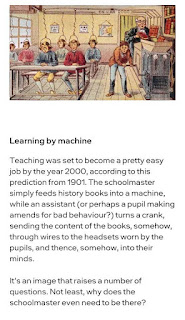
" The first lesson read to, or read by, the child should begin to put him in relation with the world and the thought of the world. This cannot be done except by the living teacher. No text-book, no one reading-book or series of reading-books, will do it. If the teacher is only the text-book orally delivered, the teacher is an uninspired machine."
Psst! Teachers: They want
more than virtual classrooms

The idea of a teacher as an uninspiring machine, distasteful and even horrific as it was to Warner, was (and still is) the ideal that was being aimed at by 'progressive reformers' who'd swallowed whole the swill of behaviorists such as Wilhelm Wundt (see 'The Leipzig Connection'), and as a result of their 'following the science!', the old expectations and requirements that teachers should actually know the subjects they were teaching, were dropped, and they were instead taught (programmed) in their new Teachers Colleges, on how to use acting techniques to present 'texts' as if they knew what they were saying, and how to prompt the desired questions from students, so as to parrot back the answers found in the back of the teacher's version of the textbook. The Pro-Regressive view of education, is less about education, than one of a grand and uniform national stimulus/response experiment in the laboratory that was and is our 'public education system' (and it shouldn't be too tough to guess what role that puts your kids into).

The goal of having teachers as uninformed automatons of a 'reading-book or series of reading-books' was an ideal they dreamed of someday achieving (hey teachers, care to guess why computers have become so popular in our schools today? Or what use that pedagogists will have for living breathing teachers, once they can get away with (you know, like how they 'get away with' porn in the library) programming a bot or avatar to do what you do transmit their material exactly as they intend them, in their 'virtual classes'?). Students are shaped by their lessons, and the shapes that emerge from lessons taken from the better stories of literature, is going to differ greatly from what emerges from lessons taken from textbooks, worksheets, games, movies, twitter threads, etc.,. Add to that the fact that the teachers who teach them, are rarely at liberty to teach as they might choose to teach (policies & program dictate their actions and responses), they are being transformed into that long desired 'content delivery system' for transmitting the school system's approved lesson plans, for what is an unworthy education, into your child, and into our future.

Continuing:
" We must revise our notions of the function of the teacher for the beginners. The teacher is to present evidence of truth, beauty, art. Where will he or she find it? Why, in experimental science, if you please, in history, but, in short, in good literature, using the word in its broadest sense. The object in selecting reading for children is to make it impossible for them to see any evidence except the best. That is the teacher's business, and how few understand their business! How few are educated!"[emphasis mine]
How impossibly far away does what Warner is recalling from the vantage point of 1890, seem in comparison with the Nikole Hannah-Jones's 2021 perspectives that we are surrounded with today? What you will not find in today's 'Lived Experiences', is "truth, beauty, art", which is a natural consequence of both the *Woke*'s rejection of 'objective truth', and the moderate's pragmatic indifference to it. Continuing:
" In the best literature we find truth about the world, about human nature; and hence, if children read that, they read what their experience will verify. I am told that publishers are largely at fault for the quality of the reading used in schools—that schools would gladly receive the good literature if they could get it. But I do not know, in this case, how much the demand has to do with the supply."
It is critically important to keep in mind that 'the best' (horrific, but popular) pedagogists of today (those who teach your teachers what and how and why to teach your children what they'll learn), openly state that Truth - usually enclosed by them in scare quotes as 'objective truth' - is impossible to attain, and that all 'truths' are subjective, and that power is alone worthy of their grasping for and pursuing. Keeping in line with understanding that purpose, means that lies and lying are sometimes necessary and useful tools for gaining power over others and over society (for 'the greater good', of course), and they have grade-level expectations for transforming it (and your child, and you) into being a means for their ends.

And here, in the last part of Warner's paragraph, we see the action of the would-be defender of Education, from Webster (next post), to Warner, and into our day, in that they step into the error that unknowingly to them has enabled our world to become what it has become today, and that foot which Warner had in the Education which our Founders' generation had formed themselves from, is betrayed and left behind, with the step which he advises (unaware of its implications) our taking into line with our world of today,
"I am certain, however, that educated teachers would use only the best means for forming the minds and enlightening the understanding of their pupils. It must be kept in mind that reading, silent reading done by the scholar, is not learning signs and calling words; it is getting thought. If children are to get thought, they should be served with the best—that which will not only be true, but appeal so naturally to their minds that they will prefer it to all meaner stuff. If it is true that children cannot acquire this taste at home—and it is true for the vast majority of American children—then it must be given in the public schools. To give it is not to interrupt the acquisition of other knowledge; it is literally to open the door to all knowledge...."[emphasis mine] 
How our understanding of Education became what it is today, began with the good intentions of people who looked into the immediate future, without carefully considering what kind of future might be had from breaking with their own past, and that break resulted in our original Semantic Deception, whereby the same word 'Education', came to mean two very different meanings, one of which was useful in gaining public support, to implement still other very different meanings and purposes, through educational experiments that were to create a system to nudge, ensnare, and conform its student's minds to whatever ideological issue which 'those who know best' had concluded was for the 'greater good'. That latter meaning never had any interest whatsoever in carrying forward the original idea of education which Warner still had one foot in, and instead were and are intent upon first ignoring it, then vilifying and condemning every aspect of it, and eventually eliminating all memory of that understanding, in order to 'remake the world anew', in their own idealized view of how you should be compelled to live, or as Godfather Rousseau put it: "They must be forced to be free. "

What Warner failed to realize, as has nearly everyone who's succeeded him on down to today, is that what was once meant by the word Education, was being gradually altered, from what was taken for granted, such as 'To John Adams from Samuel Adams, Sr., 25 November 1790',
"...Should we not, my friend, bear a gratefull remembrance of our pious and benevolent Ancestors, who early laid plans of Education; by which means Wisdom, Knowledge, and Virtue have been generally diffused among the body of the people, and they have been enabled to form and establish a civil constitution calculated for the preservation of their rights, and liberties..."
, where Education was understood as a means to the light of truth which set a person free and enabled them to discover how best to live in liberty. That understanding was unintentionally in the process of being reversed - the turn away from an ideal of what is right and true, towards what is useful, had gotten that ball rolling, and from there it became a simple matter of course before it became the political plaything of the 'progressive' educationistas who intended it to be used as a political tool of and means to power to reform the people into the ideal of 'those who know best', as the 'Father of Critical Pedagogy', Henry Giroux, acknowledged in an interview, that:
"...Critical Pedagogy must be seen as a political and moral project and not a technique. Pedagogy is always political because it is connected to the acquisition of agency... illuminates the relationships among knowledge, authority, and power... pedagogy is a deliberate attempt on the part of educators to influence how and what knowledge and subjectivities are produced within particular sets of social relations..."
The purpose of a mandatory public school system was from the very beginning, to establish political controls over those same people that it would be instructing in what and how to think, the fact that it began with better purposes, in no way deterred it from quickly tending towards worse ones.

To answer how these changes came about, and why, we need to get at the roots so that we aren't surprised by those same weeds growing back yet again, and that requires looking at the role that some of our most respected Founding Fathers played in them. How their good intentions played into the hands of those with the worst of intentions, in the next post.