There are those who'd very much like to see that fear come true, and especially as they know full well that it is not yet true, having you believe the lie of it is of supreme importance to them. The reality is that until those who so love power, have total power over us, they do still need something more from us, and we should understand what that is, because it is critical to our identity and to the possibility of restoring it. That's why I thought it was such fortunate timing that 'The Ship of Theseus' paradox - 2,500 year old metaphysical consideration of identity and change - was suddenly popularized earlier in the year in an episode of the TV show WandaVision, and if you are in the habit, as most are, of deciding the nature of identity and change on the basis of appearances, you really need to take that paradox more seriously, and especially what it is that causes something to be what it is, or to no longer be what it might still appear to be (see yesterday's post).

As to what those seeking power over you, need from you, have you given any thought to what it is that they require from you? Do you think that they need you to believe them? We so often say "That just isn't true!" as if we expect someone to acknowledge that they've been caught, confess, and put things aright.
Does that sound plausible to you? Let's take a quick review of where it is you think we are:
They're not doing what they're doing because they're concerned about your thinking "That isn't true!" - Truth isn't their value, power is, and they need more of it. They don't need you to believe them to gain more power from you, they only need you to go along with their making these changes for just... a... little bit... longer, and to be able to do that, there is something that they desperately do still need from you (are you 'them' or you?), and you do still have the power to deny it to them.

Aleksandr Solzhenitsyn, who knew a thing or two about not just standing up to, but winning against totalitarian thinking, wrote an essay "Live not by lies", and in advising what to do when faced with a system which persists in telling what you and they both know to be lies, he noted that:
Which brings us back around to 'The Ship of Theseus' paradox, and in looking at all of the substitutions that've been made, the more worthwhile question for us today is not is America still America, but can it become more like America again - and what would that involve? You can, and certainly do, know that the situation is bad right now, and you may be painfully aware that you do not see a way out of our situation, but that does not mean that there is no way out, it only means that you, me, we, are as yet unable to perceive it.
Fictional Realism
There is still the possibility, due to what we are not in a position to know, for our chapter of this story to end in ways that the wisest amongst us would not predict and cannot imagine. More than that, it is important to realize that denying that, is itself a corrupting aspect of the totalitarian mindset - a mindset that is and must be shared by both those in power and by those they rule over - it is an an act of believing that what is not and cannot be known, is certain, inevitable, and that it's 'unrealistic' to think otherwise. Faking reality is not being 'realistic', and you should beware the temptation of that, for it's a fatal one. Don't deny the harsh reality before you, but do deny that reality must somehow conform to your presumptions (or fears) of it, rather than the other way around. That subtle reversal of cause and effect is the mainspring of the darker transformations, which have been operating upon us since at least the time of Descartes.
That call to 'be realistic' is a deceptive one, and is the stock in trade of the morbid fact-checkers of the 'News' of what happens to have happened here, and there, and they're deeply invested in pretending to know what cannot be known ('experts say...'), yet despite the routine failure of their assertions and predictions (President Hillary could not be reached for comment about sixty years worth of predictions of the world ending in a decade), such 'realistic' notions have even less of true use to tell us about how to deal with the problems of the here & now. Once upon a time we understood that grappling with what is timelessly true is more important than faking it, even though it can have frightening consequences to who we think we are, and are willing to be. What was also once understood, was that if you left it to the 'here and now' to grapple with such issues, you'd be beaten to a pulp by them - if you want to have a fighting chance in life, that requires venturing beyond the appearances of the moment by stepping into the poetic realm of stories and works of fiction. Realizing that, it was once a commonplace for us to teach our children not just to read widely, but to memorize passages of scripture and poetry, a habit which most continued throughout adulthood, for pleasure, inspiration, and to have the support in their minds to aid them in carrying on through those darker moments which naturally incline us all towards hopelessness and despair.
Do you really think, that they think, that you believe, that the FBI is truly seeking to uphold the Law? Or that their forming a commission to look into packing the Supreme Court, is motivated by a desire for Justice? Do you really think that they expect you to believe that racists who're wistfully advocating genocide, care about Justice - social or otherwise? If they had little or nothing to say about the daily riots & violent attacks upon the federal justice building in Portland, do you think, that they think ,that you believe, that their ranting over one particular riot on Jan 6th has had anything to do with a concern for either peace, law & order, or Justice? Do the the Marxist founders of BLM who just bought a million dollar home in a predominantly white neighborhood (and three other homes), expect you to believe that they care about either Marxism or black lives? You and they both know that their praising & promoting songs like WAP & transgender story hour for kids, while condemning Dr. Seuss books as being harmful to kids, has nothing at all to do with a concern about what's good for kids (not that Dr. Seuss is all that good, but that's another story).Are you getting the picture? The Covid Relief bill was not passed to relieve Americans, but to ingratiate politicians with influential players around the world, 'anti-racism' isn't an effort to oppose 'systemic racism', it's an attempt to impose an explicitly racist system upon us all, and HR1 is not an act to preserve voter integrity, but to eliminate it, so as to complete their 'maintenance' of America's own Final and Formal Causes into passing that point where America no longer bears even a passing resemblance to what America once was.
They're not doing what they're doing because they're concerned about your thinking "That isn't true!" - Truth isn't their value, power is, and they need more of it. They don't need you to believe them to gain more power from you, they only need you to go along with their making these changes for just... a... little bit... longer, and to be able to do that, there is something that they desperately do still need from you (are you 'them' or you?), and you do still have the power to deny it to them.

Aleksandr Solzhenitsyn, who knew a thing or two about not just standing up to, but winning against totalitarian thinking, wrote an essay "Live not by lies", and in advising what to do when faced with a system which persists in telling what you and they both know to be lies, he noted that:
"...When violence intrudes into peaceful life, its face glows with self-confidence, as if it were carrying a banner and shouting: “I am violence. Run away, make way for me—I will crush you.” But violence quickly grows old. And it has lost confidence in itself, and in order to maintain a respectable face it summons falsehood as its ally—since violence can conceal itself with nothing except lies, and the lies can be maintained only by violence. And violence lays its ponderous paw not every day and not on every shoulder. It demands from us only obedience to lies and daily participation in lies—all loyalty lies in that.His point is a deceptively powerful one, in that holding to what is true, and refusing to participate in the lie, is devastating to those who rely upon the power of their being feared, obeyed and accepted, all of which is dependent upon people accepting their lies. While admittedly our situation doesn't look good at the moment, we need to remember that appearances can be deceiving, and examining them is a giant step towards freeing ourselves from them.
And the simplest and most accessible key to our self-neglected liberation lies right here: Personal non-participation in lies. Though lies conceal everything, though lies embrace everything, we will be obstinate in this smallest of matters: Let them embrace everything, but not with any help from me..."
Which brings us back around to 'The Ship of Theseus' paradox, and in looking at all of the substitutions that've been made, the more worthwhile question for us today is not is America still America, but can it become more like America again - and what would that involve? You can, and certainly do, know that the situation is bad right now, and you may be painfully aware that you do not see a way out of our situation, but that does not mean that there is no way out, it only means that you, me, we, are as yet unable to perceive it.
Fictional Realism
There is still the possibility, due to what we are not in a position to know, for our chapter of this story to end in ways that the wisest amongst us would not predict and cannot imagine. More than that, it is important to realize that denying that, is itself a corrupting aspect of the totalitarian mindset - a mindset that is and must be shared by both those in power and by those they rule over - it is an an act of believing that what is not and cannot be known, is certain, inevitable, and that it's 'unrealistic' to think otherwise. Faking reality is not being 'realistic', and you should beware the temptation of that, for it's a fatal one. Don't deny the harsh reality before you, but do deny that reality must somehow conform to your presumptions (or fears) of it, rather than the other way around. That subtle reversal of cause and effect is the mainspring of the darker transformations, which have been operating upon us since at least the time of Descartes.
That call to 'be realistic' is a deceptive one, and is the stock in trade of the morbid fact-checkers of the 'News' of what happens to have happened here, and there, and they're deeply invested in pretending to know what cannot be known ('experts say...'), yet despite the routine failure of their assertions and predictions (President Hillary could not be reached for comment about sixty years worth of predictions of the world ending in a decade), such 'realistic' notions have even less of true use to tell us about how to deal with the problems of the here & now. Once upon a time we understood that grappling with what is timelessly true is more important than faking it, even though it can have frightening consequences to who we think we are, and are willing to be. What was also once understood, was that if you left it to the 'here and now' to grapple with such issues, you'd be beaten to a pulp by them - if you want to have a fighting chance in life, that requires venturing beyond the appearances of the moment by stepping into the poetic realm of stories and works of fiction. Realizing that, it was once a commonplace for us to teach our children not just to read widely, but to memorize passages of scripture and poetry, a habit which most continued throughout adulthood, for pleasure, inspiration, and to have the support in their minds to aid them in carrying on through those darker moments which naturally incline us all towards hopelessness and despair.
Perhaps the most tragic consequence of our pragmatic 'education reforms' and their shallow economy centric focus, has been that the formative stories of Western Civilization - its true substance and value - were among the first to be eliminated from our schools, and generations of children have been reared without the interest in or ability to transmit America's first and 'Final Cause's from one generation to the next (I highly recommend reading 'The Story Killers', which tells that tale so well). The crowded roles of the addicted and apathetic are made of those who never learned how to *escape* into the poetic and bring meaning back into their daily lives, and so instead they flee from life into intoxication and defeatism.
 Even so, we haven't yet given up on such stories altogether, and there are far worse places we could turn to for the value in them than to works such as J.R.R. Tolkien's 'The Lord of the Rings', where the most meaningful questions of 'real life' are raised, their often frightening aspects confronted, and the stakes involved are made more clear than any news report could ever 'hope' to. What we stand to gain from such adventures, is not entertainment - though that too - but the real ability to see a way forward by seeing more clearly what we should be focusing on and why, as when in replying to the Hobbit's wishing that such dark times had not come, Gandalf the wizard replies:
For those foolish enough to mock such works as 'escapist fiction', do you not see the difference between seeking to forearm yourself to face unexpected dangers, and practicing denialism and defeatism of 'be realistic' in the face of them? What such literature provides us is the means to escape the darkness of the moment so as to see more clearly what is right and true, which helps you to understand better what you should do when faced with such moments here & now - that is not something to be turned away from, but something to be sought out and embraced so as to regain your ability to triumph over despair in the here and now. And for those truly softheaded folks, cynics who see themselves as being 'hardheaded realists' while admonishing you that "Things just don't happen that way in real life!"... it would be pointless and 'unrealistic' to remind them of the gems of history's unexpected twists and turns, from the Spartan's 'doomed' 300, to WWII's Dunkirk and the Battle of Britain, or of what was less likely to 'turn out well', than the American Revolution itself (which our Founder's swore their lives and sacred honor to wage against the most powerful nation on earth), because they will not see it. Yet the fact remains that those who shined brightest in those moments, were not acting on how certain they were that things would turn out well, but only that they were certain that things should turn out that way, but could not, unless they acted as they knew they should, as should we, whenever we find ourselves within such moments in time, or as one of George Washington's favorite lines in his favorite play, Cato, puts it:
If you find yourself flirting with 'realistic' notions that you know what doom is to come, you should take notice of how such *wise and knowledgeable* folk as that are depicted in 'The Lord of the Rings', in the figures of Saruman the Wise, and Denethor the Steward of Gondor. Two proud leaders who sought confidence in seeing farther than they could, by viewing the world through Sauron's Palantir for facts to reassure them that their conclusions were the only ones that intelligent persons such as themselves could believe. When the Palantir let their eyes see the facts that 'the black fleet comes!', and that 'Frodo has been captured and lost the ring', their cynically 'realistic' expectations were satisfied that they need look no further for news or judgement, than their own minds. As true in fiction as in real life, the shortsighted vision of what they were unwilling to see, was lacking a context which they refused to allow for, blinding them to other possibilities than what they expected, and the context missing from what the Palantir showed them, such as that though the black fleet was coming, it was Aragorn who was now leading it, and that as Frodo had dropped the ring and been captured, Sam picked it up, freed him, and they continued on - showed the facts which the Palantir's reported for Sauron's News Network, were the purest of lies - and how much do you want to bet that in those final moments, their reactions were "That just isn't true!"? You may laugh, but you'd do better to not stare for too long into your own glowing Palantir, be it from the news, or your social media devices, and remember that, as Gandalf says,
Resolving paradoxes
The paradoxical aspect of 'The Ship of Theseus' paradox, comes from our seeing the ship as only a sum of its parts, and in failing to see the 'One in the Many', we mistake the parts for the whole. But any whole, is more than simply its many pieces fit together - the intangibles of purpose and design are not found in those parts, but they are what lend importance to the actions we take, and the materials which we use to change those parts into a whole with. The 'Realistic' outlook of Materialism, is a soul-sucking worldview, and it will leave you awash in paradoxes.
The takeaway from 'The Ship of Theseus' paradox, is that it is built, and rebuilt, one plank at a time, in accordance with a design that's formed from a purpose, and it's important to realize that there is nothing that says that the paradox can't be employed in reverse, changing a vessel that has been corrupted, by deliberately restoring it, plank by plank, to its original purpose, design, structure and materials. It's even more important to realize that the planks in America's Ship of State are not wood, but are you, your friends, and your family, and that you have the ability to define the nature of what that one particular plank of the ship which you represent, will be - do you have the purpose and plan to set you apart from being a mere material plank? If so, you may even be able to influence a few of the planks around you, and that, which Aleksandr Solzhenitsyn pointed out, is an incredibly important, and deceptively powerful truth to be understood. The failure to grasp that truth, is one that - like Sauron's assumption that the Fellowship sought not to destroy the ring, but to use it - has been key to many a triumph that's gone unforeseen by 'the wise' and 'realistic', an understanding that once upon a time formed a critical part of the education which the children of The West were raised upon, and must regain if we are to continue.
Our 'educational system' has been the chief means of changing the purposes of our Ship of State (and of ourselves), and so became the means of corrupting it into something other than what it was intended to be, one plank at a time, and far from 'leading us out' of darkness and into living a good life in liberty with others, most schools today are intent on binding their students within rings of ideology which are fundamentally opposed to everything a 'well rounded education' was once understood to be and intended to do for you. Too many of us look upon the education we failed to receive, as a 'free pass' from suffering it's consequences because your schools failed you...It doesn't work that way. the good news though is that becoming an Autodidact (or Blogodidact 😎 ) is neither impossible nor unpleasant - it used to be a norm - and it doesn't take twelve or even four years, to get the basics of one, and there are more opportunities today to engage with others doing the same, than ever before. Just remember to be cautious where you go looking for an education from, and that as important as an education is, there's no more point in seeking a liberal education from those who delight in what is illiberal, than there is in seeking sweet wine from a bottle of vinegar.
If you choose to 'go to school to get a good job', then save yourself several years and tens of thousands of dollars and go to a trade school. Do that not because you don't need a 'well rounded education', but because (with few exceptions) you have less than zero chance of receiving such an education as that at a modern College or anywhere else within our establishment educational system, and the subject is far too important a matter to your life, to your children's lives, and to our nation, to entrust to the hands of 'educators' who feel compelled to deceive you for your own good. If your kids are in them, get them out. If you are in them, or teaching in them, get yourself out. Get an actual Education - you've got a much better chance of getting one on your own, than at any establishment school system (public or private).
 And here it's worth noting one of the epic tale's truest statements, where Gandalf says:
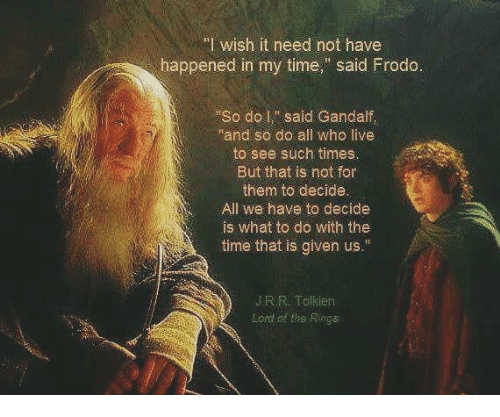
"...So do I,” said Gandalf, “and so do all who live to see such times. But that is not for them to decide. All we have to decide is what to do with the time that is given us.”When you're feeling hopeless, that has less to do with the conditions around you, than with what you've been distracted from within you, and in those moments it's the powerful and inspirational scenes from fictional works like The Lord of the Rings, that restore your inner flame and improve your effectiveness here and now. That sort of inspiration is what flows out of, and into us, from scenes such as Aragorn's 'Men of the West!' speech before charging the gates of Mordor, or of Sam & Frodo's struggle to take the One Ring to Mt. Doom,
"...Folk in those stories had lots of chances of turning back only they didn’t. They kept going. Because they were holding on to something.Our superficial 'realistic' certainty about how things will turn out, is not and should not be what defines and directs our actions, but acting in accordance with how you know that you should act, is. The memorable characters of story remind us that people are at their best and most admirable, not when they're worried about how well our petty circumstances will turn out for them, but when they realize that they should act as they should no matter how things might turn out for them, and we learn that not by argument, but by our own experience in responding to the characters and actions in the stories, and because of them we want to be better versions of ourselves by emulating them, here and now. What C.S. Lewis said in his Narnia stories
Frodo: What are we holding on to, Sam?
Sam : That there’s some good in this world, Mr. Frodo. And it’s worth fighting for..."
"Once a knig or queen of Narnia, always a King or Queen of Narnia", was well understood centuries before by George Washington when he saw to it that his troops had literature supplied or read to them, and had plays performed for them when conditions were at their worst, and that had not yet been forgotten by WWII when American soldiers were laden with Shakespeare as well as bullets, and they were because the timeless truths such stories lead their readers through, matter even and especially in times of war, in both it's tedious and terrifying moments.
For those foolish enough to mock such works as 'escapist fiction', do you not see the difference between seeking to forearm yourself to face unexpected dangers, and practicing denialism and defeatism of 'be realistic' in the face of them? What such literature provides us is the means to escape the darkness of the moment so as to see more clearly what is right and true, which helps you to understand better what you should do when faced with such moments here & now - that is not something to be turned away from, but something to be sought out and embraced so as to regain your ability to triumph over despair in the here and now. And for those truly softheaded folks, cynics who see themselves as being 'hardheaded realists' while admonishing you that "Things just don't happen that way in real life!"... it would be pointless and 'unrealistic' to remind them of the gems of history's unexpected twists and turns, from the Spartan's 'doomed' 300, to WWII's Dunkirk and the Battle of Britain, or of what was less likely to 'turn out well', than the American Revolution itself (which our Founder's swore their lives and sacred honor to wage against the most powerful nation on earth), because they will not see it. Yet the fact remains that those who shined brightest in those moments, were not acting on how certain they were that things would turn out well, but only that they were certain that things should turn out that way, but could not, unless they acted as they knew they should, as should we, whenever we find ourselves within such moments in time, or as one of George Washington's favorite lines in his favorite play, Cato, puts it:
“’Tis not in mortals to command success. But we’ll do more, Sempronius, we’ll deserve it.”And while we're at it, it's equally important to recognize the villainous nature that lurks behind the 'reasonable' appearances of Wormtongue-like advice to 'be realistic' and go along to get along, and give in to the evils besetting us - good fiction reveals to us that those aren't examples of being 'realistic', but of fleeing into a decrepit fantasy world of pretending you can know and foresee the results of all people's choices. Their pretense of being 'realistic' is not an example of strength, but of abject weakness which is advising you to flee from doing what you should do, and even a denial that you (and especially them) can know what you should - such notions as those are villainous and should be strenuously guarded against.
If you find yourself flirting with 'realistic' notions that you know what doom is to come, you should take notice of how such *wise and knowledgeable* folk as that are depicted in 'The Lord of the Rings', in the figures of Saruman the Wise, and Denethor the Steward of Gondor. Two proud leaders who sought confidence in seeing farther than they could, by viewing the world through Sauron's Palantir for facts to reassure them that their conclusions were the only ones that intelligent persons such as themselves could believe. When the Palantir let their eyes see the facts that 'the black fleet comes!', and that 'Frodo has been captured and lost the ring', their cynically 'realistic' expectations were satisfied that they need look no further for news or judgement, than their own minds. As true in fiction as in real life, the shortsighted vision of what they were unwilling to see, was lacking a context which they refused to allow for, blinding them to other possibilities than what they expected, and the context missing from what the Palantir showed them, such as that though the black fleet was coming, it was Aragorn who was now leading it, and that as Frodo had dropped the ring and been captured, Sam picked it up, freed him, and they continued on - showed the facts which the Palantir's reported for Sauron's News Network, were the purest of lies - and how much do you want to bet that in those final moments, their reactions were "That just isn't true!"? You may laugh, but you'd do better to not stare for too long into your own glowing Palantir, be it from the news, or your social media devices, and remember that, as Gandalf says,
“Even the very wise cannot see all ends.”, and to believe that you can, to think that you can and do know what is to come, despite all that you should know that you cannot possibly know, is arrogance, false pride, and, yes, corruption, and it results in your 'reality' being replaced, word by word, with a lie.
Resolving paradoxes
The paradoxical aspect of 'The Ship of Theseus' paradox, comes from our seeing the ship as only a sum of its parts, and in failing to see the 'One in the Many', we mistake the parts for the whole. But any whole, is more than simply its many pieces fit together - the intangibles of purpose and design are not found in those parts, but they are what lend importance to the actions we take, and the materials which we use to change those parts into a whole with. The 'Realistic' outlook of Materialism, is a soul-sucking worldview, and it will leave you awash in paradoxes.
The takeaway from 'The Ship of Theseus' paradox, is that it is built, and rebuilt, one plank at a time, in accordance with a design that's formed from a purpose, and it's important to realize that there is nothing that says that the paradox can't be employed in reverse, changing a vessel that has been corrupted, by deliberately restoring it, plank by plank, to its original purpose, design, structure and materials. It's even more important to realize that the planks in America's Ship of State are not wood, but are you, your friends, and your family, and that you have the ability to define the nature of what that one particular plank of the ship which you represent, will be - do you have the purpose and plan to set you apart from being a mere material plank? If so, you may even be able to influence a few of the planks around you, and that, which Aleksandr Solzhenitsyn pointed out, is an incredibly important, and deceptively powerful truth to be understood. The failure to grasp that truth, is one that - like Sauron's assumption that the Fellowship sought not to destroy the ring, but to use it - has been key to many a triumph that's gone unforeseen by 'the wise' and 'realistic', an understanding that once upon a time formed a critical part of the education which the children of The West were raised upon, and must regain if we are to continue.
Our 'educational system' has been the chief means of changing the purposes of our Ship of State (and of ourselves), and so became the means of corrupting it into something other than what it was intended to be, one plank at a time, and far from 'leading us out' of darkness and into living a good life in liberty with others, most schools today are intent on binding their students within rings of ideology which are fundamentally opposed to everything a 'well rounded education' was once understood to be and intended to do for you. Too many of us look upon the education we failed to receive, as a 'free pass' from suffering it's consequences because your schools failed you...It doesn't work that way. the good news though is that becoming an Autodidact (or Blogodidact 😎 ) is neither impossible nor unpleasant - it used to be a norm - and it doesn't take twelve or even four years, to get the basics of one, and there are more opportunities today to engage with others doing the same, than ever before. Just remember to be cautious where you go looking for an education from, and that as important as an education is, there's no more point in seeking a liberal education from those who delight in what is illiberal, than there is in seeking sweet wine from a bottle of vinegar.
If you choose to 'go to school to get a good job', then save yourself several years and tens of thousands of dollars and go to a trade school. Do that not because you don't need a 'well rounded education', but because (with few exceptions) you have less than zero chance of receiving such an education as that at a modern College or anywhere else within our establishment educational system, and the subject is far too important a matter to your life, to your children's lives, and to our nation, to entrust to the hands of 'educators' who feel compelled to deceive you for your own good. If your kids are in them, get them out. If you are in them, or teaching in them, get yourself out. Get an actual Education - you've got a much better chance of getting one on your own, than at any establishment school system (public or private).

"Some believe it is only great power than can hold evil in check, but that is not what I have found. It is the small everyday deeds of ordinary folk that keep the darkness at bay. Small acts of kindness and love.", to which I'd add Solzhenitsyn line to the 'great' "...Let them embrace everything, but not with any help from me..." You have and are one of the parts in America's Ship of Theseus paradox, and you have replaced someone who came before you, and someone will take yours, but before passing your place on to another, it is within your power to right the process within at least that one plank that is yours, and whatever you do to fix you & yours, is restoring the original body and soul of at least one part of the whole of the materials and design of America's Ship of State.
It remains to you, and it all may even depend upon you, and others like you, insignificant little Hobbits that you are, to simply do your part well. Even if you've failed all your life to do so, do what little you can, as well as you can, now, not by attempting something grand, but by doing something even more daring - refuse to play a part in the spreading of lies - "Let them embrace everything, but not with any help from me" - and do so because it is what you should do, and when you're told to 'be realistic!', to give in, that there's nothing you can do, simply answer back "That just isn't true", and do what you know you should... and leave it to the larger drama to unfold around you as it will.


