Showing posts with label Philosophy. Show all posts

Tuesday, August 18, 2026

'Critical Thinking' Fails its Socratic Paternity Test

If, as I contend, 'Critical Thinking' is and always has been a critical threat to sound reasoning (it has) - why did (do) otherwise intelligent people adopt and promote it? That's partly due to what we saw in the previous post, where its deceptive claims about what CT is and will 'do' for students, are furthered by the claim that 'Critical Thinking' is directly descended from what Socrates practiced at the dawn of Western philosophy. As has already been pointed out, these claims are clearly bogus, even on the basis of the title itself, as 'Critical Thinking' stretches no further back in time than to John Dewey in the 1890's (not actually using those words until 1910), and that the first book on 'Critical Thinking' wasn't published until 1941. But what needs to be better understood, which is the purpose of this post, is that worse than simply being technically incorrect about historic details (AKA: Lying), the substance and spirit of the claim is, at best, patently absurd.

Ironically (Socrates cheers), as their Socratic paternity claim is made to lull people into not thinking about what 'Critical Thinking' really is, if we subject 'Critical Thinking' itself to just the initial questions that Socrates might have begun with, it not only reveals itself to be a mismatch on the basis of its philosophical DNA, but it reveals how fundamentally incompatible that CT is to what Socrates was doing, and to why he was doing it, and so flat-out fails the Socratic paternity test.

At the dawn of moral philosophy some 2,500 years ago (can you feel Moses waving 'hi!' from across the sea?), Socrates had begun practicing his unique form of asking questions in a manner he called the Dialectic, to clarify the meaning of the words we use, and how to use them to better understand ourselves and the world around us. As Plato recounts it, his dialectical process began with asking someone a seemingly simple question about what had been claimed or repeated by them, and whether or not an obvious implication of that was something that they thought to be true. He'd continue questioning the answers given to his questions to reveal the extent and integrated nature of that knowledge (or lack of it), in the hopes that both the questioner and the person being questioned (and those of us participating in the dialog at home) would gain a better depth of understanding of what they did and did not know about what they had presumed to be so.

One thing that practicing his dialectical reasoning upon his fellow Athenians brought out into the open, was that those terms which Socrates' fellows' lives revolved around, in everything from the seemingly mundane, to the loftiest of sentiments, were so poorly understood by them, that their own words were leading themselves astray from what they expected they could secure by using them. Worse still, their lack of understanding was being used by those amongst them, the Sophists, who understood how to cultivate their confusion in order to disorder their minds into whichever state of passionate intensity or apathetic disregard, seemed to best serve the interests of a well-positioned few.

NOTE: You shouldn't read Plato to find 'answers' (that's a bad habit from 'Critical Thinking'), but to identify the questions, and how best to pursue understanding. 
One such dialog, the Euthyphro, is set where Socrates is waiting to be arraigned on the charges of impiety that he'd soon be executed for, and it recounts the conversation that followed from Socrates asking another fellow in 'the waiting room', about what he was there for. Euthyphro answered that he was there waiting to charge his father with 1st degree murder over the accidental death of a misbehaving fieldhand, because Euthyphro thought that would be the pious thing to do.

Socrates, a bit taken back by that, asked him what he meant by Piety? To which Euthyphro, as do most of Socrates' 'victims', replied with a surface level answer:
"Piety is giving an offering to the gods, or being respectful"
, and in typical fashion, Socrates began by clarifying what he'd asked, before launching into the dialog of further questioning the answers being given:
"You misunderstand me, you've given me examples of pious behavior, but I'm interested in what it is that Piety means..."
, and the dialogs get underway with Socrates attempting - oftentimes without succeeding - to clarify what the speaker actually meant by the words and terms they'd been carelessly using to think with.

Consider, for instance, Euthyphro charging his father with murder. His father had taken an action, and his slave died following it - that was an obvious and readily apparent fact. But whose action was it that caused the death, the father's or the slave's? And what was meant by 'Caused'? And was the action Just?

Without having questioned his way past the surface level of appearances, Euthyphro could not have the knowledge that only follows from examining the depths of context surrounding an issue, and acting 'as if' you already know what you haven't bothered to examine, causes consequences that cannot be good. Can justice be served by taking action against someone 'as if' you know what you haven't bothered to understand? Can such an action be pious? By disregarding the context of what happened, Euthyphro's pious action amounted to virtue signaling the pretense of it at his father's expense - how likely was it that (Zeus? Athena? The Furies?) would look kindly upon that?

By ignoring context, we butcher our grasp of causation into a materialistic "Cause & Effect" response, which is not adequate for gaining a sound understanding of an issue. Unfortunately for Euthyphro, Aristotle's study of Causation and the four causes which that revealed (final cause, efficient cause, formal cause, and material cause), was still several decades in the future, and Aquinas's 5th 'Exemplary cause', was still a thousand years beyond that. We, however, can benefit from what Euthyphro lacked... but how many of us do? As 'Critical Thinking' gives no consideration to such concerns, it helps to ensure that those numbers are few.

What the Socratic dialogs that Plato left us also demonstrate, is not only how little people often understand of what they're saying, but how angry they can become when made to face their own errors & ignorance - so much so that Socrates' was ultimately executed for refusing to stop practicing his dialectic of questioning upon the people of Athens.

What is critically important for us to understand still to this day, and perhaps especially today, is that it is as easy as it is unwise to behave as if we understand something, when the underlying meaning of the words we're using amounts to what 'everyone knows!', and without the context being clear to us, we truly cannot know what we are talking about.

The painful fact is that the real drama of history often ensues from those critical misunderstandings which result from the right questions having not been asked, or having been asked, were left unheeded. In fact, tragedians, comedians, and historians have long made their living by providing their audiences with an awareness of the context which the people 'on stage' lack, and without which they lead themselves into taking those unwise positions and actions that can only lead to disaster, while 'the audience' is left to experience the agony of knowing what could have been prevented if someone, anyone, would have simply asked one or two key questions that would have unraveled the entire awful turn of events.

But unlike an audience, we here in the present cannot know what might hinge upon what it is that we do not consider, or say, and we should learn from those dramatists that real knowledge is never isolated, and only (seemingly) ethically neutral in certain contexts. And we should also realize that the sophists of every age view those who ask and pursue questions as Socrates did, as threats to those whose interests are served by such matters not being common knowledge, and they view those who teach such lessons, as Socrates did, as being... unwelcome.

But being ignorant of important facts isn't nearly the problem that being ignorant of the need to ask relevant questions, is. The inclination to assume that we cannot know what is true, or that 'knowledge' is just a matter of recalling isolated facts, combine together with our willingness to accept 'obvious' facts and 'answers' that 'everyone knows!', to leave you forever 'just asking questions!' while never gaining an understanding of what an answer to them should be, which mainly benefits those who'd prefer they remain concealed by what 'everyone knows!'.

A Critical Difference between philosophical reasoning and 'Critical Thinking'
We saw in the previous post, that when asked what 'Critical Thinking' is, CT'rs standard reply to parents and the public, was very much like that of Euthyphro's reply about what Piety is, with:
"Critical thinking is a kind of thinking in which you question, analyze, interpret, evaluate and make a judgement about what you read, hear, say, or write...."
, and with Socrates's response as an example, we can see that we should reply to those CT'rs:
"You misunderstand me, you've given me examples of 'Critical Thinking's behavior, but I'm interested in what it is that 'Critical Thinking' means..."
, but to be fair, as that is clearly not the kind of thinking that 'Critical Think'rs are familiar with, we, like Socrates, should clarify a little further about just what kind of reply it is that we're looking for, and why. When we feel ourselves being either stirred up into anger or lulled to sleep by another's words, as you feel their words taking ahold of you, you should do as he did and question the nature of the context that they're leading you into. Ask:
  • What ends will the good or ill passions you're being led to feel, serve to excuse, distract you from, or accomplish?
  • Is what is meant by the words being used to urge you on, going to have the same meaning when they're being applied?
  • Who benefits most from the actions you're being led to take?
, and despite his famously protesting that he knew nothing, Socrates clearly understood the importance of knowing the meaning of the words you're thinking with. He knew how the overall context that those words are used in, could shift what is assumed to be meant by them, and he knew that it's only by asking and pursuing questions into that as yet shadowy context, that we can hope to understand whether the positions and actions that people are being led into taking, are of value or not, are true or false, or right or wrong, which are matters that shouldn't remain concealed through our ignorance of it.

Socrates referred to the practice of his dialectic, as Philosophy, 'the love of wisdom', and it was clear that he considered Philosophy to be - in a way that has been made nearly alien to our ears today - a deeply moral matter of consciously using our language to integrate our understanding of reality, so as to develop our knowledge of what is real & true and right & wrong to do, and without which we cannot know what it is that we're talking about.

Having a systematic approach to understanding what it was that Socrates's dialectical practice of philosophical reasoning meant and entailed, would have to wait for his philosophical son & grandson, Plato and Aristotle, to begin developing. But it was his persistent engagement of his fellows in those habits of inquiry (which (no surprise to him) would eventually cost him his life), that started the Grecco/Roman half of The West upon the path towards seeking an objective understanding of what is real & true, and right & wrong, and which, IMHO, was and is central to what enabled its Judeo/Christian counterpart to join together with it, in the forming of Western civilization.

Socrates starts opening a can of worms with a leading sophist, in The Gorgias: ...
SOCRATES: Very good, Callicles; but will he answer our questions? for I want to hear from him what is the nature of his art, and what it is which he professes and teaches; he may, as you (Chaerephon) suggest, defer the exhibition to some other time.
CALLICLES: There is nothing like asking him, Socrates; and indeed to answer questions is a part of his exhibition, for he was saying only just now, that any one in my house might put any question to him, and that he would answer.
SOCRATES: How fortunate! will you ask him, Chaerephon—?
CHAEREPHON: What shall I ask him?
SOCRATES: Ask him who he is...."
Socrates' opponents at the time, the Sophists, OTOH, were already well aware of the misunderstandings that the misuse of language could create, and rather than attempt to clarify what our words mean and how best to use them, they thrived upon that darker form of dialectical reasoning which cultivates the ignorance & errors that result from an absence of good questions being asked, and in fact depends upon utilizing ignorance and the ambiguities of language to conceal meaning. Their skill in the manipulation of that, was what the Sophists were sought out and rewarded for.

Sophistry requires the ability to get away with treating words and terms 'as if' their meaning is disintegrated from the rest of what you know, and that depends upon a widespread view of knowledge being seen as little more than the ability to recall what's useful in one moment, and to consider that completely irrelevant to the concerns of the next moment. That Pragmatic view of knowledge as essentially having 'meaning' in name only (another variant of Nominalism), is what enables the sort of language that we accept today in phrases such as 'Truth is an illusion' and 'Truth is what works', which is critical for spurring people into taking those positions and actions that serve a given narrative which they likely know less than nothing about (hello 'stay 6' apart for social distancing'!), for a 'common good' that primarily serves the interests of those that the sophists of the Ideological Observatories serve.

And so with that contrast between Socrates' Philosophical Reasoning, and that of Rhetorical Sophistry in mind, I hope you're recalling two of the primary contentions of the Critical Thinking crowd from the previous post, which are that:
1)“...a student attains 'higher order thinking' when he no longer believes in right or wrong"
, and that that assertion is dependent upon the view of 'knowledge' that Bloom's Taxonomy of Educational Objectives has been teaching to those who've been teaching our teachers since the 1950s, that 'knowledge' is only a matter of recalling "...previously learned material...", and as such, it:
2)"...represents the lowest level of learning outcomes in the cognitive domain."
, and if so, you should now recognize - if you are thinking reasonably rather than 'critically' - that both of these beliefs that are at the heart of 'Critical Thinking', are in full opposition to the deeply integrated knowledge and moral clarity of thought that Socrates was pursuing through his Dialectic.

And seeing now why the CT'rs reply to the question of what 'Critical Thinking' is, is so much like Euthyphro's, we can compare and contrast what Socrates' purpose of using his Dialectic to pursue Philosophy was, to the nature of the 'Critical Thinking' that our modern day sophists teach in our schools, and notice just how unlike that is to Socrates' method, which sought to understand and integrate our thinking, and to expand our knowledge in order to better do what Aristotle said in the opening of the Nichomachean Ethics:
"Every art and every inquiry, and similarly every action and pursuit, is thought to aim at some good; and for this reason the good has rightly been declared to be that at which all things aim ..."
In complete contrast to that, what the sophistry of 'Critical Thinking' aims at, is what is momentarily useful to ends that can only be unworthy, because they are achieved by diminishing the nature of our knowledge to a recalling of random facts as suitable 'answers', and with which CT'rs seek to bring about an attitude within a student's mind, that:
“...a student attains 'higher order thinking' when he no longer believes in right or wrong"
On that basis alone, any reasonable consideration of the evidence before us, shows that 'Critical Thinking' not only fully and completely fails the Socratic paternity test, but reveals that the claim could only have been made, in order to put you and your children under its power. You needn't fear that this failed paternity test will leave our 'Critical Thinkers' as philosophical orphans though, for since it was also the Sophists' primary interest to get people to act without considering whether such actions were 'right or wrong', and instead to just do 'what works', we have identified that our 'Critical Thinkers' philosophical pedigree truly lies with the Sophists.

The authentic intelligence that leads people out of the darkness of confusion and into seeking to see and do what is right, comes from turning your own attention towards actively identifying what is (Metaphysics), how you know it (through an epistemology of Causality and Logic), and what should be done in response to that (Ethics), and will reveal to you a depth of context in every aspect of your life, that can only be revealed by the light of what is real and true.

Because the Sophist's power - then and now - depends upon those manipulations of language that are only possible within a climate of subtle misunderstandings and meaningless 'knowledge', their 'Critical Thinking', like Euthyphro, blinds themselves into believing that they can see what they do not, and if we are not aware of their doing so, we put ourselves in peril.

To prevent the same old sophistry from becoming as fatal to us today, as it was to Socrates in his day, it is critical for us to stop mistaking the Artificial Intelligence of 'Critical Thinking', for the real thing, and we'll dig further into that, in the next post.

Saturday, October 28, 2023

Epistemology: You keep using that word - 1

In the movie the Princess Bride, in response to his Sicilian employer repeatedly blurting out the word 'unbelievable!', the character Inigo Montoya utters what has become an iconic and meme-tastic line:
"You keep using that word, I don't think it means what you think it means."
, which makes it the perfect lead-in for discussing Epistemology. Why? Because too often its origins and official meaning, are at odds with its history & modern practices, which, given that the term is concerned with verifying the truth of what we know and how we know it, is deliciously ironic.

But, to avoid the Inigo Montoya treatment, before going into that use and abuse, we should clarify what the word means, which the search-engine branch of the Oxford English Dictionary defines as:
e·pis·te·mol·o·gy
/əˌpistəˈmäləjē,eˌpistəˈmäləjē/
_noun_ PHILOSOPHY
1. the theory of knowledge, especially with regard to its methods, validity, and scope. Epistemology is the investigation of what distinguishes justified belief from opinion.
"he grappled with metaphysics and epistemology in his writings and sermons"
Fair enough. However the 3rd and 4th lines of the Encyclopedia Britanica online, reveals something that's worth giving your attention to:
epistemology, the philosophical study of the nature, origin, and limits of human knowledge. The term is derived from the Greek epistēmē (“knowledge”) and logos (“reason”), and accordingly the field is sometimes referred to as the theory of knowledge. Epistemology has a long history within Western philosophy, beginning with the ancient Greeks and continuing to the present. Along with metaphysics, logic, and ethics, it is one of the four main branches of philosophy, and nearly every great philosopher has contributed to it.
, which is more than a little bit, shall we say, 'misleading'. The site etymology online provides an important clue as to why I say that, with:
epistemology (n.) "theory of knowledge," 1856, coined by Scottish philosopher James F. Ferrier (1808-1864) from Greek episteme "knowledge, acquaintance with (something), skill, experience," from Ionic Greek epistasthai "know how to do, understand," literally "overstand," from epi "over, near" (see epi-) + histasthai "to stand," from PIE root *sta- "to stand, make or be firm."
Do you notice a wee bit of discrepancy between the claim that 'Epistemology' traces its history as the '4th branch of philosophy' back to the classical era of Socrates, Plato, and Aristotle, and the fact that the word was first coined by a Scotsman in 1856?!

How did a term coined by an obscure Scotsman, James F. Ferrier, become accepted in modernity as the name for their 'ancient' and oh-so important '4th branch of philosophy'? Possibly because the name for that part of the German idealism behind their new '4th branch's system for 'justified belief', 'Wissenschaftslehre', wasn't exactly a catchy term, and even though it was doing an impressive job of dividing knowledge from reality, it was far too cumbersome and thoroughly modern sounding of a term to be credibly associated with the 'great philosophers' of ancient Greece, who plainly could have had no knowledge of either it or their new '4th branch of philosophy'.

The word 'Epistemology', OTOH, coined from the Greek term 'Episteme', which Aristotle had used in his metaphysics for one of the forms of knowledge, looked and sounded the part, and it could easily be used to work modernism and the 'great philosophers' of ancient Greece, into the same breath. Taking a glance at an Engram viewer (which references the number of mentions of a term in the libraries of books that've been scanned), together with a helpfully misleading reference from, of all places, Wikipedia, illustrates that the new term had come into 'popular' usage in less than a century, which helped serve an additional purpose:
"Luciano Floridi considers that there was a "renaissance" of epistemology between the two world wars. He describes it as "a bridge between early modern and contemporary philosophy of knowledge."[13] ..."
, and true to its misleading origins, we can cue Inigo Montoya once again here, over associating with the word 'bridge', as it's use has less to do with being a 'bridge' between competing modern philosophies, than as an offramp created to detour unwary thinkers away from any remaining paths to premodern philosophy; it's used to give the impression that the only worthwhile philosophical destinations were (are) one or more of modernity's many fractious varieties, while at the same time portraying any classical alternatives as little more than pesky footnotes (IYKYK) that aren't worth exploring.

And that's why I say that Inigo Montoya's "You keep using that word, I don't think it means what you think it means.", is the perfect meme for modern 'Epistemology'.

Epistemology: A method in need of its meaning
To be 'fair', my identifying 'Epistemology' as the '4th branch of Philosophy', is a matter of convenience, as a quick search will show you that modernity now refers to anywhere from three to ten or more 'branches', most of which differ even on which branch is first, let alone fourth, as well as multiple variations such as having Ethics paired with Esthetics as minor branches under Axiology as the 'major' branch for studing 'value', and so on.

Following after Socrates' time, when philosophy essentially consisted of one branch, the 'love of wisdom', somewhere between Aristotle (who saw Logic as a tool, not a branch) and the Stoics (who did view Logic as a branch), and began to be classify it along the lines of three major questions of 'First Philosophy':
1 - 'What is there to know?' (Metaphysics, physics, sciences, etc.),
2 - 'How do I know that?' - Logic, mathematics, etc.,
3 - 'What should I do about that?' Ethics, politics, economics, aesthetics (art), rhetoric, etc.,
, which in time became referred to as the major and minor branches of philosophy.

The problem with the Modern's use of 'branches', is that by treating them as separate and distinct compartments, rather than integrated features of one philosophy, they are used to limit & control philosophical thought, creating and exploiting divisions within it.
For those with an interest in how Philosophy developed, this link gives a fascinating tour of that, some of which I agree with, much of which I do not (especially with the site's approval of Wittgenstein - gack!), but all of which is interestingly, and for the most part, fairly, presented.
The truth is, of course, that despite never having had use of the term 'Epistemology', a deep concern for the nature, meaning, and validation of knowledge, was something that philosophers from Socrates (who lost his life in that pursuit) to Aquinas were very much driven by. While Thales of Miletus is usually credited as having been the first philosopher, what he began wondering about was the physical world around us, it was Socrates who first began methodically wondering about what it is we do when thinking, and why, which his student Plato elaborated upon in his dialogs, and which Plato's student, Aristotle, reformulated into the first means for establishing an intelligible framework and systematic means for seeking, justifying, and conveying, our knowledge of what is real and true, and what to do about that.

How the ancients managed to do that without the use of modernism's shiny new '4th branch of Philosophy', was by not approaching philosophy as a conglomeration of compartmentalized 'branches', but by employing philosophy as a system whose features enabled us to examine and give guidance for your thinking, from "First Principles" (Metaphysics) that root your reasoning in experience, and identifying what is, and what truth is, through the three forms of knowledge we grasp all of that through, together with the analytics which uses logic to validate your knowledge (as a carpenter would use a tool), with ethics clarifying how to properly respond in light of what you know to be real and true, and how best to express that through the rhetoric and poetics. In short, in their view the purpose of philosophy - the love of wisdom - not only required your being able to meaningfully know what is real and true, and how to justify it, that was central to philosophy as a whole, rather than one of a number of compartmentalized branches that tend to produce incomprehensible answers bereft of meaning, as it tends to operate in our world today.

From classical times on up into the Renaissance, not only had philosophy provided the means for bringing method and clarity to how people thought, it also stressed the importance of exposing those shadowy notions which sophists are so adept at using to acquire the power to operate within and upon society. But of course, as what the modernists desire most is the power to reinvent reality in their own image, they needed those shadowy uncertainties to operate within, and so to one degree or another, they all - from Descartes through Hegel, and on down the line to today - gravitated towards ever more clever means to 'muddy the waters to make them appear deep'.

As it turned out, the Scotsman's new 'ancient term' of 'Epistemology' gave a useful appearance of legitimacy to the modernist's new '4th branch of philosophy', and ever since then, it (in actual practice, rather than its supposed meaning) has been the primary tool for moving the philosophical goal posts away from what can be known to be real and true, and over onto the turf of whichever ideology seems most suited to the moment for steering popular thought away from the clarity and wisdom of premodern philosophy, which had for over two thousand years made modernity's new tool and branch unnecessary.

And yet with all that having been said, I've often spoken of the importance of Epistemology... why? Because despite my hostility to how the term has been foisted upon us and to how it is routinely misused & abused, the fact is that Epistemology - its purported meaning, rather than its modern practice - entails the unified application of metaphysics, logic, and ethics, and anyone who takes the time to employ the term in accordance with its proper meaning, will regain the ability to safely navigate around the many booby-traps that modernity has positioned in our path, and every instance of doing so helps with putting the West back upon solid ground again.

We'll look at how to align what Epistemology does, with what the word means, over the next few posts.

Friday, May 07, 2021

Facing America's troublesome Ship of Theseus paradox, with 'Live not by lies', and The Lord of the Rings (pt 2 of 2)

In yesterday's post I pointed out how considering 'The Ship of Theseus' paradox, reveals how easily surface changes can falsely appear to be significant, while a too shallow consideration of seemingly small changes, can fundamentally alter, and even corrupt, something or someone into being what they once were not, and yet appear not to have changed at all. A consequence of that is a tendency of those who see themselves as being fact based 'realists', to calculate themselves into a fictional sense of being able to see what the future really holds, forgetting that.... always shifting, the future is. And as our common reactions to new interpretations of once fixed terms tends to be "That just isn't true!", we are in danger of succumbing to the fear that 'America is now America in name only'.

There are those who'd very much like to see that fear come true, and especially as they know full well that it is not yet true, having you believe the lie of it is of supreme importance to them. The reality is that until those who so love power, have total power over us, they do still need something more from us, and we should understand what that is, because it is critical to our identity and to the possibility of restoring it. That's why I thought it was such fortunate timing that 'The Ship of Theseus' paradox - 2,500 year old metaphysical consideration of identity and change - was suddenly popularized earlier in the year in an episode of the TV show WandaVision, and if you are in the habit, as most are, of deciding the nature of identity and change on the basis of appearances, you really need to take that paradox more seriously, and especially what it is that causes something to be what it is, or to no longer be what it might still appear to be (see yesterday's post).

As to what those seeking power over you, need from you, have you given any thought to what it is that they require from you? Do you think that they need you to believe them? We so often say "That just isn't true!" as if we expect someone to acknowledge that they've been caught, confess, and put things aright. 

Does that sound plausible to you? Let's take a quick review of where it is you think we are:
Do you really think, that they think, that you believe, that the FBI is truly seeking to uphold the Law? Or that their forming a commission to look into packing the Supreme Court, is motivated by a desire for Justice? Do you really think that they expect you to believe that racists who're wistfully advocating genocide, care about Justice - social or otherwise? If they had little or nothing to say about the daily riots & violent attacks upon the federal justice building in Portland, do you think, that they think ,that you believe, that their ranting over one particular riot on Jan 6th has had anything to do with a concern for either peace, law & order, or Justice? Do the the Marxist founders of BLM who just bought a million dollar home in a predominantly white neighborhood (and three other homes), expect you to believe that they care about either Marxism or black lives? You and they both know that their praising & promoting songs like WAP & transgender story hour for kids, while condemning Dr. Seuss books as being harmful to kids, has nothing at all to do with a concern about what's good for kids (not that Dr. Seuss is all that good, but that's another story).
Are you getting the picture? The Covid Relief bill was not passed to relieve Americans, but to ingratiate politicians with influential players around the world, 'anti-racism' isn't an effort to oppose 'systemic racism', it's an attempt to impose an explicitly racist system upon us all, and HR1 is not an act to preserve voter integrity, but to eliminate it, so as to complete their 'maintenance' of America's own Final and Formal Causes into passing that point where America no longer bears even a passing resemblance to what America once was.

They're not doing what they're doing because they're concerned about your thinking "That isn't true!" - Truth isn't their value, power is, and they need more of it. They don't need you to believe them to gain more power from you, they only need you to go along with their making these changes for just... a... little bit... longer, and to be able to do that, there is something that they desperately do still need from you (are you 'them' or you?), and you do still have the power to deny it to them.

Aleksandr Solzhenitsyn, who knew a thing or two about not just standing up to, but winning against totalitarian thinking, wrote an essay "Live not by lies", and in advising what to do when faced with a system which persists in telling what you and they both know to be lies, he noted that:
"...When violence intrudes into peaceful life, its face glows with self-confidence, as if it were carrying a banner and shouting: “I am violence. Run away, make way for me—I will crush you.” But violence quickly grows old. And it has lost confidence in itself, and in order to maintain a respectable face it summons falsehood as its ally—since violence can conceal itself with nothing except lies, and the lies can be maintained only by violence. And violence lays its ponderous paw not every day and not on every shoulder. It demands from us only obedience to lies and daily participation in lies—all loyalty lies in that.

And the simplest and most accessible key to our self-neglected liberation lies right here: Personal non-participation in lies. Though lies conceal everything, though lies embrace everything, we will be obstinate in this smallest of matters: Let them embrace everything, but not with any help from me..."
His point is a deceptively powerful one, in that holding to what is true, and refusing to participate in the lie, is devastating to those who rely upon the power of their being feared, obeyed and accepted, all of which is dependent upon people accepting their lies. While admittedly our situation doesn't look good at the moment, we need to remember that appearances can be deceiving, and examining them is a giant step towards freeing ourselves from them.

Which brings us back around to 'The Ship of Theseus' paradox, and in looking at all of the substitutions that've been made, the more worthwhile question for us today is not is America still America, but can it become more like America again - and what would that involve? You can, and certainly do, know that the situation is bad right now, and you may be painfully aware that you do not see a way out of our situation, but that does not mean that there is no way out, it only means that you, me, we, are as yet unable to perceive it.
 
Fictional Realism
There is still the possibility, due to what we are not in a position to know, for our chapter of this story to end in ways that the wisest amongst us would not predict and cannot imagine. More than that, it is important to realize that denying that, is itself a corrupting aspect of the totalitarian mindset - a mindset that is and must be shared by both those in power and by those they rule over - it is an an act of believing that what is not and cannot be known, is certain, inevitable, and that it's 'unrealistic' to think otherwise. Faking reality is not being 'realistic', and you should beware the temptation of that, for it's a fatal one. Don't deny the harsh reality before you, but do deny that reality must somehow conform to your presumptions (or fears) of it, rather than the other way around. That subtle reversal of cause and effect is the mainspring of the darker transformations, which have been operating upon us since at least the time of Descartes.

That call to 'be realistic' is a deceptive one, and is the stock in trade of the morbid fact-checkers of the 'News' of what happens to have happened here, and there, and they're deeply invested in pretending to know what cannot be known ('experts say...'), yet despite the routine failure of their assertions and predictions (President Hillary could not be reached for comment about sixty years worth of predictions of the world ending in a decade), such 'realistic' notions have even less of true use to tell us about how to deal with the problems of the here & now. Once upon a time we understood that grappling with what is timelessly true is more important than faking it, even though it can have frightening consequences to who we think we are, and are willing to be. What was also once understood, was that if you left it to the 'here and now' to grapple with such issues, you'd be beaten to a pulp by them - if you want to have a fighting chance in life, that requires venturing beyond the appearances of the moment by stepping into the poetic realm of stories and works of fiction. Realizing that, it was once a commonplace for us to teach our children not just to read widely, but to memorize passages of scripture and poetry, a habit which most continued throughout adulthood, for pleasure, inspiration, and to have the support in their minds to aid them in carrying on through those darker moments which naturally incline us all towards hopelessness and despair. 

Perhaps the most tragic consequence of our pragmatic 'education reforms' and their shallow economy centric focus, has been that the formative stories of Western Civilization - its true substance and value - were among the first to be eliminated from our schools, and generations of children have been reared without the interest in or ability to transmit America's first and 'Final Cause's from one generation to the next (I highly recommend reading 'The Story Killers', which tells that tale so well). The crowded roles of the addicted and apathetic are made of those who never learned how to *escape* into the poetic and bring meaning back into their daily lives, and so instead they flee from life into intoxication and defeatism.
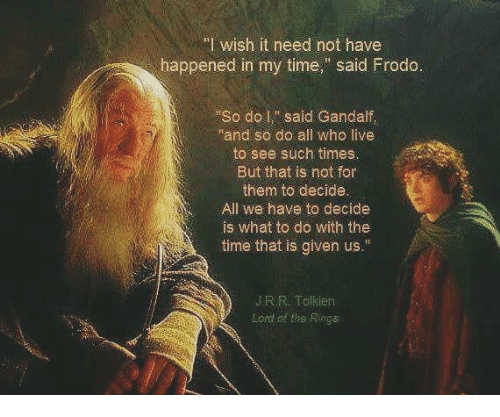
Even so, we haven't yet given up on such stories altogether, and there are far worse places we could turn to for the value in them than to works such as J.R.R. Tolkien's 'The Lord of the Rings', where the most meaningful questions of 'real life' are raised, their often frightening aspects confronted, and the stakes involved are made more clear than any news report could ever 'hope' to. What we stand to gain from such adventures, is not entertainment - though that too - but the real ability to see a way forward by seeing more clearly what we should be focusing on and why, as when in replying to the Hobbit's wishing that such dark times had not come, Gandalf the wizard replies:
"...So do I,” said Gandalf, “and so do all who live to see such times. But that is not for them to decide. All we have to decide is what to do with the time that is given us.”
When you're feeling hopeless, that has less to do with the conditions around you, than with what you've been distracted from within you, and in those moments it's the powerful and inspirational scenes from fictional works like The Lord of the Rings, that restore your inner flame and improve your effectiveness here and now. That sort of inspiration is what flows out of, and into us, from scenes such as Aragorn's 'Men of the West!' speech before charging the gates of Mordor, or of Sam & Frodo's struggle to take the One Ring to Mt. Doom,
"...Folk in those stories had lots of chances of turning back only they didn’t. They kept going. Because they were holding on to something.
Frodo: What are we holding on to, Sam?
Sam : That there’s some good in this world, Mr. Frodo. And it’s worth fighting for..."
Our superficial 'realistic' certainty about how things will turn out, is not and should not be what defines and directs our actions, but acting in accordance with how you know that you should act, is. The memorable characters of story remind us that people are at their best and most admirable, not when they're worried about how well our petty circumstances will turn out for them, but when they realize that they should act as they should no matter how things might turn out for them, and we learn that not by argument, but by our own experience in responding to the characters and actions in the stories, and because of them we want to be better versions of ourselves by emulating them, here and now. What C.S. Lewis said in his Narnia stories
"Once a knig or queen of Narnia, always a King or Queen of Narnia"
, was well understood centuries before by George Washington when he saw to it that his troops had literature supplied or read to them, and had plays performed for them when conditions were at their worst, and that had not yet been forgotten by WWII when American soldiers were laden with Shakespeare as well as bullets, and they were because the timeless truths such stories lead their readers through, matter even and especially in times of war, in both it's tedious and terrifying moments.

For those foolish enough to mock such works as 'escapist fiction', do you not see the difference between seeking to forearm yourself to face unexpected dangers, and practicing denialism and defeatism of 'be realistic' in the face of them? What such literature provides us is the means to escape the darkness of the moment so as to see more clearly what is right and true, which helps you to understand better what you should do when faced with such moments here & now - that is not something to be turned away from, but something to be sought out and embraced so as to regain your ability to triumph over despair in the here and now. And for those truly softheaded folks, cynics who see themselves as being 'hardheaded realists' while admonishing you that "Things just don't happen that way in real life!"... it would be pointless and 'unrealistic' to remind them of the gems of history's unexpected twists and turns, from the Spartan's 'doomed' 300, to WWII's Dunkirk and the Battle of Britain, or of what was less likely to 'turn out well', than the American Revolution itself (which our Founder's swore their lives and sacred honor to wage against the most powerful nation on earth), because they will not see it. Yet the fact remains that those who shined brightest in those moments, were not acting on how certain they were that things would turn out well, but only that they were certain that things should turn out that way, but could not, unless they acted as they knew they should, as should we, whenever we find ourselves within such moments in time, or as one of George Washington's favorite lines in his favorite play, Cato, puts it:
“’Tis not in mortals to command success. But we’ll do more, Sempronius, we’ll deserve it.”
And while we're at it, it's equally important to recognize the villainous nature that lurks behind the 'reasonable' appearances of Wormtongue-like advice to 'be realistic' and go along to get along, and give in to the evils besetting us - good fiction reveals to us that those aren't examples of being 'realistic', but of fleeing into a decrepit fantasy world of pretending you can know and foresee the results of all people's choices. Their pretense of being 'realistic' is not an example of strength, but of abject weakness which is advising you to flee from doing what you should do, and even a denial that you (and especially them) can know what you should - such notions as those are villainous and should be strenuously guarded against.

If you find yourself flirting with 'realistic' notions that you know what doom is to come, you should take notice of how such *wise and knowledgeable* folk as that are depicted in 'The Lord of the Rings', in the figures of Saruman the Wise, and Denethor the Steward of Gondor. Two proud leaders who sought confidence in seeing farther than they could, by viewing the world through Sauron's Palantir for facts to reassure them that their conclusions were the only ones that intelligent persons such as themselves could believe. When the Palantir let their eyes see the facts that 'the black fleet comes!', and that 'Frodo has been captured and lost the ring', their cynically 'realistic' expectations were satisfied that they need look no further for news or judgement, than their own minds. As true in fiction as in real life, the shortsighted vision of what they were unwilling to see, was lacking a context which they refused to allow for, blinding them to other possibilities than what they expected, and the context missing from what the Palantir showed them, such as that though the black fleet was coming, it was Aragorn who was now leading it, and that as Frodo had dropped the ring and been captured, Sam picked it up, freed him, and they continued on - showed the facts which the Palantir's reported for Sauron's News Network, were the purest of lies - and how much do you want to bet that in those final moments, their reactions were "That just isn't true!"? You may laugh, but you'd do better to not stare for too long into your own glowing Palantir, be it from the news, or your social media devices, and remember that, as Gandalf says,
“Even the very wise cannot see all ends.”
, and to believe that you can, to think that you can and do know what is to come, despite all that you should know that you cannot possibly know, is arrogance, false pride, and, yes, corruption, and it results in your 'reality' being replaced, word by word, with a lie.

Resolving paradoxes
The paradoxical aspect of 'The Ship of Theseus' paradox, comes from our seeing the ship as only a sum of its parts, and in failing to see the 'One in the Many', we mistake the parts for the whole. But any whole, is more than simply its many pieces fit together - the intangibles of purpose and design are not found in those parts, but they are what lend importance to the actions we take, and the materials which we use to change those parts into a whole with. The 'Realistic' outlook of Materialism, is a soul-sucking worldview, and it will leave you awash in paradoxes.

The takeaway from 'The Ship of Theseus' paradox, is that it is built, and rebuilt, one plank at a time, in accordance with a design that's formed from a purpose, and it's important to realize that there is nothing that says that the paradox can't be employed in reverse, changing a vessel that has been corrupted, by deliberately restoring it, plank by plank, to its original purpose, design, structure and materials. It's even more important to realize that the planks in America's Ship of State are not wood, but are you, your friends, and your family, and that you have the ability to define the nature of what that one particular plank of the ship which you represent, will be - do you have the purpose and plan to set you apart from being a mere material plank? If so, you may even be able to influence a few of the planks around you, and that, which Aleksandr Solzhenitsyn pointed out, is an incredibly important, and deceptively powerful truth to be understood. The failure to grasp that truth, is one that - like Sauron's assumption that the Fellowship sought not to destroy the ring, but to use it - has been key to many a triumph that's gone unforeseen by 'the wise' and 'realistic', an understanding that once upon a time formed a critical part of the education which the children of The West were raised upon, and must regain if we are to continue.

Our 'educational system' has been the chief means of changing the purposes of our Ship of State (and of ourselves), and so became the means of corrupting it into something other than what it was intended to be, one plank at a time, and far from 'leading us out' of darkness and into living a good life in liberty with others, most schools today are intent on binding their students within rings of ideology which are fundamentally opposed to everything a 'well rounded education' was once understood to be and intended to do for you. Too many of us look upon the education we failed to receive, as a 'free pass' from suffering it's consequences because your schools failed you...It doesn't work that way. the good news though is that becoming an Autodidact (or Blogodidact 😎 ) is neither impossible nor unpleasant - it used to be a norm - and it doesn't take twelve or even four years, to get the basics of one, and there are more opportunities today to engage with others doing the same, than ever before. Just remember to be cautious where you go looking for an education from, and that as important as an education is, there's no more point in seeking a liberal education from those who delight in what is illiberal, than there is in seeking sweet wine from a bottle of vinegar.

If you choose to 'go to school to get a good job', then save yourself several years and tens of thousands of dollars and go to a trade school. Do that not because you don't need a 'well rounded education', but because (with few exceptions) you have less than zero chance of receiving such an education as that at a modern College or anywhere else within our establishment educational system, and the subject is far too important a matter to your life, to your children's lives, and to our nation, to entrust to the hands of 'educators' who feel compelled to deceive you for your own good. If your kids are in them, get them out. If you are in them, or teaching in them, get yourself out. Get an actual Education - you've got a much better chance of getting one on your own, than at any establishment school system (public or private).
And here it's worth noting one of the epic tale's truest statements, where Gandalf says:
"Some believe it is only great power than can hold evil in check, but that is not what I have found. It is the small everyday deeds of ordinary folk that keep the darkness at bay. Small acts of kindness and love."
, to which I'd add Solzhenitsyn line to the 'great' "...Let them embrace everything, but not with any help from me..." You have and are one of the parts in America's Ship of Theseus paradox, and you have replaced someone who came before you, and someone will take yours, but before passing your place on to another, it is within your power to right the process within at least that one plank that is yours, and whatever you do to fix you & yours, is restoring the original body and soul of at least one part of the whole of the materials and design of America's Ship of State. 

It remains to you, and it all may even depend upon you, and others like you, insignificant little Hobbits that you are, to simply do your part well. Even if you've failed all your life to do so, do what little you can, as well as you can, now, not by attempting something grand, but by doing something even more daring - refuse to play a part in the spreading of lies - "Let them embrace everything, but not with any help from me" - and do so because it is what you should do, and when you're told to 'be realistic!', to give in, that there's nothing you can do, simply answer back "That just isn't true", and do what you know you should... and leave it to the larger drama to unfold around you as it will.

Thursday, May 06, 2021

Facing America's troublesome Ship of Theseus paradox, with 'Live not by lies', and The Lord of the Rings (pt 1 of 2)

Isn't "That just isn't true!", one of the more common reactions we have towards nearly everything we're faced with today? If it were just lying liars lying, it wouldn't be quite so bad, but as terms which were once understood to have unchangeably fixed meanings, such as Freedom of Speech, Racism, Justice, Education, etc., are now being used to convey radically different meanings in what is widely being accepted, tolerated and popularized in society today, we see the ludicrous presented as being scientific, the ugly as being attractive, obscenity as virtue, the despicable as being admirable, and injustice as Justice, so that the sense of "That just isn't true!" seems to permeate the very air. In other words, our words remain the same in name only - what better timing could there be for 'The Ship of Theseus' paradox to have resurfaced?


The Avengers' themed TV show 'WandaVision', recently got this 2,500 year old philosophical paradox on the nature of identity & change to begin trending on the web, when the virtual android, Vision, was made to confront a physical copy of himself, and so began asking about the essential nature of what something IS. If you missed the episode, or Philosophy 101, it refers to how for centuries the Athenians had preserved and maintained the ship which the hero Theseus was supposed to have returned to Athens in, after having slain the Minotaur. The paradox points out that as maintaining Theseus's ship required repairing or replacing its aged and damaged planks, there eventually must have come a point where no original material of the ship which Theseus and his crew had sailed on, remained within the ship that they were so carefully maintaining, and so it asks:
Is 'The Ship of Theseus' still the same ship? If so, how, and if not, at what point of change did it stop being what it originally was?
The 'common sense' answer, that Theseus's ship can't be the same ship because it's made of different parts, doesn't age well, and is particularly troublesome as you realize that your own body is not made of the same cells & minerals as it was some years ago. The Ship of Theseus paradox is troublesome, but it's also well worth asking because it's good for us to realize that the 'common sense' answers we are often so quick to give, often depend upon the thinnest of surface appearances which are too shallow a means for identifying what that ship, or anything else, is. Working our way through such paradoxes, leads us into a deeper understanding of identity and change, by asking: what do we mean by what something is, and how can we make changes to it and have it remain meaningfully the same? 

Can we change and remain the same? Well... consider the source: Are you still you?

Getting a better understanding of what we mean, requires going beyond appearances, which is what Aristotle was doing when he identified Four Causes which are essential to what makes something what it is, and in his hierarchical system, matter, the Material Cause, that 'out of which something is made' - is the last and possibly least important of those causes. The Formal Cause, 'the design and form of what-it-is-to-be', precedes that and directs what matter will be used, and how; prior to that and more essential still, is the Efficient Cause, 'the primary source of the object' coming into being, as with the making of the ship by its maker, who creates it from a design which calls for those materials that are to be used in it; and finally there's the Final Cause, 'the end, that for the sake of which a thing is done', which is the initial source that provides the purpose for what is being made - the reason why it is made, and why it was made as it was. The ship that Theseus and his crew took to sail home in, consisted of more than the surface of its parts - which they may or may not have touched - and when a plank of the ship is replaced, the rest of it's matter, form, workmanship and purpose, remain. In that sense, if the materials replaced are of the same type, quality and purpose as the Final, Efficient, Formal and Material causes which had brought it into being, then even as that ship undergoes changes, it remains the same ship (not the pieces, but the whole) that Theseus and his crew once sailed on, and which they would likely prove on returning by recognizing it, crewing it, and sailing it back home again - whether or not they'd remember to change and raise the sails... that's another question altogether (though John Locke's take adds something to that aspect of the paradox ).

There is of course a potential dark side to the paradox, in that what if the changes made are not made with the same materials, quality, and purpose? What if in practice, the changes are maintaining only the surface appearances of the ship, while beneath that surface its deeper structure is being progressively altered? Then in that case, wouldn't the apparent maintenance being performed upon the ship that was Theseus's, be gradually corrupting it into being that which 'The Ship of Theseus' was not? What answer would the captain and crew give to their own paradox, if they returned and could not recognize it, because of the nature of what those changes, had changed Theseus's ship into?

The troublesomeness of the 'Ship of Theseus' paradox should trouble what we mean by our own Ship of State too, as one by one a Ship of State's original founders eventually retire and pass on, and as with the planks of wood being replaced in Theseus's ship, they too are gradually replaced in society by members of the next generation, until eventually the time comes when none of the original founding generation remain. When that time comes, is that Ship of State the same? How do you decide that? And when their children's children, replace them, what then? The answer is not in the 'thing' itself, but in what makes the thing, the thing it is. If those children, and their children, are mindful of their nation's essential causes - if they retain their nation's purpose, while understanding and living by its fundamental principles and holding to the same quality of character in the day to day life of that nation, then yes, it is of the same nation, and they are the same people, and they do sail the high seas on the same Ship of State.

And if that's not the case? America today, is an example of both approaches to change being imposed at the same time upon America, by Americans. Much of the original form and substance of our founding has gradually been replaced, its deeper designs have most certainly been altered, corrupted even, but the more paradoxical question facing us today, is whether or not the changes we're still calling for are in fact doing more to maintain or corrupt it, and between us - Left, Right & Center - we do not even seem to be able to agree upon how to differentiate between the two. To the question 'is America, America, in more than name only?', I think you'll find that the answer to that has less to do with America, than with the Americans living within it. Us. Who are you, and why, and how do you know it?

We can begin answering that question by looking at how the changes we've undergone began, which just as 'The Ship of Theseus' paradox describes, they began gradually and with the best of intentions through small and seemingly sensible steps, to improve our lives. One of the first and most significant of those changes, came from our changing the purpose of going to school, from 'get a good education so as to be capable of living a good life in liberty', to 'get a good education for the skills to get a good job!' Of course that change was made then, as most parents still make it today, to ensure their child's economic success. Unfortunately, despite their good intentions, that change in goals implicitly conflicts with two of those four most essential causes that America was formed from - with the purpose of education (it's Final Cause), and the form (Formal Cause) that education was to be given through. Had they, and we, thought beyond the scope of efficiency and material causes & short-term benefits, we might've been more mindful of Mark 8:36,
'What doth it profit a man, to gain the whole world, and lose his own soul?'
, for what good does it do Americans, to aim at succeeding in America, while losing what made America, America?

But where we really need to have the troublesomeness of 'The Ship of Theseus' paradox felt today, is less with those changes we can see, than in those intangible matters which easily change over time and produce major changes in everything that we can see and touch, and yet which go unnoticed because the part of them that we can see - the name - remains the same. You'll see this pretty quickly if you consider what has been meant over time by getting an education, as the popular understanding of that word has been radically changed over a relatively short period of time, and I challenge you to think of some aspect of our lives that is not touched by the education we do, or don't, receive.

It's not necessary for our purposes here to go into the details, as a quick glance at its outward appearances makes it clear that something major has been changed within. For instance, a well educated person traditionally has - from the 17th century to the 21st - been thought of as someone who's gone to college and received a degree, right? Well a Bachelor of Arts Degree in 1820, the generation following our founding, was fairly similar to one received in our Founder's era of the 1700's, and though notable changes had been made, the Bachelor of Arts and even the new (1860?) Bachelor of Sciences Degrees, were still recognizably *the same* as what would be awarded even as late as 1920. But those degrees resemble the nature of the B.A. & B.S. degrees being given out in 2020, in no more than name only. And so when we say today that education is important, and it is, it's unlikely that what we mean by that word today, is what Thomas Jefferson had in mind when he said of it that
"If a nation expects to be ignorant and free, in a state of civilization, it expects what never was and never will be"
, so what do we mean by 'education', and in what way does getting a college degree indicate that someone is educated today? How sure are you that what you mean by 'education', isn't what Jefferson meant by expecting to be 'ignorant and free'? Why? That too is a troublesome question, which for now I'll leave to you to educate yourself on - I'll just point out that the paradox is paradoxical in name only, as the original and current meanings bear no resemblance to each other beyond name only.

What's more important for our purposes here, is to realize that turning away from well founded aims - Final Causes - such as 'get a good education so as to be capable of living a good life in liberty', for more shallow and ill-considered goals such as 'get a good education for the skills to get a good job!', can't help but make obstacles of those deeper and more worthwhile paths which our new goals turn us away from, especially as today they've left us unable to either define 'education', or what is 'good'.

The lack of clarity which accompanies working at such cross-purposes, implicitly weakens those essential causes that make something what it is, especially as they detract from the 'Final Cause', which will in turn affect the actions, designs and substance which follows from it. Shallow and ill-considered goals weaken our understanding and create uncertainty in what we should do, which generates a falseness in what we choose to do, and why, which becomes visible in our later attempts to defend our having done it, and in that turbulence truth recedes and power naturally rushes in to fill in the gaps. In the absence of truth, the finest minds behave stupidly, as consciously or not, to accept the lie is to reduce your ability to perceive what is in reality true, and so we act on what isn't, and consequently in losing contact with reality, our actions become less justifiable, and their results become more chaotic, and in more need of power to sustain them.

As people perceive that growing chaos, it naturally steers them to seek reassurance in greater power, and they will advance themselves over those who don't, and as that scenario becomes the norm, power, brutality and injustice will reign, while true Justice is rained upon. Not intentionally, but necessarily so, because of the purposes that've changed. Corruption is not only wrought by deliberate dishonesty, bribery, or the criminal behavior of those in power - it's also the process of something being changed from its original purpose, even and especially with the best of intentions, into an opposition to that original purpose; it's a process of decay and putrefaction, and there should be no mystery why it's all around us today.

I do think it's important for us to realize that these changes weren't only done to us by devious men working behind the curtain - we've all participated in at least some aspect of it, right? We've all seen, and even reveled in, some aspects of these changes - we saw their effects in our movies and in our television shows, and as they mocked what was good and respectful, we assured ourselves that 'It's just a joke'. 

It was more than a joke, but everyone else was laughing and so we laughed along as well, and after all, they were just harmless little things, right? We all laughed as the late-night shows 'man in the street' interviews, showed us our fellow Americans - usually students - who didn't know who America fought in the Revolutionary War, or even who won in our Civil War, and as we laughed at those, we took comfort in spectacles of chanting 'USA! USA! USA!', as if the enthusiasm from people who didn't understand what was meant by 'USA!', could substitute for those planks of understanding that were being lost from our American Ship of State. What is more than a little bit funny, is how many of us now behave as if shocked that those now coming of age, and into power, have little or no knowledge of, or respect for, the ideals that America was founded upon. Seriously folks, we haven't just accidentally reached the point where students are being taught that it's racist to deny that 2+2 can =5! And no, I don't think our problem is our lack of 'Critical Thinking' skills. IMHO it is much more likely that our rapid immersion in that shallow construct of 1940's wacademia - a system which has no coherent or consistent definition or design - may be one of the darker examples of our employing 'The Ship of Theseus' paradox upon ourselves within our very minds. Our accepting of ''Critical Thinking'' as a replacement for thinking reasonably, gradually replaced the principled thinking that American's were once known for, with the flowcharted and narrowly calculated style of short term thinking, which we're better known for today.

Each of the changes which we've allowed over the last century have made some change to the essentials of what being an American was understood to mean, and little by little the small good things which we once routinely performed for each other without much concern for the effort required (such as civility & manners), were replaced with easier means & more usefully satisfying appearances (rudeness & self-serving), and we failed to realize that the lack of knowledge and character being paraded around for our amusement, were less causes for amusement, than the unavoidable effects of making intentional alterations and re-formations of us. We thought we could escape the consequences of indulging in or ignoring the 'little things', but of course we couldn't, and we haven't, and we're living in the consequences of our having given respectful attention to fools & knaves ('beotch!') we thought seemed so 'cool'.

Ronald Reagan famously said that 'liberty isn't passed down through the bloodstream', which is true enough, but unfortunately for us, barbarism is! Every generation is a barbarian invasion, and education (not schooling!) is our chief means of repelling them. All that was required for the vaunted quality of American Exceptionalism to fade away, was for us to teach less and less of it to the next generation, each of which would then be less exceptional and more barbaric than the one preceding them, and by the end of the 20th Century enough of that exceptionalism was absent, to excuse our importing the unexceptional materials and designs that've long defined and permeated most of the rest of the world. Sure, our maps still label this land as being 'America', but if the original captain & crew returned, would they recognize either it or us? Abraham Lincoln once warned that no one else would or could invade America, but if we weren't careful, we'd do it to ourselves. We may not have sunk ourselves yet, but all of these changes have left America's Ship of State leaking & adrift in dangerous waters, and it's not difficult to predict what the future holds for us.

And yet... if you believe that by being 'realistic', you can see what will happen next, you are probably the least connected to reality of us all, having forgotten that 'always shifting the future is'. And we'll look at what Soviet dissident Aleksandr Solzhenitsyn, and The Lord of the Rings, can tell us about that, in tomorrow's post.

Sunday, January 03, 2010

The Myth of Myths

Follow me here on a little trip from myth to reality and the strange fantasies of realists... I'm afraid I'm not in one of my cheerier moods... but it may still be worth your while.

A Little Knowledge…
I've been listening to a lecture on Myths and at the beginning of them, the lecturer does a bit of the standard dividing of myths into categories, one being Etiological myths or 'just so' stories, which, he explains, explain the gaps in peoples knowledge with doings of gods, and the other form of myth being heroic adventure' stories, where he explains, relate exciting quests that are accomplished, and problems are resolved, and probably have roots in long forgotten actual deeds, that have grown in the telling down through the ages.

Sadly, illustrating the 'a little knowledge is a dangerous thing' truism, this is the starting and ending point of most people in considering myth, poetry, religion - the first answer being taken as the entire, whole and complete answer. You gotta wonder if they've ever eaten an onion, and if so, how.

Hades Abducts Persephone
As examples of these two types of myths, for the first he cites the story of Persephone being abducted by Hades. Hades, jealous of the other Gods having mates, as Zeus with Hera (can you imagine someone being jealous of a wife like Hera?), but no one is eager to pair up with Hades, being the god of the unseemly underworld and the dead. Hades is ticked off, mounts his chariot and cruises to get a mate the old fashioned way, dragging her off by the hair, sees Persephone, and abducts her to the underworld. Persephone's mother, Demeter (Mother Nature) demands that Zeus make his brother return her daughter, Zeus says no, give Hades a break, fuhgeddaboudit. Demeter doesn't, and withholds her life giving powers from the earth and it even begins to drift away from the reach of the sun, plunging it into the first winter, one that she says will never end. Zeus gets the picture, no life, no people, no worshippers... no upside. He convinces Hades and Demeter to compromise, Hades gets Persephone for six months, Demeter gets to reunite with Persephone for six months, and viola!, the Seasons are born.

For the adventure myth, he gives the instance of Odysseus entering the cave of the Cyclops, finding food, and wanting to linger around and meet the owner. Unfortunately the owner is a Cyclops, recognizes no rules of hospitality, resents Odysseus and his men eating his food, closes the entry with a great stone, and begins eating Odysseus's men. Wiley E. Odysseus, who had cautiously gave his name as "Nobody" to the Cyclops, tricks him into drinking wine till he drops, then burns his one eye out with a flaming branch. The monster must let it's sheep out to graze, but knowing Odysseus will try to escape, guards the opening and ensures that
Cyclops, Polyphemus, blinded by Odysseus only it's sheep leave. But Odysseus and his men manage to slip out of the blinded Cyclops's cave by clinging to the underside of his sheep when he lets them out to graze. Odysseus, wanting to get in a dig, hollers back "Nyah-Nyahh!", the Cyclops rages, his neighbors poke their heads out and holler what's the problem, and the Cyclops hollers back "Nobody has blinded me!", they shake their heads at the fool, and go back in their caves. Odysseus rubs it in again, gets a few boulders thrown in the direction of his voice, killing a few more of his men and almost sinks his ship, but nevertheless escapes, somewhat wiser.

The flat thinker see’s these as nothing but ‘just so’ stories and action movie-ish tales. Now... what's the problem with that? Well, the problem is that it gives "A" answer as "The only" answer, to the question of "What is a myth" (I'm only partially into the lectures, maybe, hopefully, he'll do the deeper digging later on), but this is the sole and dismissive explanation typical of scientistic modernity, they hear the tales of myth and religion, and go no further into them than the surface "Talking Snake" story level, and leave those who innocently thought they knew what they were talking about, deeply impoverished and truthfully wounded by their explanations.

"What more is there?" they ask, teacher and student alike, smiling the sneer of the intelligently stupid, "It's fantasy, false and childishly foolish on the face of it... do you mean to say that you believe in Mother Nature, Hades and Cyclops's?!", and my answer is... yes... yes I do, but to see them, you have to look beyond the ignorant conception of them which you are too willfully blind to see beyond.

Two Additional Layers
Let me give two further views for these two myths... note these are not 'alternative answers' - a very misleading phrase - deeper would be better, the surface reading is still there and perfectly valid, as far as they go... but as doorways, not rooms. They only point the way beyond the impoverished adolescence of the intelligently stupid, but you have to be willing to accept them and enter through them, in order to begin examining the many rooms of the mansion.

I'm not going to go for too much here, I'll stick to a Joseph Campbell, pop culture-ish, first layer of the Onion deeper explanation, but it's enough to make the point... I hope it’s a start anyway.

Look at the 'myth of the seasons'. Rephrasing it a tad, this is a tale of the core Gods, the three brothers, Zeus, god of the air and thunder, Poseidon, god of the waters and oceans, and Hades, god of the underworld. The underworld is the home of the dead, of shadow, of things uncomfortable and preferably forgotten, not very nice to associate with, things. Hades resentful of his surroundings and envious of his more glamorous and popular brothers, refuses to remain shunned and alone, invades their world and takes from it that which is most valued and adored of what makes their world possible, returning to his frightful abode with their prize.

One view is that when you neglect to attend to what is important, though uncomfortable, what you do value and prefer, may be unexpectedly compromised, withdrawn from you, perhaps even fatally, as an unexpected consequence of the avoided issue, and which itself causes another unforeseen action, and unless you learn to face your issues and responsibilities and deal with them as required, you risk losing all.

Another thing to consider, is that, as with the seasons, you can't avoid doing this... you can't outsmart or ignore the consequences of your actions… you can only choose to face them and make the best of them, and learn, as with Oedipus, that running from them will only bring you for forcibly into contact with them.

How about Odysseus and the Cave? Well... see if you can imagine some symbolic meanings for a lusty adventurer who enters a dark cave seeking after forbidden delights... if that's not Freudian enough for you, ask the nearest teenager what comes to their mind when you say "One eyed Monster". That one eyed monster of a Cyclops, tall erect and unwilling to see in perspective, powerful; it will, especially if you aren't careful and give it control over you, it will seek to keep you forever enwombed... er... entombed... in that cave, to the detriment of your friends and your voyages and your future, eventually consuming you as well, unless you master it. That Cyclops, ravenous as it is for it's delights, can be ruined by intoxication, blinded and unable to identify it's foes.

You, the trespasser, if you master your own lusts and fears, you can overcome the monster, and not become consumed by, one with, it… and make no mistake, one of the messages of myth, in that you can become one or both – Odysseus, the Cyclops, or both at the same time… but that’s a different story.

And more, those passive wooly lambs, kids, children, may not only enable you to exit the confines of your lustful prison, but give you freedom in the truest sense. The reckless adventurer and the one eyed monster of appetite both enter the cave, only forethought, Prometheus, will enable you to leave, but not alone... had you attempted to leave on your own two feet, it would have detected you and destroyed you. But holding on to the belly of the kids, subordinating yourself to your children, putting them over you, only by doing that can you gain your freedom.

There's more... what of the name 'nobody'? What of the Cyclops, each living alone like hermits... appearing only at an alarm, and turning away, abandoning you, on the sole strength of your initial answer? What of Odysseus urge to boast on escaping? Does he not risk merging with the Cyclops, even after seemingly escaping the cave? What else... there are an infinite number of layers to be peeled back.

Once upon a time the truly wise man, such as a village bard for instance, whether it be one with a harp or a pulpit, would take those engaging 'just so' and 'adventure' tales, and upon the plain 'Talking Snake' story garment of those tales, would weave colorful lessons aiding his listeners in their quests for attaining maturity, in facing responsibility, of managing your passions, of becoming a responsible Father, and on and on and on.

'Talking Snake' stories, monsters and gods... are anything but childish tales of mere 'explanation' or 'adventure' or simply for providing 'god of the gaps' explanations, they are vehicles for, or even chalices of, wisdom, and reveal as much as the listener is willing to find or be guided into realizing on their own, and the most important point is, that they are not fiction - but conveyors of the deepest, most important Truth - vital to both your daily practical needs of life and more importantly, to your very soul.

Only the fool looks upon a myth as a myth, and not so coincidentally, fools are forever impervious to learning any important lessons. The pomofo (post-modernist fool) sees only fact that ‘caused’ fanciful tales, and so truth is to be forced....

The Other Onion
Don't forget to look at, and peel the layers of, the other onion... what other onion? The one that claims that the mythological onion is no onion at all, but an apple, with no layers, and to be discarded as so much rotten fruit.

Now, the pomofo would be quick to say “Why, what you’ve been doing with these tales… that’s post-modern deconstruction at it’s very core!", but in fact it is not. Is not, because of one very important fact… I believe that facts can be known, reality is in fact real, and knowable, I’m not describing ‘cultural biases’, but unchanging facts of human nature, which true poetry, myth, religion and philosophy, are all fully concerned with, first and foremost – not explaining away, but using a particular perspective to more clearly see what is unchanging, real and true.

The people who say there is nothing else to be examined, nothing else to be considered, nothing else to be thought, are the same ones who are saying that there is nothing to be valued, nothing that is true, nothing that is worth fighting for, standing for believing in at all. Reality, to them, is not knowable - seriously - and they wish to impose upon us what they think reality should be.

Realize, that they are Onions themselves, and as much as they wish to present themselves as simple, factual members of the ‘reality based community’, their explanations too have deeper meanings, and as befitting their shallowness, they deny it, ignore it, and stew in it.

Does that sound over the top? Simplistic? Sure, it sounds that way, on the surface of it, but as you dig in deeper, you'll find that it is the truth within their onion of lies and stupidity, the grain of sand at the heart of their poison pearl, that those who tell you there is nothing to be learned from imaginative tales, are the same ones who attempt to switch lust for beauty and shock for awe; the same ones who tell you that reality is not knowable and who are the most intent to tell you what politically correct views you should accept in truth’s place.

It has only been in modernity, that such fools, the intelligently stupid, have managed to gain such prominence in the west. They've managed to make the work of the wise - poetry, myth, religion, seem foolish, and themselves seem 'smart'... you can see it's steps in the 'progress' of modern education, which began by discarding the traditional humanities (Homer, The Bible, Greek & Latin, Shakespeare, history) in place of textbooks of unimaginative, disintegrated, facts and social studies... so much time has been wasted among us in the west in fearful search for invading armies and conspiratorial international cabals... but the real invasion, the real plot to overthrow of the West, has been happening in the only place it could have happened, the only place the West has ever been vulnerable, in our own hearts and minds. It was noted once that "Good and Evil are in eternal war, and the battleground is the human soul", and that is so very, very true... and so easily snickered at and dismissed if you've been disarmed into accepting that all notions of Good and Evil are but 'Talking Snake Stories' – if so, then you are a victim of pomofo thermonuclear war, for that cynical skepticism is the nuclear weapon of Evil, and those infected with it are carriers of soul killing radiation poisoning.

But how did they pull this off? How did the inmates take over the asylum? I've spent a lot of time and posts in looking at those who made it possible, Machiavelli, Bacon, Hobbes, Descartes, Rousseau, Hume, Kant, Hegel, Peirce, Marx and Dewey... but we shouldn’t neglect those who actually did the deeds, the unwitting foot soldiers who actually pulled the hat out of the rabbit.

There were goofballs like the Kantian, Friedrich Max Müller, who saw myth as 'a disease of language', an unfortunate side effect of explanations getting into the hands of the less intelligent, where otherwise scientific explanations replete with nouns, properties and actions are fancified into supernatural tales… which becomes the task of the ‘smart’ to reduce to ‘historic’ explanations.

But a term like 'goofballs' is a mistake to make on my part, every bit as dangerous a one as referring to Hitler as a madman and a monster - neither was or is true. They were smart people, fed bad ideas, given plenty of intellectual fertilizer, which with a few progressively bad choices, to cause them to germinate, pollinate and overrun the garden with their evil choking weeds. They were people who were given a conceptual seedling by those they felt they assumed to be wise, and they trusted that what they were given would grow into glorious flowers, when in fact they were the most virulent of choking weeds.

Muller was an energetic student of myth who was infected early on in college (the hothouse of evil) with the ideas of Kant. Kant was the media star of the end of the enlightenment (that movement which raised capital 'R' Reason to prominence), who had ironically sworn to end the enlightenment - and succeeded. His 'Copernican revolution' was hailed by people who should have known better, but, unable to grasp it, and sure others did, enthused blindly about his philosophical depths. Unwitting imbibers of ideas like Muller, drank deeply, painfully, persistently, from Kant’s foul fount... here is how he describes his struggles to accept Kantian (unbeknownst to him) falsehood, as truth:

paragraph 49 of his preface to a translation of Kant's Critique of Pure reason,

"Kant’s Critique has been my constant companion through life. It drove me to despair when I first attempted to read it, a mere school-boy. During my university days I worked hard at it under Weisse, Lotze, and Drobisch, at Leipzig, and my first literary attempts in philosophy, now just forty years old, were essays on Kant’s Critique. Having once learnt from Kant what man can and what he cannot know, my plan of life was very simple, namely, to learn, so far as literature, tradition, and language allow us to do so, how man came to believe that he could know so much more than he ever can know in religion, in mythology, and in philosophy. This required special studies in the field of the most ancient languages and literatures. But though these more special studies drew me away for many years towards distant times and distant countries, whatever purpose or method there may have been in the work of my life was due to my beginning life with Kant."
I feel for the guy with “…It drove me to despair when I first attempted to read it, a mere school-boy. During my university days I worked hard at it…" and you just want to shake him and say that it’s not difficult because it’s too deep for you, but because it was wrong and deeply offensive to common sense. And then there’s that one phrase, "Having once learnt from Kant what man can and what he cannot know, my plan of life was very simple, namely, to learn, so far as literature, tradition, and language allow us to do so, how man came to believe that he could know so much more than he ever can know in religion, in mythology, and in philosophy. ", should chill you to the bone in the same way the paralyzed dreamer feels when they hear the approaching Freddy Kruger scraping the walls with his claws.

Immanuel Kant
With "what man can and what he cannot know" - Kant, through the most amazingly convoluted set of equivocations and unintelligible sentence structures, he restates his notions as mental actualities and splits reality into necessary and contingent (pure off the scale philosophic radiation poisoning) camps by which he manages to make his assertions seem like reasoned arguments, the conclusion of which was that we cannot know reality, our minds instead shape and fudge the world we only think we see... in fact we only are ever able to perceive intuitions of it, and only through the agreement of other peoples intuitions, can we ever approach what is likely to be real and true.

The best and brightest of us are tricked into thinking that they are in fact pursuing a previously hidden and deeper truth, when all the while it is honeyed poison, "to learn, so far as literature, tradition, and language allow us to do so, how man came to believe that he could know so much more than he ever can know in religion, in mythology, and in philosophy" - by that method, the minds of the best of us are led to 'expose' the folly of thinking that what you know is knowable - and from that fruit the acid of cynical skepticism, mislabeled as wine, flows from it, into our culture, into our children, into our own unprotected hearts and minds, with deadening intoxication.

This may seem crazy to you, but I assure you, that if you look behind and beneath all the evils of modernity, beneath Political Correctness, Post-Modernism, Modern Art, Existential Angst, beneath the unprincipled moral degeneracy and dehumanizing relativistic dis-educational doctrine, and every form of communistic, socialistic political collectivism and the hundreds of millions of bodies in their wake – hold your nose and steady your stomach and look beneath the slimed stone, for after the last cockroach of intellectual fadism has scurried away from the light, Kant’s are the Ideas you will find as their lure and motive power dis-illuminating anti-candle power.

Not all were fooled by Kant, Moses Mendelssohn saw through his pretended idealism to the camouflaged skepticism it really was, and called Kant "The All-Destroyer", as did others,
"Thus, Moses Mendelssohn’s description of Kant as the “all-destroyer” is, in Heine’s terms, completely apt, for the Kantian revolution itself is part of a larger world-historical event on the horizon in contemporary European culture that is in the process of being culminated; again anticipating Nietzsche’s more famous formulation, Heine notes that with the arrival of Kantianism on the scene, “Our heart is full of terrible compassion – It is ancient Jehovah who is readying himself for death – . . . Do you hear the bell ringing? Kneel down – Sacraments are being brought to a dying God...."
... and he, they, were so very, very right. Nietzsche, an infected victim himself, nevertheless saw the confusion of epistemological and metaphysical filth that issued from Kant and Hegel, and described the type who 'muddy the water to make it appear deep'. Many saw the threat, but many more believed the hype, the window dressing on a charnel house, and have led the world to doom.

It's Not Paranoia When It's True
I really am not being over dramatic, I assure you that even now I am exercising great restraint upon my words... painfully, bitterly so. Lenin, Hitler, Stalin, Mao... the leftist termites destroying our world today... they all spring from Kant’s changeling seedlings. Of the names I’ve listed earlier, the most significant are Descartes, Rousseau, Hume and Kant, and of those, I can only say with certainty, that one of them, Rousseau, understood what he was doing, who knowingly and malevolently twisted his ideas before peddling them. Kant, IMHO, was so taken by Rousseau, and fearful of Hume (and his own agreement with him), that he sought to 'do good', sought in his mind to save religious faith by hobbling reason, which he perceived as a threat, and with that pretext in mind, and stated openly, he hoodwinked the intellectual world into thinking that he was a lover of truth and wisdom.

From Muller’s translation of Kant's Preface to the Second Edition. 1787. [p. vii],Which he translates as:

"I am not allowed therefore even to assume, for the sake [p. xxx] of the necessary practical employment of my reason, God, freedom, and immortality, if I cannot deprive speculative reason of its pretensions to transcendent insights, because reason, in order to arrive at these, must use principles which are intended originally for objects of possible experience only, and which, if in spite of this, they are applied to what cannot be an object of experience, really changes this into a phenomenon, thus rendering all practical extension of pure reason impossible. I had therefore to remove knowledge, in order to make room for belief. For the dogmatism of metaphysic, that is, the presumption that it is possible to achieve anything in metaphysic without a previous criticism of pure reason, is the source of all that unbelief, which is always very dogmatical, and wars against all morality."
The sentence prior to the one I emphasized, gives you a hint of Kant's method - high sounding phrasing, new, hazily defined terms - such as the fact that ‘dogmatic ‘ doesn’t refer to dogma, ‘object’ doesn’t refer to objects, etc, made all the more hazy by the extent of verbiage (Kant's longwindedness makes my own seem breathless) and then after your mental exhaustion he declares his assertions proven and to be accepted as established facts in order to make a final, otherwise even more absurd assertion, seem reasonable and true. But it was his only his fear he sought to assuage, and the emphasized pretext was his purpose and plan, and he proposed that in his conclusions would be found the only possible truth and wisdom available to man.

But Truth and Wisdom are not to be found by pretext and prevarication, and Kant's many tome's are monumental tombs of misdirection, permanently burying Truth for all who accept his thoughts into their minds and souls. There are many, many, isolated sayings of Kant's which will be plucked out and repeated to you to make him seem like a champion of Reason, instead of it's executioner, but they are isolated, disintegrated, words, undercut by the 'substance' of his misophy... you don't believe barack obama when he says he wants to help you, strengthen the free market, 'fix' health care, do you? Don't make the even greater mistake of accepting Kant as a defender of Reason.

Reason, as Stephen Hicks put it in is excellent, and remarkably short book, "Explaining Postmodernism: Skepticism and Socialism from Rousseau to Foucalt", put it this way,

"The fundamental question of reason, is its relation to reality. Is reason capable of knowing reality - or is it not? Is our rational faculty a cognitive function, taking its material from reality, understanding the significance of that material, and using that understanding to guide our actions in reality - or is it not? This is the question that divides philosophers into pro- and anti-reason camps, this is the question that divides the rational gnostics and the skeptics, and this was Kant's question in his Critique of Pure Reason.

Kant was crystal clear about his answer. Reality, noumenal reality - is forever closed off to reason, and reason is limited to awareness and understanding of its own subjective products. Reason has "no other purpose than to prescribe its own formal rule for the extension of its empirical employment, and not any extension beyond al limits of empirical employment." Limited to knowledge of phenomena that it has itself constructed according to it own design, reason cannot know anything outside itself. Contrary to the "dogmatists" who had for centuries held out hope for knowledge of reality itself, Kant concluded that "the dogmatic solution is therefore not only uncertain, but impossible."

Thus Kant, that great champion of reason, asserted that the most important fact about reason is that it is clueless about reality."
All that has followed, was in reaction to, response to and developed from, that core butt nugget, that reality is not knowable and reason is self deceptive, at best.

That same "Critique of Pure Reason" which Hicks (and I) are talking about, is the same critique of Kant's that Muller was so enthusiastic about making available to the English speaking world, the same one in which he stated the pretext for his philosophy, to 'destroy knowledge in order to save faith"... give that some thought for a moment.

Here we've got, as a keystone statement for a major world philosophy - philosophy being using reason to guide your life - the idea that Reason is of no real use in thinking. This statement I've also seen translated as
The Scream
- 'to deny' knowledge, or..
- 'to abolish' knowledge, or..
- 'to destroy' knowledge, or...
- 'to remove' knowledge...

That last was Muller's... seemingly an attempt at being a little less offensive (which somehow seems even more horrible to me), but whatever the case, the meaning should come through, you do get the picture, right? We hear much high words against the thought of banning books... why is that?

Why all the emotional outpourings over the idea of banning... or even of burning... books? Doesn't it have something to do with what might result from a rejection of learning and education? Isn't knowledge supposed to be a key component of learning and education?

Do books live if they have no content?
Could someone explain to me what would be the value of books whose contents contain no knowledge? What do our high minded wackedemic fools think must follow from a philosophy built upon the denial, abolishment, destruction and removal of knowledge?

In the Kantian worldview, and that includes all that has followed from it, and even those who nominally disagree with Kant nevertheless buy into his essential point about the unknowableness of reality, that Knowledge is at root either meaningless or a deception.

The Freefall of Knowledge and Imagination
One of the more interesting side effects of this view of knowledge, can be seen in their accompanying mania for snuffing out any hint of the imaginative from anything purporting to be of a 'serious' nature. Since the very early days of proregressive 'education', imaginative literature has been target #1 and viciously rooted out of all educational curricula. Where Homer, Hesiod, Virgil and Shakespeare once ruled, now you do well to find "Dick and Jane". A reflection of it can also be seen in the modernistic snicker towards someone who has the misfortue of being beautiful or handsome.. the thought that they must be air heads is a foregone conclusion, and the discovery of a thought within cause for surprise and special mention.

Anyone who has had to read academic papers can't/kant help but noting the desert like dryness of them, the purposeful rooting out of anything smacking of imaginative wording - almost as if they think that if they pretend that imagination is bad and shun it, then the fact that their own work is rooted in a darkly imaginative denial of reality, in other words, in lies, will somehow go unnoticed.

In the minds of the moderns and post-moderns, it seems that imagination is to be regarded as the chief deceiver, therefore all 'reasoning' must be absent any whiff of it... it is a 'disease of language'... as yourself, when the generations which gave rise to the generation of our Founding Fathers were reared on Homer, Hesiod, Virgil and Shakespeare, to say nothing of Plato, Aristotle and Cicero... could modernity, shorn of them and any other which might dare revere them, could anything other than a culture filled with the likes of Al Franken and Kanye West help but to follow in that wake?

Persephone Returns
Far from the popular self congratulatory image of 'free thinkng' moderns and fearless 'artistes' freed of the shackles of myth and religion to live in a reality based community... we are confronted at every turn with people unwilling and unable to see what is real, unable and unwilling to see the degradation of mind and spirit which their ideals drag in tow behind them, but with their philosophy rooted in the denial of knowledge, their range of imagination is limited to what can still manage to shock their perceptions.

Kenneth Clark noted in his excellent series on Civilization, that the West once before made it through history "By the skin of our teeth", narrowly escaping both the dark ages, and the iconoclasts, the image destroyers, of the Puritans... pray that we manage to make it through once again... though the skin must be wearing mighty thin by now... perhaps Hades can be bargained with one more time.

Pandora did manage to retain that one gift... I hope it is still quite strong... but it is hard to believe in when most you meet look dumbly when you mention that, or any other 'myth', for make no mistake about it, it is only in the community of the poetic, in myth and religion, that we will find ourselves again in the presence of Truth and Beauty, and the knowledge of where we fit in the world and what in the world we should do about it.

Not only is it a myth that Myth "is just a myth", but the idea that those who are so intent on being taken seriously, and attempt to tell you that their 'reality based view' of the world is true, is the biggest myth of all.

UPDATE:
Listening to an interview today on C-SPAN with an admirer of Kant, Eva Brann, and in answer to why Kant was important, she replies that he was "... a great discoverer, or perhaps inventor, of modern ways of seeing things, particularly that way which insists that what we see and understand really is largely a construction of our own mental apparatus. "

This from a person whose family had to flee Nazi Germany as a direct result of Kant's ideas, his, Hegel, Fichte, all enabling and providing philosophical grounds and cover for, Nazism... and she brought with her, admiringly, the "Critique of Pure Reason", and says it is her most read book. Btw, she's also an admirer of Homer, of the Odyssey, Plato and Aristotle... merely reading and admiring the Great Books and Ideas is not enough, you've still got to root yourself in reality, or risk being swept from it. Beyond their philosophical constructions, the chief evil accomplished by thinkers such as Descartes, Rousseau and Kant, is that they managed to find a way, through their equivocations, convolutions and pretexts, to introduce the arbitrary, into respectable thought, and as a foundational support at that. I'll say it again, unless you root yourself in reality, and unless you understand and diligently see to it that your faculty of Reason is used to help you to see, understand and enable you to think and live in reality... you will be swept away in the tantalizing surf of evil.

She also speaks of, and interprets Aristotle's important contribution as being "The theory of the Mean, of Virtue, Excellence, being a mean between extremes... of courage... of finding the right middle between being freakingly afraid, and being brashly rash, and someway in the middle you are where you are supposed to be, which is courageous... and it's helpful, it's what works, if you think of it at a crucial moment, it might help....", which takes her out of Aristotle's camp, and puts her squarely into Hegel's. It's important to view the so called doctrine of the mean as an observed report on virtues and vices, not as a method for discovering or arriving at virtue.

All in all, you've really got to have a strong appreciation for good comedy... even of the darkest sort.