Sunday, May 30, 2021

Be aware of what it is that you obey - The diminishing returns of Economic Thinking

If you want to put America first, you've first got to figure out what in the hell it is that you think America is, and what it resulted from, and what it requires in order to continue to exist. If you don't want to bother with doing that, then you are condemning it to an ever deepening hell hole, and no matter what label you slap on it - be it Socialist, Democratic Socialist, 'Progressive' or Populist, Libertarian or Capitalist - it isn't going to alter the reality of what living under a govt without limits, will put into practice upon you.

And yes, you do have the power to do something, as Aleksandr Solzhenitsyn advised: refuse the lie. Will you take that advice, or will you continue to participate in it, in order to 'do something!' on a grander scale? Some of you are seeing in your own minds right now exactly how to excuse yourself from having to refuse the lie - which is how we first got into the box we're still in - you have to resist the urge to turn away, because we can't climb out of the box, while at the same time reinforcing the sides that are trapping you within it! Your only power - the power which they most fear - is the power to make the Black Box vanish by no longer participating in it... but you have to exercise it.
Are you able to recognize the aliens around you?

What it is that 'they' are so desperate for you to participate in, was nailed by Douglas Murray in his book "The Madness of Crowds - Gender, Race and Identity":
"...although we are being aggravated by a tech world which is running faster than our legs are able to carry us to keep up with it, these wars are not being fought aimlessly. They are consistently being fought in a particular direction. And that direction has a purpose that is vast. The purpose - unknowing in some people, deliberate in others - is to embed a new metaphysics into our societies: a new religion, if you will."[emphasis mine]
To avoid participating in the lie, requires recognizing both the nature of the box, and the philosophy which the box was designed to hide from you, and if you can do that, you'll begin to see the need to identify what it in operation around you, and avoid participating in its spread. Again, as with the Capt. Kirk/Darth Vader meme-mashup mentioned in a previous post, it isn't necessary to have a deep knowledge of the subject, only to know that that deeper knowledge does exist, and that you can access it if the need arises. To come at this from a different direction, think of whistling the 'Duh-duh-duh-DUM!' of Beethoven's 5th Symphony - even though a concert violinist has an almost unimaginably more complex understanding of that melody and how to perform it, you both are easily able to recognize that what you whistled, was Beethoven's 5th.

So with that in mind, here's the melody of Philosophy which underlies every aspect of your life, here and now:
  • Metaphysics: What is, is - and is not. Reality truly exists, and what the lie claims, does not
  • Epistemology: How it is that you know what is, is as. How you are able to identify what you know, and to what degree of certainty
  • Ethics: What you ought to do about what is. Not a list of rules, but those principles which guide how you should act towards others, and yourself
  • Political Philosophy: How Society and its people should engage with each other. Should those essential individual rights identified in our Bill of Rights, limit how government can act towards you, or should those in power be able to disregard them and your life, as they see fit
  • Economics: Managing the use of scarce resources which have alternative uses [within your society]. Is it valuable for you to be at liberty to choose what is worthwhile in your life, or should government decide that for you?
Up until that point when our Founder's era began to pass, though these were all understood to be deep subjects, most anyone would recognize the above as being as true a summary of what volumes had been written on - they'd recognize the tune being whistled. But while that is still true, and America most definitely depends upon you both recognizing the tune and whistling it, those philosophical abominations which fill the air today - Marxism, Post-Modernism, Critical Race Theory, etc. - require those five statements to be obliterated from everyone's minds, and to that end they raise such an obnoxious clatter that no one is able to catch their tune.

So lets look at some of the less obvious ways the white noise has been cranked up to do just that to us all.
  • Metaphysics: What is, is - and is not. We're not talking about the 'woo-woo' 'New Age' nuttiness, or the mess that modernity has made of it (both of which are a fearful flight away from what is), but is something more like the connection between your hand and the flame it's being burned by, and understanding the connection between the two. A conscious understanding of the fact '...That Water would certainly wet us, as Fire would certainly burn', sharpens our ability to identify what is, and what is not. If you think that you do just that fine without giving any further thought to that, then I've got a question for you. If you've given little or no thought to the nature of what identity is (what IS, is as), then what will you say when told that a dollar weight of silver, or a written receipt for that silver, or a piece of paper backed with nothing more than the word 'dollar' written on it, are all essentially the same things, and that you'll have to accept all, any, or only one of them, as payment for your time & effort?

    Sorry, that's a rhetorical question, and if you look at the dollar bill in your wallet you'll see why - We The People have already said that the Fed can say that what the identity of that particular 'is', *really* is, depends only upon what they say it 'is', and you've already given your reply to that: 'Sure, why not?'.

    What's that? You have some common sense objections that you want to raise? Oh, sorry, you see those depend upon taking seriously what Aristotle called the most fundamental of metaphysical premises, his Law of Non-Contradiction, that:
    "... the same attribute cannot at the same time belong and not belong to the same subject and in the same respect..."
    , in the same manner and context. But unfortunately for the modern 'economic man', the modern world's founding philosophical voices, such as Hume, Kant, and Hegel, claimed that we cannot ever really know reality as it 'is' because our own minds keep us from ever knowing 'the thing in itself', and so no such contradictions can ever be claimed, and even if you raise them, they (and you) will be dismissed through the aid of what Hegel derided as,
    '[*sniff*]Those are just Aristotelian contradictions[*sniff*]'
    , and quicker than you can say ipse dixit ad hominum viola!: his 'refutation' of Logic with 'dialectical logic' was accepted by the many who much preferred Hegel's words, to their own lyin' eyes, such as the Americans Pearce, Dewey & James. These three sort of worked together to make their tragic contribution to world Philosophy: Pragmatism, and it's not difficult to see why it was soon embraced by the creators of modern fascism, Giovanni Gentile & Benito Musolini, as Pragmatism provided a functional philosophical confirmation bias against reality, with its claim that "...Crudely, truth is “what works.”", which is what enables 'those-who-know-best' to brush off such common sense objections as you might want to make on being told that a weight of silver, and a word backed by nothing, are one and the same thing, with a reply such as,
    "You need to be more pragmatic: what is 'true' is what works - at the moment, and if you can buy something at the store with a paper that says 'dollar' on it, then it clearly works, am I right? So what's your problem?"
    Keep that in mind next time you feel like 'being pragmatic' about something.

    None of those assertions were ever 'proven' of course (if you can't know what is real, what would you prove it with, and how?), but they did make some sooper-dee-dooper complex, convoluted, and ultimately arbitrary explanations of their claims, which "those who know best" eagerly swallowed, at least partly because being able to say "Perception is reality", makes it so much easier to peddle your favorite fantasies as reality. That sentiment, BTW, is a notion which has also been enormously helpful in Modernity's efforts to 'progress' beyond those old outmoded concerns over what is, or isn't, true.

    The metaphysics of that American contribution to philosophy, Pragmatism, is what enabled Bill Clinton to argue that 'it depends upon what the meaning of 'IS', is' without being laughed out of court for saying so (sure, people use that as a punchline now, but the judge didn't then), and we are living in the world we are today, because We The People have let generations of 'educators' teach that miserable excuse for reality to our kids - which, if you didn't notice the name 'Dewey' above, he not only helped devise Pragmatism, but is recognized as the 'Father of modern education'.

    But of course for wll over a hundred years, We The (modern) People have shrugged and turned away at the mere mention of metaphysics, because, you know, "Metaphysics doesn't matter"...right? Well... surprise!

  • Epistemology: How it is that you know what is, is as. Have you ever been told that the results of a study by experts (nutrition, economics, climate, etc.) have confirmed that Govt must act to change our behaviors as experts dictate, and that questioning "How could that data possibly prove that?", is brushed off with 'We know best, the 'Science is settled' and we must act now!'? Such claims as those, and the attempt to act upon them, were once understood to not only be folly, but tyrannical... which is what Adam Smith was noting way back when:
    "...The statesman, who should attempt to direct private people in what manner they ought to employ their capitals, would not only load himself with a most unnecessary attention, but assume an authority which could safely be trusted, not only to no single person, but to no council or senate whatever, and which would no-where be so dangerous as in the hands of a man who had folly and presumption enough to fancy himself fit to exercise it...."
    How is it that we've gotten to the point where such complexity is being used to hide inanity, and that pointing out that claiming to know what cannot be known, is less a valid cause for concern about them, than an indication that you are the one who needs to be 'educated' or else 'cancelled'? The answer lies in the fact that since Smith's time, modern philosophers have 'freed' us from being concerned about what 'is' true, and with such '(un)Real world theories' comes the perverse sense that the less that can be known, the more that can be claimed to be known about what is unknowable.

    To understand why, you need to understand the other problem that modernity has with you who dare to question the experts, being that as Kant said, and that our universities use your money to teach you and your children that no one can know what is really true, because we cannot know reality:
    • 'We do not have access to the world as it exists in-itself (what Kant refers to as Noumenon)'
    , sure, it's a problem that Reality is beyond the reach of human reason and understanding - but - Kant also claimed that we can 'somehow' get an intuitive feeling about what's behind that noumenal wall, and when enough of the 'right' people 'feel something's true', then there just might be 'reason' to think that there's some 'truth' to it... which... is one of many reasons for the popularity of polling every opinion the public has, on every little thing.

    Before daring to examine the modern mess of metaphysics and epistemology, you'd better be sure that you have a pretty solid grasp on reality, to begin with. Since their own day, both Kant and Hegel's thoughts have been superseded multiple times over by the latest and greatest egg-headism, and many of those innovations revised still further - not towards reality, of course, only moving ever further from it - to the effect that these objections of mine here, are made quaint by comparison to what is accepted in their stead today. For instance, respected bearers of the modernist standard, such as Richard Rorty, who is still considered to be
    "...an important American philosopher of the late twentieth and early twenty-first century who blended expertise in philosophy and comparative literature into a perspective called "The New Pragmatism"..."
    , had himself repeatedly said that:
    "Truth is what your contemporaries let you get away with saying."
    , which is itself made quaint by the far more awful things that are said today.

    The upshot of this is that if a reality based Metaphysics has been discarded (and it has), and an Epistemology clarifying your ability to know that what you know is true, has been rejected (and it has), then Logic (Epistemology's key tool) is left without a leg to stand on, reducing it to a tool for rhetorical wordplay and brushing off those inconvenient truths which you - not having the expertise of 'those who know best' - aren't in a position to 'intuitively know'. IOW: Shut up and believe what everyone else believes, or be cancelled for the ideas in your head.

    But... you know, we don't need to worry about silly stuff like Epistemology, I mean, how important can 'How do we know what we know', and 'is or isn't it true', be? Right...?

  • Ethics: What you ought to do about what is. Some of you might be thinking: 'Now wait just a darn minute!', after all,
    'that 'intellectual stuff' about what IS, and how you know it, that's for pointy headed professors! We live in the 'real world' [that is so cute!], and all we need to do to right what's wrong is pass some laws to fix them!'
    Well... how very 'pragmatic' of you, 'good' for you! But tell me, if the Fed decides it needs to adjust factors that affect the value of your wealth by engaging in quantitative easing to keep important 'economic realities' under control (IOW: reducing the value of the dollars you'd earned and saved; AKA: Legalized theft, embezzlement, etc.) - would you tell them that's wrong for them to do? And if so... Why?, and then without ethics, how do you know the why of that 'why'?

    Yep, rhetorical questions again, because that is exactly what we already do, and rather than being concerned about what is ethically right and wrong, they're only concerned about how efficient and effective it appears to be - whether the economy behaves as if 'it works' - and gets things done; their concern is not for ethics, but for serving their purposes with the most effective use of Power. Right and Wrong are concepts that depend upon Truth being knowable (and the Reality it is truthful of), and poor little ol' 'economic man', having conceded that 'philosophy' is stuff that doesn't really matter, has enabled matters of 'Right' and 'Wrong' to become elastic labels for what seems useful, so that 'pragmatically' speaking, if something seems as if 'it works' for the moment, that makes it 'right' - for the moment - which has allowed evil philosophies to prevail (and yes, IMHO, deliberately opposing and undermining our ability to know reality and truth, is evil).

    IOW: What do you mean it's unethical to vandalize a child's sexual organs for propaganda value?! Shut up and do as you're told, or else.

    But don't worry, Ethics is just, you know, philosophy, and that stuff doesn't really matter. What a relief, right?
  • And now we arrive to stand upon that shaky ground whose foundations have been removed, everyone's favorite subset of Ethics, the wonderful world of:
      Political Philosophy: How Society should engage with its people. And no, I don't mean 'political science', or any other such means of evading the discussion of philosophy. Did you want to claim to have an 'inalienable right' to think, speak, act, believe, defend yourself, associate with who you want, and responsibly act as you see fit? Did you want to demand to be presumed innocent until proven (!) guilty in a court of law that operates under objective rules of evidence? Oh, sorry...yeah, mucho humongous rhetorical question once again. You see, these expectations depend upon your having a sound Political Philosophy, which in turn is developed through a sound system of Ethics, which is in turn dependent upon the reasonable reinforcements of Epistemology, which is in turn derived from (and limited by) a Metaphysics that respects reality and reveres what is True.

      We today, have chosen instead to strike away the foundations that our Founders had built into America's bedrock, in favor of building the Administrative State upon the easier shifting sands of that which we've been reviewing above. Without that bedrock, whatever claim you make to 'Rights!' today, depends not upon your grasp of reality and your concern for truth, but upon your being a member of a large enough group to sway the momentary mood of popular opinion, a farcical publicity stunt which trades philosophic roots for what politicians crave most and makes their policies 'work' (or at least 'works' to get those who propose them elected and re-elected). Such 'Rights!' are but the privileged table scraps of those in power, and they alone will determine what power will be used to say what are 'Rights!' and what's 'true'... for the moment, or at least until that popular opinion of the moment changes, as just another means to be manipulated in making the economy 'work' again, and nothing more.

      Lucky for you, rather than wasting time on useless philosophical questions of inalienable rights, the modern practitioners of 'Political Science' apply formulas (which boil down to: restricting this + permitting that = Political Power over you) which their economic policies fit in with just fine. Right?

  • And now, finally, we've worked our way down through the big three of Metaphysics, Epistemology and Ethics, and through that lil' ol' subset of Ethics, Political Philosophy, to reach that snug little nook of thought which is Political Economy, but which we only today know as:
      Economics: Managing the use of scarce resources which have alternative uses [within your society]. This at least is 'scientific', right? I won't even bother calling that a 'rhetorical question', it's just 'No'. While economics, when it was still known as 'Political Economy', was concerned with discovering the sources of, and the political impediments to, generating and retaining wealth, and then how best to manage those scarce resources which have alternative uses. That form of 'Political Economy' had an inherent concern for the philosophical requirements of liberty, Burke's 'Ordered Liberty', or the 'Natural Liberty' which Adam Smith was describing the economic operations of, and its greatest discoveries, such as Say's Law, division of labor, and the pricing mechanism, led to the understanding of how best to 'manage scarce resources that have alternate uses in society' at a distance, and together with the understanding of the widespread harm that political interference in markets produced, by interfering with individual judgments, that led to the knowledge that that political system which was best suited to a healthy economy, was one whose laws upheld and defended the individual rights and property of its people. That is the very thing that led to the realization of the need for a new field of study - there was no field called 'Economics' when Adam Smith wrote 'The Wealth of Nations', it was simply moral philosophy, which, Jean Baptiste Say built into 'Political Economy'.

      But that very understanding of Political Economy was rejected, discarded, and transformed through the later 19th century discipline of 'Economics', with its 'scientistic' calculations of theoretical incantations and 'animal spirits', not to forecast the financial weather, but to surreptitiously create an alternate climate of economic outputs, which are particularly pleasing to 'those who know best' - Cha-Ching! If that seems surprising, you might want to take another look over the preceding bullet points.

      That process was aided immensely by a modern philosophy that had already been greatly corrupted (see above), and its original discoveries were brushed off as belonging to an 'outmoded' past. The Libertarian and 'classical liberal' hero, Utilitarian, turned Positivist, turned Socialist, J.S. Mill, deftly undermined ethics with measures of utility, the meaning of Liberty, and the philosophy behind it. Karl Marx thrived in that climate, and its murkiness enabled him to easily denounce a system of equal justice under the rule of law, and outright reject its cornerstone of Private Property, and by redefining the 'Free Market', into the pejorative of 'Capitalism', he succeeded in replacing a concern for the philosophical requirements of liberty, with the 'scientific' calculations which anyone might theorize would result in useful Economic outputs. Say's 'Law of Markets', which requires a respect for reality in order to benefit from it, was repeatedly attacked, twisted and mocked, which Keynes later finished off (in public opinion) with a public rejection of it. Keynes didn't prove his rejection of course (in fact his theories were easily and thoroughly refuted), but aware of how little people had come to care about knowing what they knew, he was able to use a few artful equivocations, and a complex & convoluted smattering of vague terms like 'animal spirits', to assert it, and since it aided in distancing Economics ever further from the annoyances of Reality, Keynesian Economics was welcomed by modern economists and philosophers alike.

      It's said that 'Politics makes strange bedfellows', but that's downright puritanical, compared to who economics throws together under the sheets, and despite outward appearances, you shouldn't be too quick to assume that Marxism and Libertarianism are all that far apart, philosophically. Both use Economics as their place to begin thinking about the world from - that is their means of dispensing with Philosophy in general, and Metaphysics & Ethics in particular - so as to make matters of efficiency (or 'fairness', 'utility', 'equity', etc.) as being their only standard - a standard which actually means that Power is both their standard and their purpose. Where that 'standard' comes from, or what it means, is a floater of a concept, equally pliable in the hands of both 'isms, as neither is driven by anything more Real than their own personal preferences, aka Desire.

      Libertarianism (particularly the Murray Rothbard branches) selects their preferred standards of satisfaction, from concepts such as 'Liberty!' - which they've already made utterly meaningless by ignoring their philosophical roots in Political Philosophy, and Ethics, Epistemology and Metaphysics - and all that follows from them, follows from that. Worse, Libertarians, after having entirely amputated Ethics, (most often) then say "Hey, do whatcha want, your choice is king, pleasure yourself to your heart's(!) content!", and the Rothbardians even go so far as to dispense with Law, Govt and Intellectual Property (which all Property depends upon, and which all Individual Rights are anchored through), for the idiocy of 'Anarcho-Capitalism' and 'Minarchism' (which plays a part much as Socialism does to Communism), while prattling on about their libertine notions of "Liberty!!!", which in the long run can end in nothing other than a despotism as complete as that of Communism.
  • All of these 'isms cut the philosophic rose bush of Natural and Ordered Liberty off at the ground, and then loudly demand, indeed promise, that it will 'somehow' produce the most amazingly fragrant blossoms that anyone has ever smelled. It is thoroughly pathetic, but it gets them what they are actually after: Power, now.

    If Conservatism doesn't dedicate itself to conserving what is true, which means being willing to identify and cut out its own mistakes and falsehoods, then it is only one more ism dedicated to grasping for the power to impose its preferred mistakes and falsehoods upon us all.

    Saturday, May 29, 2021

    'Freed!' to Box Ourselves In - The diminishing returns of Economic Thinking

    In the last two posts (here and then here), we've gone over how the apparent differences of Left, Right, Libertarian, Populists, who are economically severed from any principled contact with reality, producing only an indistinguishable growth of government power, which none of their supporters like, and yet all continue to urge more of the same to 'change' which has boxed us into the short sighted world of relativism and power. We also looked at the worldview that came before the world of the Administrative State's Economic Black Box, an integrated way of looking at the world which refused to go along with divorcing thought from action, and would not allow Great Britain to use its own black box thinking upon the Colonies, transforming those colonies into The United States of America... and the tell tale signs of how we lost that understanding, and were slowly sucked into the dismal Black Box of economic thinking.

    What's most apparent today, is that we won't get out of the box we're in, by using the same thinking that put us into it, no matter how well intentioned that thinking might be. Populists, who like to think of themselves as bucking the economic elites of the Left and Right, are little different from the economically minded that they imagine themselves to be opposing, and while they often do see that 'something's up!' with what the Left, Right, and Libertarians are ignoring, they venture in no deeper than the same shallow end of the economic wading pool, which the Left & Right are busily splashing about in. Populists are quick to call out those policies and issues which they dislike (Big Tech, etc.), through some form of lukewarm traditionalism and folksy standards, but they do so without bothering to identify what the problem actually is, and so they never identify, let alone refute its premises, and so are unable to call for any meaningful reform of what the actual problem is (such as the regulatory structure which makes and encourages the issue they are calling out). Instead, they invariably utilize, reinforce and grow the very thing that brought about the problem in the first place, as they do when demanding that govt use those same regulatory agencies to enact their policies to force other 'bad people' to behave according to what some half remembered past would have described as being "only fair!".

    The populist's stand upon the divided ground of the Left & Right is doubly dangerous, as their nominal support of liberty and traditional rights is formed around the same economic measures, and the traditionalist grab bag which once had vaguely seemed to at least have a bottom-line, splits their justifications between the two in their calls for using govt power to 'do something!' to achieve what they too excuse as being for 'the greater good'. Case in point, Tucker Carlson stated in the same monologue, that:
    "Socialism is a disaster. It doesn’t work. It’s what we should be working desperately to avoid. But socialism is exactly what we’re going to get, and soon, unless a group of responsible people in our political system reforms the American economy in a way that protects normal people. "[emphasis mine]
    , somehow oblivious to the fact that pushing 'reforms to protect normal people' is precisely the costume that Socialists and every other statist ideology parades around before the public eye in, in order to justify their preferred system's usurpation of your power over your life, in order to create the world that they're convinced that you should want. It must not be forgotten that an 'economy' is made up of all of the choices that you and your fellows make in your lives - what do you think that their reforms of limiting and prohibiting the choices of others in the market, will mean to your being able to make those choices, which you might want to choose for the living of your life? Such considerations as those which segregate thoughts from actions, are what are kept out of sight through the welcome operations of the Economic Black Box.

    That is the very same populist means by which the likes of Teddy Roosevelt first saddled us with the Administrative State to begin with, which, then as now, operates through rationalizations which are just as economically divorced from reality as what they are opposing. Thomas Sowell sums up the implications of that in his "The Quest for Cosmic Justice" (an overview here):
    “In politics, the great non-sequitur of our time is that 1) things are not right and that 2) the government should make them right. Where right all too often means cosmic justice, trying to set things right means writing a blank check for a never-ending expansion of government power.”
    Worse, as they justify their measures with little more than "We The People demand this!", they lead to ever more pandering appeals to the passions of the majority through a more and more democratic process, to use power over a vilified minority, bringing us even closer to, as it was put in Federalist #10, yet another historical repeat of a forgotten lesson, that
    "... democracies have ever been spectacles of turbulence and contention; have ever been found incompatible with personal security or the rights of property; and have in general been as short in their lives as they have been violent in their deaths..."
    The painful reality is that when you follow matters through to their ends, you find that for all their trumpeting against socialism, and for 'capitalism', or traditionalism, their populist ideals have too few roots in what is real, and serve mostly as props to support their rationalizing the imposition of power over others, for what they passionately see as being useful for (and excused by) the 'greater good'.

    In short, just as 'the road to hell is paved with good intentions', the road to 'Progressivism' is paved with Populism.   

    Freeing ourselves from the Box
    Why does philosophy matter? It matters, because as I noted at the beginning, a proper and valuable use of Economics, can only come at the end of a long train of philosophic thinking about what is, how you know it, what you should do about it, and how to resolve disputes over that and why, and the fields of study which inform us about and help us think about such matters, are the philosophical subjects of metaphysics, epistemology, ethics, political, legal & moral philosophy, which 'Modern Economics' has virtually banished from modern educational practice, which if taught at all, are taught as words only, with no meaning, integration into, or relevance to their lives. It matters because by our unthinkingly beginning our thinking from the pretext of economic ideals, which itself refuses to anchor its actions down through the ethical and epistemological waters and into the metaphysical ground, we're 'Freed!' (AKA: enslaved) from the requirement to engage in the thought and effort of explaining how our understanding of economics fits or conflicts with our political philosophy, and so any 'necessary' political machinations will be approved of so long as some expert reports that 'it works!'.

    By such actions we are 'Freed!' from the need to adhere to and operate within a compatible system of ethics, as 'Freed!' from that anchor, we feel free to act as if 'the ends justify the means', which ensures that you will drift with what seems useful and 'cool!', and not getting caught is all that's needed for the justification of authoritative reports that 'it works!'. And so of course, the nature of life 'Freed!' from believing that our actions need to be supported by a sound epistemology, which would root their meaning and operations in the 'burden' of logic, and so 'Freed!' from a concern for what the meaning of anything actually is, vapid rhetorical wordplay will do just fine, so long as we can *confidently* say that 'it works'.

    That chain of reasoning is precisely how the Economic Black Box enables us all - Left, Right, Populist - to evade and escape from the requirements of what is meaningfully real and true, it is what assimilates you and your thoughts securely into the Black Box, and that is how 'Economics' has managed to substitute itself for 'philosophy' in our world today: it enables us to brush off questions of Right and Wrong, and even of reality itself, through its supposed expert power to 'do something!'. There is no love of wisdom there, only bargaining with devils so as to get a deal... and in come the walls of the box snugly around you, while telling you that it has 'Freed!' you from those outmoded ideas of dreadful past, which must be cursed and forgotten.

    To escape from the Economic Black Box we've put ourselves into, we've got to learn to identify what it is that it was designed to blind us to. Tomorrow.

    Friday, May 28, 2021

    What came before the Box we put ourselves in? - The diminishing returns of Economic Thinking

    The previous post went into how the unifying nature of the Administrative State's partisan divides, takes in the bitterly divided positions of the Left, Right, Libertarian, Populists, and their desire to 'do something!' for or against 'Capitalism', and outputs an indistinguishable lump of ever growing laws and regulations, bereft of principles, yet packed with promises to do this, and to do that, and do anything else to 'change' the world through govt's truly unlimited power. They all see that the system is not working as they expected, and they all continue doing the very same things to 'fix' it, which are what broke it. As Inigo Montoya might say, "You keep using that word 'America' - I do not think it means what you think it means".

    What it is that all of these economic fundamentalists need to be willing to see, is the fact that 'capitalism' was and still is a rhetorical product of Karl Marx's darkly economic imagination; a tool which he and nearly all economically minded experts since him have expertly used to divert our conversations away from the underlying philosophy of liberty through securing individual rights, which is what Adam Smith was attempting to describe the interrelations of. Yet discussions of terms like 'Capitalism' today, are quickly run through the procrustean bed of modern 'economics', which ideologically turns us away from giving a due regard to those parts (of the whole) of reality which had enabled Adam Smith to observe what he called 'Natural Liberty' in action, and the amazing new burst of wealth which it was producing.

    This Professor gives a glimpse at what such black box thinking necessarily closes our eyes to, even as he too leaves a critical factor out of it:
    "...Natural liberty is not a neatly packaged system of political economy. Marxism is a religious system. Socialism is a control system based on government. Capitalism is a somewhat loose formulation of economic production and distribution, but it is an “ism” and is a system. Natural liberty is a descriptive term that eschews all systems and lets liberty obtain. It is a philosophy of society and human action which requires no system. When restraints are lifted the market works in a manner similar to the laws of motion—though not as precise and exact. The laws of the market are not determined but are formulated from the tendencies of people to act in a somewhat predictable manner. The magic of a free market is more nearly analogous to actuarial prediction, rather than a physical law such as the law of gravity..."
    Did you notice what he left out? Ask yourself this: What was it that enabled those 'laws of the market' to begin operating, where they never had before? Why was there suddenly something there, for Adam Smith to observe and study? To see what I mean, I think it's important to keep in mind that Adam Smith was not an 'economist', but a moral philosopher, and that his revolutionary book was not about 'Capitalism' or even about 'Economics' (two terms which did not exist then, as they do today), but "An Inquiry into the Nature and Causes of the Wealth of Nations", which - its errors and mixed messages notwithstanding - at least he didn't ignore those wider and deeper depths which are 'pragmatically' ignored in the field today.

    The first stirrings of a Free Market began emerging in the West at the time it was reaching the pinnacle of Greco/Roman-Judeo/Christian civilization's development. Despite the many and often bloody political and doctrinal divisions which spread across Europe, and around the world, our Founder's era benefited from thousands of years of a maturing philosophy of metaphysics, epistemology, ethics and law, and because of that their education shared in an integrated understanding of its arts, culture, and religion, which was producing a society that was not only eagerly developing science, but also a political philosophy that in scope and depth was quickly surpassing all that had come before it. Through that foundation, the West had developed the concept of a Rule of Law, whose objective purpose should be Justice, rather than simply order, and through that lens, further principled observations on the nature of Individual Rights and of Govt's proper relation to them, were brought into clearer focus by people such as John Locke, which came to a point in one of the most revolutionary ideas in all of human history: that the traditional idea of government's purpose being to maintain order while also 'serving the interests of the stronger', should be transformed into an entity whose purpose should be to uphold and defend the individual rights and property of all of its citizenry, equally before the Rule of Law.

    That, and only that, and all of that, is what led to there being something to emerge on the world stage for Adam Smith to begin observing, and prior to that there were no unusual amounts of wealth being created, in any nation, for anyone to begin inquiring into! Once Western nations began to recognize the right under law of their people to have (some) measure of liberty in their actions and security in their property, unusual amounts of wealth began to be generated in their markets, and the more secure their liberty was (as was especially the case in Britain & America), the more wealth there was to observe being produced through them. After Smith published his "An Inquiry into the Nature and Causes of the Wealth of Nations" in Britain in 1776, the need for a new branch on our philosophic tree soon became obvious, and what Smith had roughly identified as 'Natural Liberty' which had caused Free Markets to enable the production of wealth, within certain a political contexts, it became better identified as being 'Political Economy'. One of the best efforts in the new field, was Jean Baptiste Say's 1803 work, on 'A Treatise on Political Economy', which greatly clarified and improved upon Smith's rougher pioneering efforts, as Thomas Jefferson noted:
    "...In France, John Baptist Say has the merit of producing a very superior work on the subject of Political economy. his arrangement is luminous, ideas clear, style perspicuous, and the whole subject brought within half the volume of Smith’s work, add to this considerable advances in correctness and extension of principles...."
    , and chief among those extensions of principles, was his 'Law of Markets', or 'Say's Law', which has been the bane of every false economic theory ever since.

    If you believe such a development as a Free Market, is separable from the general culture and philosophy which brought it about (as most 'libertarians' do), I challenge you to find another instance of it in all of the rest of the known history of the world. You will not find any such instance, because none exist. It is unique, and the wealth and power of such a society as that, cannot be overcome from the outside, but it can and will be brought down from within, by losing an understanding of what made it possible to emerge in the first place.

    What I'm not saying, is that people in 'the good 'ol days' somehow knew more stuff. Probably as few people then as now, had an encyclopedic knowledge that extended down into the philosophical depths of all that could be known. But the thing is, there was no need to have that degree of knowledge, in order to benefit from all that was known to them. Why? Because what they knew, was reflected in everything else that they knew of. What was understood by 'all', was that such depths of knowledge did exist, and that what was known in one area, touched on and was integrated into what was known in another, and was reinforced by, and greatly reflected through their common culture of history, arts, literature, etc. If you knew little of a particular matter, then through related issues which touched on it, you had some general gist of it, and you knew what went with something, and what did not, and if you didn't know enough of what you needed to, someone you knew, knew it in more detail, and or could point you to some one, or some book, which could inform you more deeply about it. What was and could be known, mattered, and it was understood that valid concerns, ideas, and criteria, had to either integrate into that whole, or else its poor fit would be rejected, or even laughed off, by everyone you might meet.
    Self Evident, even....

    The closest we can probably get today to that universal sense of a meaningful whole being understood to exist, even by those who have no extensive familiarity with it, might, appropriately enough, best be felt by picturing a meme which has Star Trek's Capt. Kirk yelling 'Kahn!' in it, or Star Wars' Darth Vader reaching out to Luke who's screaming 'Nooo..!' You may laugh, but most people who've reached 8yrs old somewhere between 1976 & 2021, can very likely call those scenes to mind, and fill you in on the stories leading up to, and after them. Even those who know little or nothing of either's movie & TV franchises, still very likely recognize the characters and have a general sense of the story involved in each. And nearly everyone you meet today would, if presented with a scene containing both Capt. Kirk and Darth Vader meeting together in a corridor, would feel an immediate sense of 'WTH?!' on seeing that, knowing at a glance that they not only don't belong together, but that they cannot sensibly be pictured together in the same scene.

    Now imagine, what it would be like if the two characters of Kirk & Vader, represented not just (what's taken today as being) meaningless adventure stories, but represented active links in people's minds into entire histories and volumes of school lessons...meaningful images that were not seen as the stuff of trivial amusement, but as guidance into the more meaningful structures of life itself?

    For instance, there was a popular theme for painters of the period to capture, called 'The Choice of Hercules', which typically had the Greek demigod Hercules deliberating on a choice between Athena, goddess of wisdom, urging him to take the steeper and more difficult high road, as a voluptuous Vice attempts to seduce him to come with her down the easier and more pleasurable low road.

    As nearly any person in America today would recognize the characters of Capt. Kirk and Darth Vader, and understand something of their traits, etc., so would nearly any person living in colonial America recognize Hercules in that painting, and be familiar with the scene it was portraying, would tie it into histories of ancient Greece, significant figures in history and literature that echoed the themes conveyed in that painting, and it would resonate with uncountable school lessons, books, conversations and historical references, which wove together themes from ancient myth, and contemporary issues of virtue and vice, and the importance of moral reflection in making choices. For them - and for us - art was not something that could or should be dismissed as 'mere entertainment' - but where they were aware of that, we are not, we instead (having been subjected to the eclipsing economic mindset), take the pragmatic (ignorant) view that nothing is integrated, all is separate, random and meaningless.

    If they were to come upon some equivalent of a meme mashup, perhaps a painting portraying Hercules' choice as being of no importance, it would have set off, not the trivial chuckle of 'WTH?!', but a sense of foreboding and chaos, and if it was promoted in Revolutionary America as being a serious statement and something to be taught in schools, it would have rattled heart & mind, and set alarms ringing with scandalized discussions throughout the town and countryside that would've made 'woke cancelling' pale by comparison. Not as a pretentious ideological trigger for those who want to posture about as being offended about politically correct positions, but because it would have been seen as an attack upon themes of what it means to be a hero, the importance of making a distinction between virtue and vice, and what the importance of moral reflection and choice are, and would rightfully be seen as being a clear and present threat to every aspect of society, which should be fought back against (see what was beginning to emerge in Germany at that time, with Goethe's 'The sorrows of young Werther').

    Now try to imagine what raising the suggestion of 'transgender story hour for kindergartners' would entail. And yet before you chide them as 'conservatives afraid of change', such was the nature of their world, that making a reasonable argument that the existing system of royal rule had run its course, while demonstrating how a new innovation (a Constitutional, representative Republic, for instance) was a truer improvement over what had always been, that resonated through that same web of knowledge and community, and produced an actual revolution.

    It was that entire system, whole, which made it objectively possible for people to realize that engaging in "the study of the use of scarce resources which have alternative uses" (which is the proper definition of what Economics actually is), would in its proper context, be of great importance to all, but not at the cost of ignoring whether or not those 'uses' are both justified and justifiable. America was not founded upon an Economic Black Box thinking of 'the ends justify the means', America was founded from refusing to allow Great Britain to use its own black box thinking upon the Colonies, the American Colonies became The United States of America, because we refused to go along with divorcing thought from action - and 'No taxation without representation', and Lexington & Concord's refusal to give up their guns, were the thoughts and actions of a people whose thinking was deeply integrated with and into their lives.

    BTW, care to guess who advised Lord North to 'do something!' about Britain's deficits by collecting taxes from the colonies? Adam Smith. God loves good comedy. And as you might guess from that, our Founding era had developed an exceptionalism which had been nipped in the bud in Europe, and our revolution came at the last possible moment that it could have occurred in the West, as the beginnings of that chaos which we see around us today, was already polluting minds through the pens of Rousseau, Hume, Kant, Bentham, and Hegel, who's ideas were helping to spread a materialized and denatured rationalism throughout society, via education, the arts and even the sciences. In Germany the Sturm und Drang movement was bringing something like our meme mash-up above, into the arts, and it didn't take long at all for that corruption to spread to Political Economy as well. By the early 1800's modern 'Economics' began to emerge (the gory details of which are well presented here), as the likes of J.S. Mill, & David Ricardo, and the Positivists, gradually twisted Say's words & meaning, to the point that when John Maynard Keynes came along, he was able to disregard the laws Say had revealed, and the field completed its slide into the isolated black box study that is what modern 'Economics' is today.

    'Economics' is not what the American system of government was derived from or founded upon and it could not have been, and it cannot continue on for long by treating it as if it's a proper basis and guidance for it - that is unsustainable. It, America, Is not that, and can no more be so than a man can successfully identify as a women, or that houses of straw and sticks can identify as a house of bricks. You can make the claim, but the reality is that the political power of the big bad wolf is going to come and blow your house down.

    Thursday, May 27, 2021

    The Real Consequences of being boxed in by Economic Ideas - The diminishing returns of Economic Thinking

    Here's something you don't hear every day: An Economy is not the result of Economic Thinking, and Economic Thinking is not the first, but the last stage in a long train of philosophic thinking (about what is, how you know it, what you should do about it, and how to resolve disputes over that, and why), which, if done well, will result in an economy worth applying economic thinking to. Whether from the Left, Right, Libertarian or Populists today, most are united in ignoring, if not actively evading the truth of this, probably because they sense that confronting it threatens all of their favorite ideologies and assumptions about how the world 'really works'. Yet putting Economics first in our thoughts, as deTracy, Marx, Keynes, Rothbard and others have led us to do, is a folly which has severed us from what we should have been seeking guidance from. To make societal decisions based upon narrow economic expectations, in ignorance of and often in contradiction to that wisdom which Western Civilization has spent thousands of years developing, is a folly which has left our society's back door open to ideologies ranging from Populism to Fascism, and to the chaotic perspectives of those Post-Modern & Critical '[whatever]' Studies which have followed in their wake, and which are now dis-integrating the very nature of life in our society today.

    Why we don't want to think about what it is that Economic Thinking enables us to evade thinking of, becomes easy enough to understand when you consider two things:
    1. why we began doing this in the first place: Power.
    2. the Black Box concept: a system which takes in simple commands, and by means which are complicated, incomprehensible, or hidden from view, promises to output desirable results
    Thinking only in Economic terms about what are philosophic issues, in everything from the minimum wage to foreign aid, provides a Black Box of unlimited power to 'do something!', without the uncomfortable technicalities and ideas of what you should do getting in the way of getting 'something' done. This system is not only desirable to those 'great' folks pursuing control of that black box in seats of power, but is also welcomed by the 'little people' who are pleased to pretend that they have no such power, and so are not responsible for how it is used in their name by the people, parties and issues which they give their support to. To accept the Economic Black Box, the sides of which are constructed out of notions of 'relative truths' and the flattery of seeing ourselves as pragmatic thinkers standing for 'economic principles!', turns a willfully blind eye to the nature of the black box itself, and to the nature of Pragmatism which was designed to escape the 'burden' of thinking either in principles, or beyond the range of the moment. Climbing into that box, naturally curves its sides back in upon itself, enclosing and absorbing the thinker within them, who's then both unable to climb back out and unaware that they should. We don't think outside of the box today because we've become the box, it's become invisible to us, even as its power tempts us everywhere we look to 'do something!' about this, and about that, and about everything else. Truly, unlimited power.

    This is, to be sure, a bi-partisan and even tri-partisan enthusiasm, and the results of its inversion are felt no matter how any particular economic coin toss might be called through an election - whether it's 'Heads!' for the utopian Leftists, or 'Tails!' for the 'practical policies' of the Conservative/Libertarian Right, or even landing on that (4th?) Populist edge of policies cherry picked from both traditionalists & utopians - whichever one wins will use the Economic Black Box to transform their own opinions into what '...the meaning of 'is', is', for them, which will then be enforced upon us all.

    The Administrative State's unifying partisan divide
    If you're in the habit of criticizing those 'other' parties who are harming America, here's something to consider: If our bi, tri, & quad partisan factions were as bitterly divided as it's claimed they are, wouldn't their collisions produce something more than headline noise in the news? After all, when truly divided people of opposing principles and the worldviews do collide in the real world, they have room for little more than open battle - think Hamas & Israel - and those collisions leave very visible marks. Back in the day of the epic clashes between Hamiltonians vs Jeffersonians, even though the broader principles they shared in enabled them to reasonably resolve their differences, the battles they had over which particular steps should be taken down the road they'd mutually agreed upon... they left significant changes in for our judiciary & systems of finance, and more. But in the '*collisions*' of our bi, tri & quad partisan factions today, the agencies of the Administrative State have steadily grown through every administration since FDR - Republican or Democrat - and none of them, not even Reagan, significantly challenged, or even successfully questioned, the wisdom and morality of the Administrative State.

    Why?

    Because while their positions outwardly disagree over 'what should be done', they are all unified in using the Economic Black Box for doing them, and so they have no underlying philosophy for real conflicts to develop out of, they have no principles or convictions to clash over. Doing something, is more important for them than what is being done, which in the end all tends to look very much the same - a sameness which, incidentally, helps their partisan positions to contrast ever more sharply in their next electoral 'clash', where each side will make statements for or against philosophic principles of 'Free Trade!' and 'Liberty!' - whenever a crowd is near enough to hear.

    For those 'Libertarians' who'd like to pose as blameless while blaming the other two parties for 'losing their liberty', to do that they've got to ignore the fact that many if not most libertarians are just fine with undermining liberty themselves, so long as they get some personal ju$tification out of it, as with:
    • their enthusiastic support for Govt to impose Net-Neutrality when they thought it'd get them cheap Netflix & broadband rates;
    • trumpeting 'Free Trade!' with Communist "eliminate all private property" China, which uses those 'profits' to steal intellectual property, undermine and threaten security, liberty & private property globally, while forbidding all individual rights to all of their own people and forcing many of them into slave labor and concentration camps;
    • openly making 'free use' of Intellectual Property in 'open source' and 'file-sharing' scams which steal copyrighted property;
    • and of course their ludicrous support for black box proposals such as anarcho-capitalism that can end in nothing other than full on tyranny,
    ... et-friggin'-cettera. A sizable portion of 'libertarians' who shout their 'Principles!', form them from their raw adolescent desire to be 'free from restraint', which they've been equating with 'liberty' since (the Utilitarian, Positivist, Socialist) J.S. Mill, at the expense of what actual Liberty (a society which systematically upholds and defends the individual rights and property of all) is, and requires.

    For those who think themselves above the party system because they look outside of the political parties for an 'outsider' to rescue them from its effects, pointing perhaps to President Trump rolling back sizable numbers of regulations (and yes, that was good), I'm sorry to point out that he did so not by persuading the nation to a clearer understanding of what is Right and Wrong, but by using that same Economic Black Box through the power of an Executive Order to 'do something!' because 'it works' - for the moment, a moment which was always unlikely to last longer than the next POTUS to come after him, which, sadly, came sooner, rather than later.

    And then there's the erstwhile Populists who congratulate themselves for being more protective of 'the little guy', than the political parties, as they turn their grass-roots public spiritedness into demands that govt power be used to 'do something!' to make life 'more fair' for all, by reforming you (but only the bad 'yous' out there, of course) into what they think that you should do and be. Populists call on govt to use and abuse the very same powers as those they verbally tar & feather as 'socialists!' & 'globalists!', and justify it the same way, with their good intentions for the 'greater good'. Few need the Economic Black Box and the knowledge it helps them evade, more than populists do.

    Believe it or not, I'm not being cynical here - I despise cynicism - I'm simply pointing out the reality that most everyone else is so intent upon ignoring. All parties that are party to utilizing the powers of the Economic Black Box, become assimilated into the Administrative State, as it was tailor made for (and made out of) that box, and when its power to 'do something!' is placed in the hands of those at the top - Left or Right, or Libertarian, or Populist or other - they can't help but think, from that perspective, about how those poor dears below them can best be saved from themselves by those they are lucky enough to have in power above them. 

    The success of this system requires nothing more than that the philosophy of America's Founding be absent from We The People's minds, which, coincidentally, is precisely what our system of education has, largely at the direction of the economically minded, produced: Americans unaware of what America is and means. Nothing has, or will, move beyond or think outside of that black box, so long as the exceptional ideas of America's founding, remain foreign to the Americans living in America.
    How does doing bad, for good, cause bad?

    It should be no surprise that every affiliation that is a party to using the power of the Administrative State's Economic Black Box, will put their faith in the pious use and abuse of its power, to fix the 'other sides' by devoting their time, energy, and passions, to criticizing 'them' for doing the flipside of the very same things that they're seeking to do themselves, and doing so while religiously avoiding looking into the reasons behind what it is that they propose doing.

    That was the case in this bit from Tucker Carlson's attention getting monologue from early 2019, where he assured people that 'they can prevail', but:
    "...first, Republican leaders will have to acknowledge that market capitalism is not a religion."
    True enough, Tucker, true enough. But to do that will also require that you, they, and all of the other 'leaders' in politics and media, and those they are leading, to look inside their precious Economic Black Box, and examine what it is that they've been using it to conceal from themselves, and from everyone else as well. 

    We'll look into that, and what came before the box, tomorrow.

    Friday, May 07, 2021

    Facing America's troublesome Ship of Theseus paradox, with 'Live not by lies', and The Lord of the Rings (pt 2 of 2)

    In yesterday's post I pointed out how considering 'The Ship of Theseus' paradox, reveals how easily surface changes can falsely appear to be significant, while a too shallow consideration of seemingly small changes, can fundamentally alter, and even corrupt, something or someone into being what they once were not, and yet appear not to have changed at all. A consequence of that is a tendency of those who see themselves as being fact based 'realists', to calculate themselves into a fictional sense of being able to see what the future really holds, forgetting that.... always shifting, the future is. And as our common reactions to new interpretations of once fixed terms tends to be "That just isn't true!", we are in danger of succumbing to the fear that 'America is now America in name only'.

    There are those who'd very much like to see that fear come true, and especially as they know full well that it is not yet true, having you believe the lie of it is of supreme importance to them. The reality is that until those who so love power, have total power over us, they do still need something more from us, and we should understand what that is, because it is critical to our identity and to the possibility of restoring it. That's why I thought it was such fortunate timing that 'The Ship of Theseus' paradox - 2,500 year old metaphysical consideration of identity and change - was suddenly popularized earlier in the year in an episode of the TV show WandaVision, and if you are in the habit, as most are, of deciding the nature of identity and change on the basis of appearances, you really need to take that paradox more seriously, and especially what it is that causes something to be what it is, or to no longer be what it might still appear to be (see yesterday's post).

    As to what those seeking power over you, need from you, have you given any thought to what it is that they require from you? Do you think that they need you to believe them? We so often say "That just isn't true!" as if we expect someone to acknowledge that they've been caught, confess, and put things aright. 

    Does that sound plausible to you? Let's take a quick review of where it is you think we are:
    Do you really think, that they think, that you believe, that the FBI is truly seeking to uphold the Law? Or that their forming a commission to look into packing the Supreme Court, is motivated by a desire for Justice? Do you really think that they expect you to believe that racists who're wistfully advocating genocide, care about Justice - social or otherwise? If they had little or nothing to say about the daily riots & violent attacks upon the federal justice building in Portland, do you think, that they think ,that you believe, that their ranting over one particular riot on Jan 6th has had anything to do with a concern for either peace, law & order, or Justice? Do the the Marxist founders of BLM who just bought a million dollar home in a predominantly white neighborhood (and three other homes), expect you to believe that they care about either Marxism or black lives? You and they both know that their praising & promoting songs like WAP & transgender story hour for kids, while condemning Dr. Seuss books as being harmful to kids, has nothing at all to do with a concern about what's good for kids (not that Dr. Seuss is all that good, but that's another story).
    Are you getting the picture? The Covid Relief bill was not passed to relieve Americans, but to ingratiate politicians with influential players around the world, 'anti-racism' isn't an effort to oppose 'systemic racism', it's an attempt to impose an explicitly racist system upon us all, and HR1 is not an act to preserve voter integrity, but to eliminate it, so as to complete their 'maintenance' of America's own Final and Formal Causes into passing that point where America no longer bears even a passing resemblance to what America once was.

    They're not doing what they're doing because they're concerned about your thinking "That isn't true!" - Truth isn't their value, power is, and they need more of it. They don't need you to believe them to gain more power from you, they only need you to go along with their making these changes for just... a... little bit... longer, and to be able to do that, there is something that they desperately do still need from you (are you 'them' or you?), and you do still have the power to deny it to them.

    Aleksandr Solzhenitsyn, who knew a thing or two about not just standing up to, but winning against totalitarian thinking, wrote an essay "Live not by lies", and in advising what to do when faced with a system which persists in telling what you and they both know to be lies, he noted that:
    "...When violence intrudes into peaceful life, its face glows with self-confidence, as if it were carrying a banner and shouting: “I am violence. Run away, make way for me—I will crush you.” But violence quickly grows old. And it has lost confidence in itself, and in order to maintain a respectable face it summons falsehood as its ally—since violence can conceal itself with nothing except lies, and the lies can be maintained only by violence. And violence lays its ponderous paw not every day and not on every shoulder. It demands from us only obedience to lies and daily participation in lies—all loyalty lies in that.

    And the simplest and most accessible key to our self-neglected liberation lies right here: Personal non-participation in lies. Though lies conceal everything, though lies embrace everything, we will be obstinate in this smallest of matters: Let them embrace everything, but not with any help from me..."
    His point is a deceptively powerful one, in that holding to what is true, and refusing to participate in the lie, is devastating to those who rely upon the power of their being feared, obeyed and accepted, all of which is dependent upon people accepting their lies. While admittedly our situation doesn't look good at the moment, we need to remember that appearances can be deceiving, and examining them is a giant step towards freeing ourselves from them.

    Which brings us back around to 'The Ship of Theseus' paradox, and in looking at all of the substitutions that've been made, the more worthwhile question for us today is not is America still America, but can it become more like America again - and what would that involve? You can, and certainly do, know that the situation is bad right now, and you may be painfully aware that you do not see a way out of our situation, but that does not mean that there is no way out, it only means that you, me, we, are as yet unable to perceive it.
     
    Fictional Realism
    There is still the possibility, due to what we are not in a position to know, for our chapter of this story to end in ways that the wisest amongst us would not predict and cannot imagine. More than that, it is important to realize that denying that, is itself a corrupting aspect of the totalitarian mindset - a mindset that is and must be shared by both those in power and by those they rule over - it is an an act of believing that what is not and cannot be known, is certain, inevitable, and that it's 'unrealistic' to think otherwise. Faking reality is not being 'realistic', and you should beware the temptation of that, for it's a fatal one. Don't deny the harsh reality before you, but do deny that reality must somehow conform to your presumptions (or fears) of it, rather than the other way around. That subtle reversal of cause and effect is the mainspring of the darker transformations, which have been operating upon us since at least the time of Descartes.

    That call to 'be realistic' is a deceptive one, and is the stock in trade of the morbid fact-checkers of the 'News' of what happens to have happened here, and there, and they're deeply invested in pretending to know what cannot be known ('experts say...'), yet despite the routine failure of their assertions and predictions (President Hillary could not be reached for comment about sixty years worth of predictions of the world ending in a decade), such 'realistic' notions have even less of true use to tell us about how to deal with the problems of the here & now. Once upon a time we understood that grappling with what is timelessly true is more important than faking it, even though it can have frightening consequences to who we think we are, and are willing to be. What was also once understood, was that if you left it to the 'here and now' to grapple with such issues, you'd be beaten to a pulp by them - if you want to have a fighting chance in life, that requires venturing beyond the appearances of the moment by stepping into the poetic realm of stories and works of fiction. Realizing that, it was once a commonplace for us to teach our children not just to read widely, but to memorize passages of scripture and poetry, a habit which most continued throughout adulthood, for pleasure, inspiration, and to have the support in their minds to aid them in carrying on through those darker moments which naturally incline us all towards hopelessness and despair. 

    Perhaps the most tragic consequence of our pragmatic 'education reforms' and their shallow economy centric focus, has been that the formative stories of Western Civilization - its true substance and value - were among the first to be eliminated from our schools, and generations of children have been reared without the interest in or ability to transmit America's first and 'Final Cause's from one generation to the next (I highly recommend reading 'The Story Killers', which tells that tale so well). The crowded roles of the addicted and apathetic are made of those who never learned how to *escape* into the poetic and bring meaning back into their daily lives, and so instead they flee from life into intoxication and defeatism.
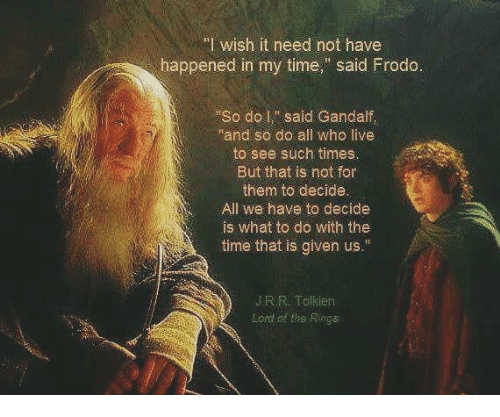
    Even so, we haven't yet given up on such stories altogether, and there are far worse places we could turn to for the value in them than to works such as J.R.R. Tolkien's 'The Lord of the Rings', where the most meaningful questions of 'real life' are raised, their often frightening aspects confronted, and the stakes involved are made more clear than any news report could ever 'hope' to. What we stand to gain from such adventures, is not entertainment - though that too - but the real ability to see a way forward by seeing more clearly what we should be focusing on and why, as when in replying to the Hobbit's wishing that such dark times had not come, Gandalf the wizard replies:
    "...So do I,” said Gandalf, “and so do all who live to see such times. But that is not for them to decide. All we have to decide is what to do with the time that is given us.”
    When you're feeling hopeless, that has less to do with the conditions around you, than with what you've been distracted from within you, and in those moments it's the powerful and inspirational scenes from fictional works like The Lord of the Rings, that restore your inner flame and improve your effectiveness here and now. That sort of inspiration is what flows out of, and into us, from scenes such as Aragorn's 'Men of the West!' speech before charging the gates of Mordor, or of Sam & Frodo's struggle to take the One Ring to Mt. Doom,
    "...Folk in those stories had lots of chances of turning back only they didn’t. They kept going. Because they were holding on to something.
    Frodo: What are we holding on to, Sam?
    Sam : That there’s some good in this world, Mr. Frodo. And it’s worth fighting for..."
    Our superficial 'realistic' certainty about how things will turn out, is not and should not be what defines and directs our actions, but acting in accordance with how you know that you should act, is. The memorable characters of story remind us that people are at their best and most admirable, not when they're worried about how well our petty circumstances will turn out for them, but when they realize that they should act as they should no matter how things might turn out for them, and we learn that not by argument, but by our own experience in responding to the characters and actions in the stories, and because of them we want to be better versions of ourselves by emulating them, here and now. What C.S. Lewis said in his Narnia stories
    "Once a knig or queen of Narnia, always a King or Queen of Narnia"
    , was well understood centuries before by George Washington when he saw to it that his troops had literature supplied or read to them, and had plays performed for them when conditions were at their worst, and that had not yet been forgotten by WWII when American soldiers were laden with Shakespeare as well as bullets, and they were because the timeless truths such stories lead their readers through, matter even and especially in times of war, in both it's tedious and terrifying moments.

    For those foolish enough to mock such works as 'escapist fiction', do you not see the difference between seeking to forearm yourself to face unexpected dangers, and practicing denialism and defeatism of 'be realistic' in the face of them? What such literature provides us is the means to escape the darkness of the moment so as to see more clearly what is right and true, which helps you to understand better what you should do when faced with such moments here & now - that is not something to be turned away from, but something to be sought out and embraced so as to regain your ability to triumph over despair in the here and now. And for those truly softheaded folks, cynics who see themselves as being 'hardheaded realists' while admonishing you that "Things just don't happen that way in real life!"... it would be pointless and 'unrealistic' to remind them of the gems of history's unexpected twists and turns, from the Spartan's 'doomed' 300, to WWII's Dunkirk and the Battle of Britain, or of what was less likely to 'turn out well', than the American Revolution itself (which our Founder's swore their lives and sacred honor to wage against the most powerful nation on earth), because they will not see it. Yet the fact remains that those who shined brightest in those moments, were not acting on how certain they were that things would turn out well, but only that they were certain that things should turn out that way, but could not, unless they acted as they knew they should, as should we, whenever we find ourselves within such moments in time, or as one of George Washington's favorite lines in his favorite play, Cato, puts it:
    “’Tis not in mortals to command success. But we’ll do more, Sempronius, we’ll deserve it.”
    And while we're at it, it's equally important to recognize the villainous nature that lurks behind the 'reasonable' appearances of Wormtongue-like advice to 'be realistic' and go along to get along, and give in to the evils besetting us - good fiction reveals to us that those aren't examples of being 'realistic', but of fleeing into a decrepit fantasy world of pretending you can know and foresee the results of all people's choices. Their pretense of being 'realistic' is not an example of strength, but of abject weakness which is advising you to flee from doing what you should do, and even a denial that you (and especially them) can know what you should - such notions as those are villainous and should be strenuously guarded against.

    If you find yourself flirting with 'realistic' notions that you know what doom is to come, you should take notice of how such *wise and knowledgeable* folk as that are depicted in 'The Lord of the Rings', in the figures of Saruman the Wise, and Denethor the Steward of Gondor. Two proud leaders who sought confidence in seeing farther than they could, by viewing the world through Sauron's Palantir for facts to reassure them that their conclusions were the only ones that intelligent persons such as themselves could believe. When the Palantir let their eyes see the facts that 'the black fleet comes!', and that 'Frodo has been captured and lost the ring', their cynically 'realistic' expectations were satisfied that they need look no further for news or judgement, than their own minds. As true in fiction as in real life, the shortsighted vision of what they were unwilling to see, was lacking a context which they refused to allow for, blinding them to other possibilities than what they expected, and the context missing from what the Palantir showed them, such as that though the black fleet was coming, it was Aragorn who was now leading it, and that as Frodo had dropped the ring and been captured, Sam picked it up, freed him, and they continued on - showed the facts which the Palantir's reported for Sauron's News Network, were the purest of lies - and how much do you want to bet that in those final moments, their reactions were "That just isn't true!"? You may laugh, but you'd do better to not stare for too long into your own glowing Palantir, be it from the news, or your social media devices, and remember that, as Gandalf says,
    “Even the very wise cannot see all ends.”
    , and to believe that you can, to think that you can and do know what is to come, despite all that you should know that you cannot possibly know, is arrogance, false pride, and, yes, corruption, and it results in your 'reality' being replaced, word by word, with a lie.

    Resolving paradoxes
    The paradoxical aspect of 'The Ship of Theseus' paradox, comes from our seeing the ship as only a sum of its parts, and in failing to see the 'One in the Many', we mistake the parts for the whole. But any whole, is more than simply its many pieces fit together - the intangibles of purpose and design are not found in those parts, but they are what lend importance to the actions we take, and the materials which we use to change those parts into a whole with. The 'Realistic' outlook of Materialism, is a soul-sucking worldview, and it will leave you awash in paradoxes.

    The takeaway from 'The Ship of Theseus' paradox, is that it is built, and rebuilt, one plank at a time, in accordance with a design that's formed from a purpose, and it's important to realize that there is nothing that says that the paradox can't be employed in reverse, changing a vessel that has been corrupted, by deliberately restoring it, plank by plank, to its original purpose, design, structure and materials. It's even more important to realize that the planks in America's Ship of State are not wood, but are you, your friends, and your family, and that you have the ability to define the nature of what that one particular plank of the ship which you represent, will be - do you have the purpose and plan to set you apart from being a mere material plank? If so, you may even be able to influence a few of the planks around you, and that, which Aleksandr Solzhenitsyn pointed out, is an incredibly important, and deceptively powerful truth to be understood. The failure to grasp that truth, is one that - like Sauron's assumption that the Fellowship sought not to destroy the ring, but to use it - has been key to many a triumph that's gone unforeseen by 'the wise' and 'realistic', an understanding that once upon a time formed a critical part of the education which the children of The West were raised upon, and must regain if we are to continue.

    Our 'educational system' has been the chief means of changing the purposes of our Ship of State (and of ourselves), and so became the means of corrupting it into something other than what it was intended to be, one plank at a time, and far from 'leading us out' of darkness and into living a good life in liberty with others, most schools today are intent on binding their students within rings of ideology which are fundamentally opposed to everything a 'well rounded education' was once understood to be and intended to do for you. Too many of us look upon the education we failed to receive, as a 'free pass' from suffering it's consequences because your schools failed you...It doesn't work that way. the good news though is that becoming an Autodidact (or Blogodidact 😎 ) is neither impossible nor unpleasant - it used to be a norm - and it doesn't take twelve or even four years, to get the basics of one, and there are more opportunities today to engage with others doing the same, than ever before. Just remember to be cautious where you go looking for an education from, and that as important as an education is, there's no more point in seeking a liberal education from those who delight in what is illiberal, than there is in seeking sweet wine from a bottle of vinegar.

    If you choose to 'go to school to get a good job', then save yourself several years and tens of thousands of dollars and go to a trade school. Do that not because you don't need a 'well rounded education', but because (with few exceptions) you have less than zero chance of receiving such an education as that at a modern College or anywhere else within our establishment educational system, and the subject is far too important a matter to your life, to your children's lives, and to our nation, to entrust to the hands of 'educators' who feel compelled to deceive you for your own good. If your kids are in them, get them out. If you are in them, or teaching in them, get yourself out. Get an actual Education - you've got a much better chance of getting one on your own, than at any establishment school system (public or private).
    And here it's worth noting one of the epic tale's truest statements, where Gandalf says:
    "Some believe it is only great power than can hold evil in check, but that is not what I have found. It is the small everyday deeds of ordinary folk that keep the darkness at bay. Small acts of kindness and love."
    , to which I'd add Solzhenitsyn line to the 'great' "...Let them embrace everything, but not with any help from me..." You have and are one of the parts in America's Ship of Theseus paradox, and you have replaced someone who came before you, and someone will take yours, but before passing your place on to another, it is within your power to right the process within at least that one plank that is yours, and whatever you do to fix you & yours, is restoring the original body and soul of at least one part of the whole of the materials and design of America's Ship of State. 

    It remains to you, and it all may even depend upon you, and others like you, insignificant little Hobbits that you are, to simply do your part well. Even if you've failed all your life to do so, do what little you can, as well as you can, now, not by attempting something grand, but by doing something even more daring - refuse to play a part in the spreading of lies - "Let them embrace everything, but not with any help from me" - and do so because it is what you should do, and when you're told to 'be realistic!', to give in, that there's nothing you can do, simply answer back "That just isn't true", and do what you know you should... and leave it to the larger drama to unfold around you as it will.

    Thursday, May 06, 2021

    Facing America's troublesome Ship of Theseus paradox, with 'Live not by lies', and The Lord of the Rings (pt 1 of 2)

    Isn't "That just isn't true!", one of the more common reactions we have towards nearly everything we're faced with today? If it were just lying liars lying, it wouldn't be quite so bad, but as terms which were once understood to have unchangeably fixed meanings, such as Freedom of Speech, Racism, Justice, Education, etc., are now being used to convey radically different meanings in what is widely being accepted, tolerated and popularized in society today, we see the ludicrous presented as being scientific, the ugly as being attractive, obscenity as virtue, the despicable as being admirable, and injustice as Justice, so that the sense of "That just isn't true!" seems to permeate the very air. In other words, our words remain the same in name only - what better timing could there be for 'The Ship of Theseus' paradox to have resurfaced?


    The Avengers' themed TV show 'WandaVision', recently got this 2,500 year old philosophical paradox on the nature of identity & change to begin trending on the web, when the virtual android, Vision, was made to confront a physical copy of himself, and so began asking about the essential nature of what something IS. If you missed the episode, or Philosophy 101, it refers to how for centuries the Athenians had preserved and maintained the ship which the hero Theseus was supposed to have returned to Athens in, after having slain the Minotaur. The paradox points out that as maintaining Theseus's ship required repairing or replacing its aged and damaged planks, there eventually must have come a point where no original material of the ship which Theseus and his crew had sailed on, remained within the ship that they were so carefully maintaining, and so it asks:
    Is 'The Ship of Theseus' still the same ship? If so, how, and if not, at what point of change did it stop being what it originally was?
    The 'common sense' answer, that Theseus's ship can't be the same ship because it's made of different parts, doesn't age well, and is particularly troublesome as you realize that your own body is not made of the same cells & minerals as it was some years ago. The Ship of Theseus paradox is troublesome, but it's also well worth asking because it's good for us to realize that the 'common sense' answers we are often so quick to give, often depend upon the thinnest of surface appearances which are too shallow a means for identifying what that ship, or anything else, is. Working our way through such paradoxes, leads us into a deeper understanding of identity and change, by asking: what do we mean by what something is, and how can we make changes to it and have it remain meaningfully the same? 

    Can we change and remain the same? Well... consider the source: Are you still you?

    Getting a better understanding of what we mean, requires going beyond appearances, which is what Aristotle was doing when he identified Four Causes which are essential to what makes something what it is, and in his hierarchical system, matter, the Material Cause, that 'out of which something is made' - is the last and possibly least important of those causes. The Formal Cause, 'the design and form of what-it-is-to-be', precedes that and directs what matter will be used, and how; prior to that and more essential still, is the Efficient Cause, 'the primary source of the object' coming into being, as with the making of the ship by its maker, who creates it from a design which calls for those materials that are to be used in it; and finally there's the Final Cause, 'the end, that for the sake of which a thing is done', which is the initial source that provides the purpose for what is being made - the reason why it is made, and why it was made as it was. The ship that Theseus and his crew took to sail home in, consisted of more than the surface of its parts - which they may or may not have touched - and when a plank of the ship is replaced, the rest of it's matter, form, workmanship and purpose, remain. In that sense, if the materials replaced are of the same type, quality and purpose as the Final, Efficient, Formal and Material causes which had brought it into being, then even as that ship undergoes changes, it remains the same ship (not the pieces, but the whole) that Theseus and his crew once sailed on, and which they would likely prove on returning by recognizing it, crewing it, and sailing it back home again - whether or not they'd remember to change and raise the sails... that's another question altogether (though John Locke's take adds something to that aspect of the paradox ).

    There is of course a potential dark side to the paradox, in that what if the changes made are not made with the same materials, quality, and purpose? What if in practice, the changes are maintaining only the surface appearances of the ship, while beneath that surface its deeper structure is being progressively altered? Then in that case, wouldn't the apparent maintenance being performed upon the ship that was Theseus's, be gradually corrupting it into being that which 'The Ship of Theseus' was not? What answer would the captain and crew give to their own paradox, if they returned and could not recognize it, because of the nature of what those changes, had changed Theseus's ship into?

    The troublesomeness of the 'Ship of Theseus' paradox should trouble what we mean by our own Ship of State too, as one by one a Ship of State's original founders eventually retire and pass on, and as with the planks of wood being replaced in Theseus's ship, they too are gradually replaced in society by members of the next generation, until eventually the time comes when none of the original founding generation remain. When that time comes, is that Ship of State the same? How do you decide that? And when their children's children, replace them, what then? The answer is not in the 'thing' itself, but in what makes the thing, the thing it is. If those children, and their children, are mindful of their nation's essential causes - if they retain their nation's purpose, while understanding and living by its fundamental principles and holding to the same quality of character in the day to day life of that nation, then yes, it is of the same nation, and they are the same people, and they do sail the high seas on the same Ship of State.

    And if that's not the case? America today, is an example of both approaches to change being imposed at the same time upon America, by Americans. Much of the original form and substance of our founding has gradually been replaced, its deeper designs have most certainly been altered, corrupted even, but the more paradoxical question facing us today, is whether or not the changes we're still calling for are in fact doing more to maintain or corrupt it, and between us - Left, Right & Center - we do not even seem to be able to agree upon how to differentiate between the two. To the question 'is America, America, in more than name only?', I think you'll find that the answer to that has less to do with America, than with the Americans living within it. Us. Who are you, and why, and how do you know it?

    We can begin answering that question by looking at how the changes we've undergone began, which just as 'The Ship of Theseus' paradox describes, they began gradually and with the best of intentions through small and seemingly sensible steps, to improve our lives. One of the first and most significant of those changes, came from our changing the purpose of going to school, from 'get a good education so as to be capable of living a good life in liberty', to 'get a good education for the skills to get a good job!' Of course that change was made then, as most parents still make it today, to ensure their child's economic success. Unfortunately, despite their good intentions, that change in goals implicitly conflicts with two of those four most essential causes that America was formed from - with the purpose of education (it's Final Cause), and the form (Formal Cause) that education was to be given through. Had they, and we, thought beyond the scope of efficiency and material causes & short-term benefits, we might've been more mindful of Mark 8:36,
    'What doth it profit a man, to gain the whole world, and lose his own soul?'
    , for what good does it do Americans, to aim at succeeding in America, while losing what made America, America?

    But where we really need to have the troublesomeness of 'The Ship of Theseus' paradox felt today, is less with those changes we can see, than in those intangible matters which easily change over time and produce major changes in everything that we can see and touch, and yet which go unnoticed because the part of them that we can see - the name - remains the same. You'll see this pretty quickly if you consider what has been meant over time by getting an education, as the popular understanding of that word has been radically changed over a relatively short period of time, and I challenge you to think of some aspect of our lives that is not touched by the education we do, or don't, receive.

    It's not necessary for our purposes here to go into the details, as a quick glance at its outward appearances makes it clear that something major has been changed within. For instance, a well educated person traditionally has - from the 17th century to the 21st - been thought of as someone who's gone to college and received a degree, right? Well a Bachelor of Arts Degree in 1820, the generation following our founding, was fairly similar to one received in our Founder's era of the 1700's, and though notable changes had been made, the Bachelor of Arts and even the new (1860?) Bachelor of Sciences Degrees, were still recognizably *the same* as what would be awarded even as late as 1920. But those degrees resemble the nature of the B.A. & B.S. degrees being given out in 2020, in no more than name only. And so when we say today that education is important, and it is, it's unlikely that what we mean by that word today, is what Thomas Jefferson had in mind when he said of it that
    "If a nation expects to be ignorant and free, in a state of civilization, it expects what never was and never will be"
    , so what do we mean by 'education', and in what way does getting a college degree indicate that someone is educated today? How sure are you that what you mean by 'education', isn't what Jefferson meant by expecting to be 'ignorant and free'? Why? That too is a troublesome question, which for now I'll leave to you to educate yourself on - I'll just point out that the paradox is paradoxical in name only, as the original and current meanings bear no resemblance to each other beyond name only.

    What's more important for our purposes here, is to realize that turning away from well founded aims - Final Causes - such as 'get a good education so as to be capable of living a good life in liberty', for more shallow and ill-considered goals such as 'get a good education for the skills to get a good job!', can't help but make obstacles of those deeper and more worthwhile paths which our new goals turn us away from, especially as today they've left us unable to either define 'education', or what is 'good'.

    The lack of clarity which accompanies working at such cross-purposes, implicitly weakens those essential causes that make something what it is, especially as they detract from the 'Final Cause', which will in turn affect the actions, designs and substance which follows from it. Shallow and ill-considered goals weaken our understanding and create uncertainty in what we should do, which generates a falseness in what we choose to do, and why, which becomes visible in our later attempts to defend our having done it, and in that turbulence truth recedes and power naturally rushes in to fill in the gaps. In the absence of truth, the finest minds behave stupidly, as consciously or not, to accept the lie is to reduce your ability to perceive what is in reality true, and so we act on what isn't, and consequently in losing contact with reality, our actions become less justifiable, and their results become more chaotic, and in more need of power to sustain them.

    As people perceive that growing chaos, it naturally steers them to seek reassurance in greater power, and they will advance themselves over those who don't, and as that scenario becomes the norm, power, brutality and injustice will reign, while true Justice is rained upon. Not intentionally, but necessarily so, because of the purposes that've changed. Corruption is not only wrought by deliberate dishonesty, bribery, or the criminal behavior of those in power - it's also the process of something being changed from its original purpose, even and especially with the best of intentions, into an opposition to that original purpose; it's a process of decay and putrefaction, and there should be no mystery why it's all around us today.

    I do think it's important for us to realize that these changes weren't only done to us by devious men working behind the curtain - we've all participated in at least some aspect of it, right? We've all seen, and even reveled in, some aspects of these changes - we saw their effects in our movies and in our television shows, and as they mocked what was good and respectful, we assured ourselves that 'It's just a joke'. 

    It was more than a joke, but everyone else was laughing and so we laughed along as well, and after all, they were just harmless little things, right? We all laughed as the late-night shows 'man in the street' interviews, showed us our fellow Americans - usually students - who didn't know who America fought in the Revolutionary War, or even who won in our Civil War, and as we laughed at those, we took comfort in spectacles of chanting 'USA! USA! USA!', as if the enthusiasm from people who didn't understand what was meant by 'USA!', could substitute for those planks of understanding that were being lost from our American Ship of State. What is more than a little bit funny, is how many of us now behave as if shocked that those now coming of age, and into power, have little or no knowledge of, or respect for, the ideals that America was founded upon. Seriously folks, we haven't just accidentally reached the point where students are being taught that it's racist to deny that 2+2 can =5! And no, I don't think our problem is our lack of 'Critical Thinking' skills. IMHO it is much more likely that our rapid immersion in that shallow construct of 1940's wacademia - a system which has no coherent or consistent definition or design - may be one of the darker examples of our employing 'The Ship of Theseus' paradox upon ourselves within our very minds. Our accepting of ''Critical Thinking'' as a replacement for thinking reasonably, gradually replaced the principled thinking that American's were once known for, with the flowcharted and narrowly calculated style of short term thinking, which we're better known for today.

    Each of the changes which we've allowed over the last century have made some change to the essentials of what being an American was understood to mean, and little by little the small good things which we once routinely performed for each other without much concern for the effort required (such as civility & manners), were replaced with easier means & more usefully satisfying appearances (rudeness & self-serving), and we failed to realize that the lack of knowledge and character being paraded around for our amusement, were less causes for amusement, than the unavoidable effects of making intentional alterations and re-formations of us. We thought we could escape the consequences of indulging in or ignoring the 'little things', but of course we couldn't, and we haven't, and we're living in the consequences of our having given respectful attention to fools & knaves ('beotch!') we thought seemed so 'cool'.

    Ronald Reagan famously said that 'liberty isn't passed down through the bloodstream', which is true enough, but unfortunately for us, barbarism is! Every generation is a barbarian invasion, and education (not schooling!) is our chief means of repelling them. All that was required for the vaunted quality of American Exceptionalism to fade away, was for us to teach less and less of it to the next generation, each of which would then be less exceptional and more barbaric than the one preceding them, and by the end of the 20th Century enough of that exceptionalism was absent, to excuse our importing the unexceptional materials and designs that've long defined and permeated most of the rest of the world. Sure, our maps still label this land as being 'America', but if the original captain & crew returned, would they recognize either it or us? Abraham Lincoln once warned that no one else would or could invade America, but if we weren't careful, we'd do it to ourselves. We may not have sunk ourselves yet, but all of these changes have left America's Ship of State leaking & adrift in dangerous waters, and it's not difficult to predict what the future holds for us.

    And yet... if you believe that by being 'realistic', you can see what will happen next, you are probably the least connected to reality of us all, having forgotten that 'always shifting the future is'. And we'll look at what Soviet dissident Aleksandr Solzhenitsyn, and The Lord of the Rings, can tell us about that, in tomorrow's post.